Car Catches Fire in Parking Lot on University of South Alabama Campus
A car was fully engulfed in flames in a parking lot on the University of South Alabama campus in Mobile. Mobile Fire Rescue responded Thursday morning.
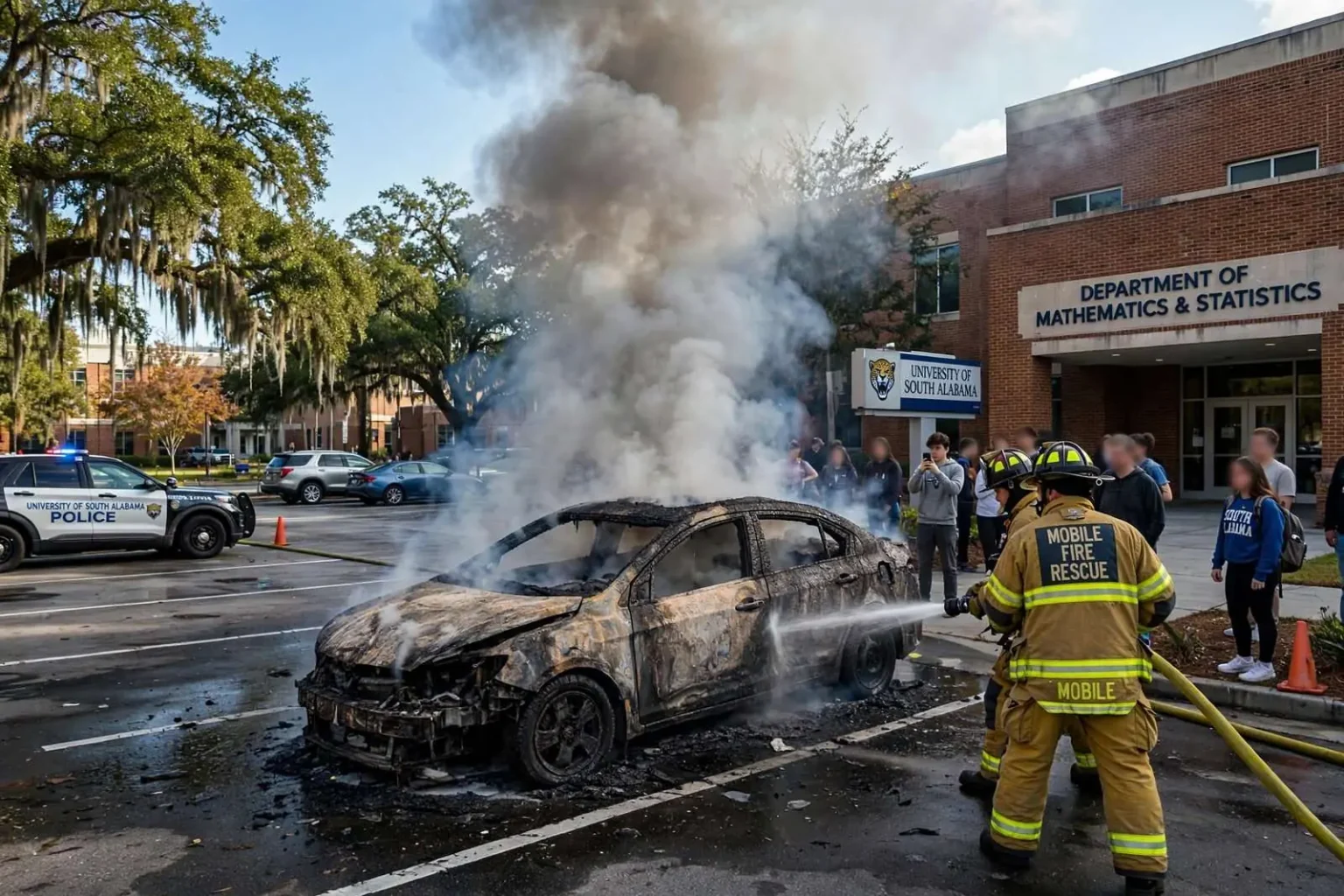
A car was fully engulfed in flames in a parking lot on the University of South Alabama campus Thursday morning, prompting a response from the Mobile Fire Rescue Department. The fire drew a crowd and a fire crew to the middle of a working campus day, and by mid-morning the burning vehicle had been extinguished with no injuries reported — but the sight of a car consumed by flames a few steps from an academic building left students and staff with plenty of questions the department could not yet answer.
The fire was first spotted around 9 a.m. near the Department of Mathematics and Statistics building on the school’s west Mobile campus. Nine o’clock lands at the center of the morning class change, when parking lots are at their fullest and the walkways around the campus’s academic buildings carry their heaviest foot traffic. That timing is precisely why the fire drew so much attention so quickly: a car fire in an empty lot at dawn might have burned unwatched, but a fully engulfed vehicle at the height of the morning rush had an audience within moments.
Students who saw the vehicle burning contacted the fire department, and one student captured video of the flames consuming the car. The footage — the kind of eyewitness video that has become the default first documentation of almost any public incident — circulated among students as crews worked, giving the story a second life on social media.
The response
Firefighters responded to the scene to put out the blaze. Vehicle fires present a specific set of hazards that distinguish them from structure fires: fuel systems that can vent or rupture, pressurized components that can fail violently, tires that burn hot and thick, and toxic smoke from burning plastics, upholstery and fluids. A car that is fully engulfed when crews arrive has usually been burning for several minutes, which means the crew’s first priority is protecting anything nearby — other parked vehicles, the building’s exterior, anyone still too close — before knocking the fire down.
No injuries were reported in the incident, and there was no immediate word on what sparked the fire or whether any nearby vehicles were damaged. Both of those questions matter to the people who park in that lot. Vehicle fires in parking areas routinely damage or destroy adjacent cars — heat from a fully involved vehicle can melt trim and crack glass several feet away — and the cause determination affects everyone from the owner’s insurance company to the university’s facilities staff, who will be left with a burned-out shell to remove and scorched pavement to assess.
The causes of vehicle fires are usually mundane. Electrical shorts in aging wiring, fuel or fluid leaks onto hot engine components, and mechanical failures account for most of them, and the possibilities multiply in the Gulf Coast climate, where heat and humidity age rubber and plastic under the hood faster than in cooler regions. Fires in parked vehicles that have not been running can also start from electrical faults that remain live even when the ignition is off. Until investigators finish, all of that remains hypothesis; the department’s formal determination is the only answer that counts.
Response on campus
The burning vehicle drew attention from students and staff moving through the area as crews worked the scene. Campus fires occupy an unusual place in the rhythm of a university day. Classes continue, walkways stay open, and students stream past a working fire scene on their way to lectures — pausing to watch, filming, and comparing accounts of when they first noticed the smoke. The Department of Mathematics and Statistics building sits in the middle of the main campus grid, which meant the scene was visible from multiple directions and hard to miss for anyone with a mid-morning class.
For the students in the buildings nearby, the morning offered an unplanned lesson in how such incidents actually get handled. The fire was reported by bystanders — not by sensors, not by a patrol — and the first responders arrived to find the vehicle fully involved, which underscores the timeline that fire officials always describe: a vehicle fire doubles in intensity in the minutes before anyone calls, and the difference between a smoking car and a fully engulfed one is often the time it takes a bystander to stop filming and dial.
University officials had not issued a broader campus alert about the incident as of mid-morning. Campus alert systems are generally reserved for threats to people — active dangers, closures, severe weather — and a single vehicle fire with no injuries typically does not trigger one. The absence of an alert, in that context, is itself information: the university treated the fire as an isolated incident contained to one parking space, not a danger requiring the campus community to shelter or move.
Vehicle fires and what comes next
The Mobile Fire Rescue Department is expected to release additional details about the cause once an investigation into the fire is complete. Fire investigation is a methodical process. Investigators document the burn patterns on the vehicle, examine the engine compartment and electrical system, interview the witnesses who saw the fire begin and check whether anything in the vehicle’s recent history — a repair, a mechanical complaint, a prior warning — points toward the origin. The work is done after the fact, once the wreckage is cool, and it routinely takes days rather than hours.
The findings matter to more than curiosity. Insurance claims for the vehicle — and for any neighboring cars damaged by heat — will lean on the official cause determination, and a finding of accidental mechanical failure is treated very differently from evidence of an intentional fire. Vehicle arson is its own category of investigation, and investigators withhold that distinction until the physical evidence is in. The absence of an immediate answer is normal procedure, not a dead end.
Anyone with information about how the fire started is encouraged to contact campus police or the fire department. That request is standard in vehicle fires on public property, where the pool of witnesses is large but scattered — the student who walked past at 8:45 and noticed a smell, the driver who saw smoke before the flames, the classmate whose video captured the earliest moments. Those details, assembled later, often give investigators the timeline they need to determine where and how the fire began.
The university’s role
For the University of South Alabama, the incident lands on a campus where public safety infrastructure is a daily presence. The university operates its own police department, and its west Mobile campus — the main campus along Old Shell Road, home to the majority of the university’s academic buildings — sits within the city of Mobile, which means incidents there draw both campus resources and city services like Mobile Fire Rescue. The division of labor is familiar: campus police handle the campus-specific questions, city firefighters handle the fire, and university facilities handle whatever the aftermath leaves behind.
Parking lots are among the trickiest spaces a campus manages. Thousands of students and employees cycle through the main campus lots each weekday, and the vehicles they leave there range from late-model cars to decades-old trucks — any of which can be the next electrical short away from this week’s scene. Universities address the risk the way property managers generally do: with lot patrols, clear fire lanes and prompt removal of abandoned vehicles, while depending on the students and staff who move through those lots every hour to be the ones who notice when something is wrong.
Thursday morning’s fire was contained to one vehicle, reported quickly by the students who saw it, and extinguished without a single injury — the outcome every fire department prefers. What remains is the paperwork: an investigation, a cause determination, an insurance claim and a scorched parking space near the Department of Mathematics and Statistics that the campus community will walk past for weeks, remembering the morning a car burned in the middle of it.
What the witnesses saw
The student video that circulated through campus feeds is part of a pattern that has changed how incidents like this one unfold. A generation ago, a car fire in a campus lot would have produced a fire report and, at most, a paragraph in the student newspaper. Today the same fire produces minutes of video from multiple angles before the fire trucks arrive, and the public record of the incident is assembled by bystanders in real time. For investigators, that footage is often genuinely useful — a video that shows where the smoke first appeared narrows the search for the fire’s origin considerably.
The same footage shapes how the campus community experiences the event. Students who were nowhere near the lot Thursday morning have already seen the fire, repeatedly, on their phones — which means the incident will register in campus memory as bigger than its actual footprint. That gap between the drama of the video and the mundane reality of the outcome — one car, no injuries, no alert — is worth naming, because vehicle fires on campuses are almost always exactly this: an owner’s bad morning, a tow truck, and a story that gets retold at the same lunch table for years.
The report of a fire by students also reflects the norm fire departments try to cultivate: when in doubt, call. A bystander who hesitates, assuming someone else has already reported the smoke, costs the response minutes; a bystander who calls and turns out to be the second or third report costs nothing. Thursday’s calls went in early enough that crews arrived to a fully involved vehicle rather than a spreading one — the difference, potentially, between one burned car and a row of them.
Waiting on the investigation
For now, the incident remains an open file with a short list of known facts: a car, fully engulfed, around 9 a.m. Thursday, near the Department of Mathematics and Statistics building, reported by students, fought by Mobile Fire Rescue, extinguished without injuries, cause undetermined. The campus community will add one more fact to that list when the fire department’s investigation concludes, and until then the parking lot near the math building will hold a space that looks different from its neighbors.
The reminder embedded in the morning is one campus safety offices deliver every semester. Vehicles age, and the Gulf Coast’s climate ages them faster — heat degrades battery connections, fuel lines and the wiring harnesses that run through a car’s engine bay, and a failure that starts as a flicker can become a fire in the time it takes to walk from the lot to a classroom. Owners who notice a burning smell, a warning light, or smoke from under the hood are advised to move away from the vehicle and call immediately rather than investigate under the hood themselves.
Thursday’s fire will likely be closed out with a cause, a claim and a tow — the standard end of the thousands of vehicle fires departments respond to every year. For the students who watched a car burn outside the math building and did the right thing, it was a morning’s drama handled exactly as it should have been: reported fast, extinguished safely, and investigated properly.