
Car crashes into Holloway Elementary School in Mobile
A car crashed into Holloway Elementary School in Mobile on April 24, 2019. No one was hurt, and a school system spokeswoman said the accelerator may have.
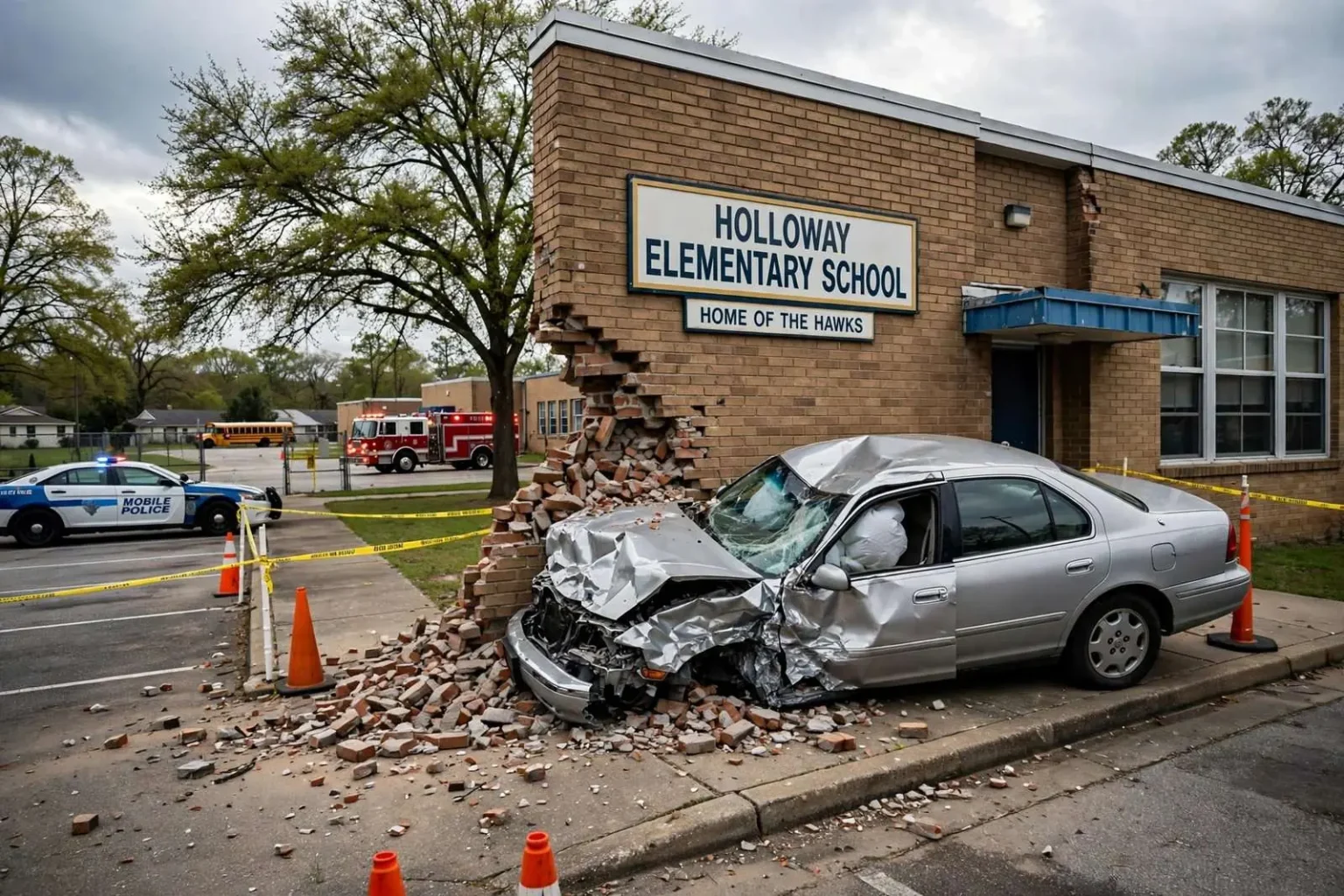
MOBILE, Ala. — A car crashed into Holloway Elementary School on the afternoon of April 24, 2019. Rena Philips of the Mobile County Public School System said the vehicle hit a wall and no one was hurt. Philips said the car’s accelerator may have gotten stuck. The incident caused damage to the building but resulted in no injuries, according to the school system.
The crash happened during the school day, an hours-long window when campuses across Mobile County are filled with students, teachers, and staff. That no injuries were reported came as a relief to families and school officials alike, given how differently an afternoon crash into an occupied school building could have ended. A wall absorbed the impact of the vehicle, preventing it from penetrating deeper into the building where students and staff were working.
School system officials said the building sustained damage from the collision, and crews would assess the structure before normal operations resumed. Incidents of this kind set off a standard sequence for school districts: engineers or maintenance staff examine the affected wall for structural integrity, administrators determine which parts of the building can be used, and families are notified about any changes to schedules or classroom locations.
The scene at Holloway Elementary
Holloway Elementary School serves students in the Mobile County Public School System, the largest school district in Alabama and one of the largest in the southeastern United States, with tens of thousands of students spread across more than ninety schools. Elementary campuses like Holloway are typically single- or multi-story buildings set near residential neighborhoods, with drive aisles, parking areas, and drop-off zones close enough to the structure that a vehicle leaving the roadway presents a genuine hazard.
When the car struck the wall, the first priorities for responders were securing the vehicle, checking the driver, and confirming that no students had been in the vehicle’s path. Mobile police and fire crews handle thousands of vehicle-into-building calls across the city each year, and the response protocol is well practiced: stabilize the structure, evaluate the driver for injuries or medical distress, and determine whether the building remains safe for occupancy.
By the time word of the crash reached parents, the immediate danger had passed. School system communications staff — the role Philips fills — coordinate the messaging in such incidents, providing reporters and families with confirmed details and correcting speculation as it spreads on social media. Her account that the accelerator may have gotten stuck was among the earliest official indications of what might have caused the driver to lose control.
Pedal misapplication and stuck accelerators
Crashes in which a driver’s accelerator becomes stuck or is mistakenly applied are a recurring category of vehicle-into-building incidents nationwide. Investigators distinguish between true mechanical failures — a pedal trapped under a floor mat or a throttle that fails to return — and pedal misapplication, in which a driver intending to press the brake presses the accelerator instead. Both produce the same alarming result: a car that surges forward unexpectedly, often at low speed but with enough force to breach walls, fences, and storefronts.
Modern vehicles include safeguards such as brake-override systems that cut engine power when the brake and accelerator are pressed together, but older vehicles on the road may lack such features. Safety agencies have urged drivers for years to make sure floor mats are properly secured and compatible with their vehicles, after a series of high-profile recalls tied to pedal entrapment. Whether any of those factors played a role in the Holloway crash was not detailed by officials, who said only that the accelerator may have gotten stuck.
For the driver, the aftermath of such a crash can involve citations, insurance claims, and liability for the damage to the building. Authorities did not announce whether any charges were filed, and with no injuries reported, the matter was largely handled as a property damage incident between the driver and the school system.
Building safety and school security
School buildings are designed with public safety in mind, and exterior walls bear loads and absorb impacts far better than the glass storefronts typical of retail buildings. The fact that the car’s impact was stopped by a wall meant the damage was confined to the structure’s exterior rather than extending into hallways or classrooms. Even so, any damage to an occupied school building is treated seriously until inspectors confirm that nothing was compromised.
District maintenance teams in large systems like Mobile County’s respond to everything from storm damage to vehicle strikes across a property inventory that spans the county. Repairs to load-bearing walls require careful evaluation, and temporary measures such as barriers or fencing keep students away from affected areas while work is scheduled. Classes at the affected part of the campus would continue only after the area was cleared.
What it means for the community
For the families of Holloway students, the incident was a reminder of how quickly ordinary afternoons can turn unexpected near school campuses. The streets around elementary schools carry a constant mix of buses, parent vehicles, delivery trucks, and young pedestrians, and school zones exist precisely because that mix demands caution. Drivers passing through school areas are asked to slow down, avoid distractions, and be ready for the unexpected — a lesson underscored when a vehicle ends up against a school wall.
The Mobile County Public School System did not report any change to the school’s schedule as a result of the crash, and the story concluded with the building damaged but the school community unharmed. Updates on the investigation into the vehicle’s mechanical condition were left to local authorities, who handled the incident as they would any property damage collision within the city limits.
How schools communicate during emergencies
The quick confirmation from the school system reflects the communication practices that large districts have developed over years of handling campus incidents. In Mobile County, communications staff serve as the single voice for the school system during emergencies, filtering information so that families receive confirmed facts rather than rumor. Parents today expect near-immediate notification when something happens at their child’s school, and districts have responded with text alerts, social media updates, and automated calling systems alongside traditional media statements.
The stakes of accurate communication are considerable. In the first minutes after any school incident, incomplete information circulates quickly among parents, and inaccurate assumptions about injuries can spread before officials have confirmed anything. Statements like the one Philips provided — confirming the crash, the wall impact, the possible stuck accelerator, and above all the absence of injuries — serve to steady families and prevent panic while responders finish their work.
Vehicle crashes into buildings in Mobile
Vehicle-into-building crashes are not rare events in a city of Mobile’s size. Nationwide, thousands of such crashes occur every year, striking storefronts, restaurants, homes, and schools, and safety engineers who study them attribute the majority to driver error — particularly pedal misapplication by older or inexperienced drivers — with the remainder involving medical emergencies, intoxication, or mechanical failure. The pattern holds in urban areas like Mobile, where parking areas and buildings sit close together and a momentary loss of control leaves little distance to stop.
Because of that frequency, businesses and institutions have increasingly installed protective measures: bollards in front of storefronts, concrete planters, and reinforced barriers at building entrances. School campuses typically rely on distance, landscaping, and perimeter design rather than hard barriers, which is why a wall that stops a vehicle outright — as happened at Holloway — is credited with preventing a far worse outcome.
The financial aftermath of such crashes is handled primarily through insurance. Damage to public school property is documented by district facilities staff, and claims against the driver’s coverage pay for repairs. When the damage is limited to an exterior wall, repairs are usually completed within days or weeks, and the incident rarely leaves any lasting mark on campus operations beyond the memory of the afternoon it happened.
The broader picture of school safety
School safety planning in Alabama covers far more than intruders and weather. Districts drill for fires, tornadoes, and hazardous conditions, and their plans increasingly account for traffic incidents near campuses, since the daily movement of buses and cars is statistically among the most dangerous parts of a student’s school day. Mobile County’s school transportation system runs one of the largest bus fleets in the state, and each campus maintains procedures for managing vehicles on and around school property.
The April 2019 crash at Holloway ended without injury, but it became part of the long ledger of incidents that school administrators quietly prepare for. Drivers lost control near schools for all sorts of reasons — medical events, mechanical failures, momentary distractions — and the systems that respond, from school secretaries calling 911 to maintenance crews boarding up a damaged wall, exist to keep a bad moment from becoming a tragedy. In this case, they worked.
No further details about the driver or the vehicle were released by the school system, which treated the matter as a property damage incident once it was clear everyone involved had escaped harm. The quick response by school and city personnel, and the wall that stood between the car and the classrooms, meant that April afternoon ended as a story about damage and repairs rather than injuries and loss.


