
Car Engulfed in Flames on I-65 Northbound Between Airport Blvd and Dauphin Street Exits
A car was engulfed in flames and removed from I-65 northbound between the Airport Boulevard and Dauphin Street exits in Mobile.
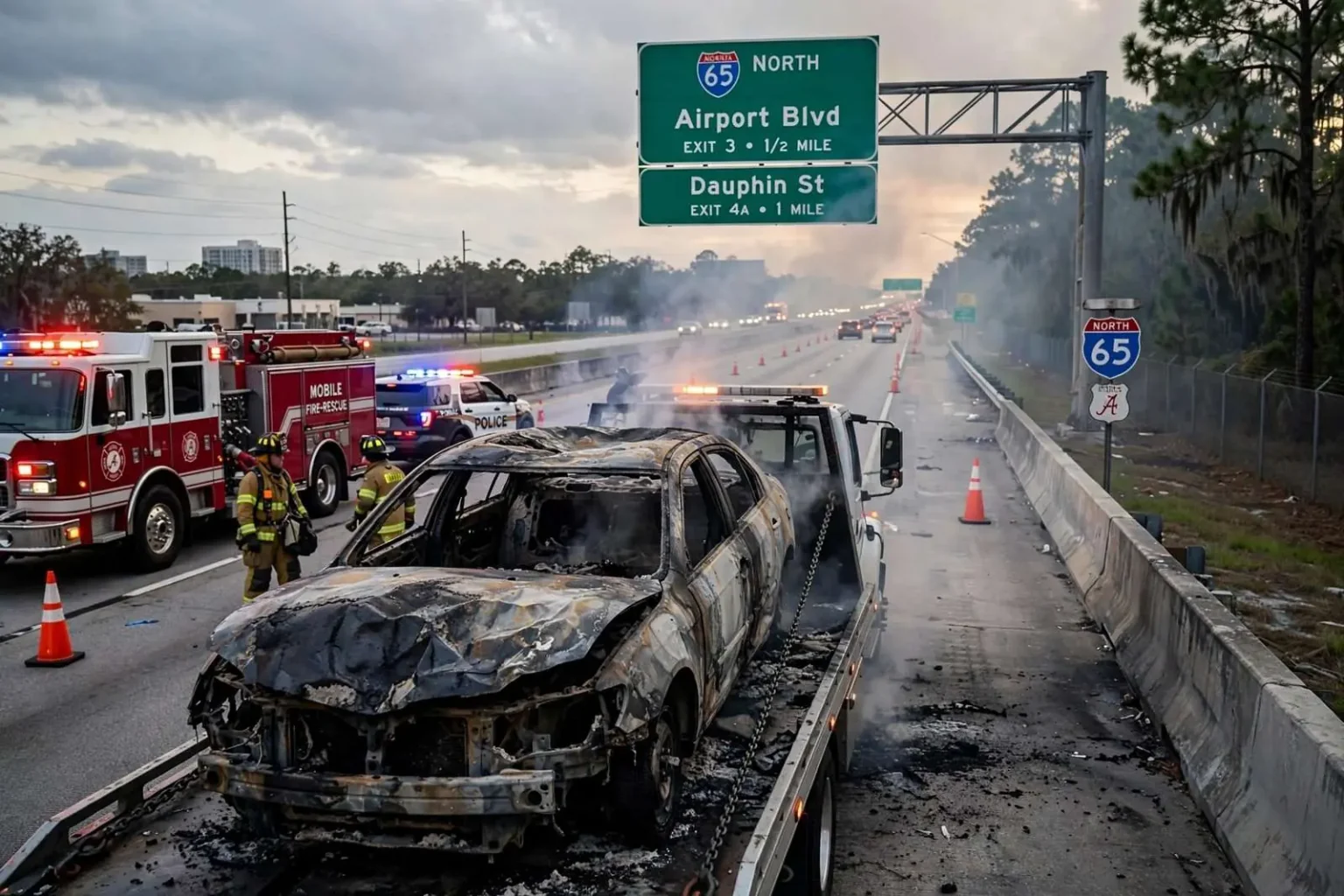
MOBILE, Ala. — A burning car had to be removed from Interstate 65 Saturday afternoon after it became engulfed in flames on the northbound side. The fire broke out shortly before 6 p.m. between the Airport Boulevard and Dauphin Street exits. Photos from the scene showed the car’s hood flipped back and its interior scorched as it was hauled out of the northbound lanes. No injuries were reported in connection with the fire.
Anyone who drives Mobile’s stretch of Interstate 65 regularly knows the rhythm of the corridor between the two exits where the fire occurred — a busy urban segment that carries commuter traffic, freight moving between the Port of Mobile and points north, and travelers passing through the city on the interstate’s run from Mobile toward Montgomery. When trouble strikes there, even a minor incident can ripple through the city’s traffic picture for hours. A vehicle fire on the northbound lanes is a different order of problem: flames, smoke, and the threat of a fuel-fed blaze demand that firefighters close lanes while they work, backing traffic up toward Government Boulevard and beyond as the evening rush built.
Vehicle fires on interstate highways pose a distinctive set of challenges for firefighters. The vehicle itself must be approached carefully, since engine fires can intensify suddenly and modern cars carry components — fuel lines, pressurized struts, magnesium parts, and in newer models high-voltage batteries — that can burn fiercely or explode when exposed to heat. Crews typically position apparatus to shield the burning car from oncoming traffic, attack the fire with copious water or foam, and only then turn to the task of removing the wreck, which is where tow operators take over the delicate job of dragging a burned-out shell off the travel lanes without scattering debris across the roadway.
A familiar stretch of interstate
The segment of I-65 between the Airport Boulevard and Dauphin Street exits is one of Mobile’s most heavily traveled corridors, funneling drivers between the city’s central neighborhoods, its airport and medical districts, and the commercial hubs to the west. The interstate slices through the city just east ofthe residential areas, and its northbound side climbs through a series of interchanges that see heavy merging traffic at all hours. Incidents there routinely draw gawkers’ delays that stretch for miles, and first responders are accustomed to working shoulder-to-shoulder with passing traffic — which is why lane closures are imposed quickly and aggressively whenever flames are involved.
For drivers caught behind the incident, the Saturday afternoon fire meant a long wait while the car was extinguished and cleared. Traffic incident management practice in Alabama emphasizes quick clearance — the faster a disabled or burned vehicle is removed, the lower the risk of secondary crashes as drivers slow, merge, and rubberneck. Alabama’s Move Over law requires drivers to change lanes away from stopped emergency vehicles when possible, or slow to a safe speed when they cannot, a rule designed to protect the firefighters, law enforcement officers, and tow operators who work inches from live traffic every day.
Vehicle fires are more common than most drivers realize. Mechanical failure, electrical shorts, fluid leaks onto hot exhaust components, and collisions are the leading causes, and the risk grows with vehicle age and deferred maintenance. Fire safety officials advise drivers who notice smoke or a burning smell while on the highway to pull as far onto the shoulder as safely possible, shut off the engine, get everyone out of the vehicle and away from it, and call for help rather than opening the hood — which can feed a smoldering fire a sudden rush of oxygen and turn it into a deadly flare-up.
What happens after the flames
Once the fire was out and the wreckage hauled away, the northbound lanes returned to service, but the incident’s aftermath typically lingers. Burned vehicle residue — melted rubber, pooled fluids, and charred debris — has to be swept from the roadway, since even small patches of oil or coolant create slippery hazards for following vehicles at highway speed. Responding crews generally coordinate with highway maintenance or the towing company to make sure the lane is not just clear but safe before traffic is fully released.
For the car’s owner, the days after a vehicle fire bring a different kind of work. An insurance claim for a burned vehicle generally moves quickly when the fire was accidental, with the adjuster documenting the loss and the vehicle typically declared a total loss if the damage reached the engine bay and interior, as photos from this fire suggested. The owner will need to arrange removal of personal property, handle registration and title paperwork for the totaled vehicle, and arrange alternate transportation in the meantime — practical steps that are easy to overlook in the moment but that consume most of the week that follows a fire like this one.
The incident also serves as a reminder for Mobile-area drivers about readiness. Fire officials recommend keeping a small fire extinguisher in the vehicle, checking for fluid leaks during routine maintenance, and being alert to warning signs such as a sudden electrical odor, smoke from under the hood, or fuses that blow repeatedly. In a busy urban corridor like I-65 through Mobile, where thousands of vehicles pass between the Airport Boulevard and Dauphin Street exits every day, a single car fire can endanger dozens of people in the seconds before traffic slows — and a driver who pulls over promptly and gets out quickly is the single best protection against a minor incident becoming a tragedy.
The response also highlighted the coordination that interstate incidents demand among agencies. Vehicle fires on the interstate typically bring firefighters from the station nearest the scene, law enforcement officers to manage traffic and close lanes, and tow operators to clear the wreckage once the flames are out. Each has a distinct job, and they have to be sequenced: the fire must be out before a wrecker can hook up to a burned car, and lanes generally cannot reopen until law enforcement is satisfied the roadway is safe and debris has been swept from the travel surface. On a corridor as busy as I-65 through Mobile, that sequence can stretch from minutes into hours during peak travel times.
Interstate 65 itself has been a defining feature of Mobile’s transportation landscape for decades. The interstate runs from Mobile north through Montgomery, Birmingham, and Huntsville before crossing into Tennessee, making it a primary artery for freight and passenger traffic between the Gulf Coast and the interior Southeast. In Mobile, it intersects with Interstate 10 on the city’s south side, creating one of the region’s busiest interchanges, and its northern exits — including Airport Boulevard and Dauphin Street — serve neighborhoods, medical facilities, shopping districts, and the regional airport. The volume of traffic on this segment means that vehicle equipment failures happen here regularly, and experienced Mobile drivers have come to expect occasional slowdowns from stalled or burning vehicles alongside the everyday congestion.
Airport Boulevard and Dauphin Street, the two exits bounding the fire scene, are among the most familiar names in Mobile’s road network. Airport Boulevard runs east-west across the city, connecting the mobile regional airport area to neighborhoods and commercial strips stretching toward the eastern shore. Dauphin Street, one of the city’s historic thoroughfares, runs from downtown’s entertainment district westward through residential sections. Drivers merging between these two exits navigate curves and a steady stream of on-ramps and off-ramps, and incidents between them can trap drivers with few good alternatives — surface streets parallel to the interstate absorb overflow traffic, but they carry their own signals and congestion.
The human side of a highway fire
For the driver of the burned car, the experience of a vehicle catching fire at highway speed is one of the more frightening things that can happen on the road. Fire officials describe a narrow window between the first signs of trouble — smoke, a burning smell, a warning light — and a fully involved fire, and they urge drivers to use that window to pull over, stop, and get out rather than trying to reach an exit or drive home. Once a fire reaches the passenger compartment, escape time shrinks dramatically, which is why the decision to stop immediately matters more than any other choice a driver makes in that moment.
Bystanders and passing drivers, meanwhile, face their own tests. The instinct to stop and help is strong, but safety officials consistently warn against it on an active interstate: stopped vehicles create obstacles, and approaching a burning car exposes would-be rescuers to toxic smoke, exploding components, and traffic. The right response is to move over, slow down as required by law, and call the emergency line if no one else appears to have done so — a small act that brings trained help faster than anything an untrained motorist can do at the scene.
No injuries were reported in the Saturday fire, which means the system worked as intended: the driver got out safely, firefighters contained the blaze to the vehicle, and the wreckage was removed without a secondary crash. That outcome is not guaranteed in every vehicle fire, particularly ones that occur in heavy traffic or at night, and it reflects the combination of a driver who recognized the danger quickly and crews who reached the scene in time to keep the fire from spreading.
Reducing the risk
Many vehicle fires are preventable with ordinary maintenance. Worn fuel lines and loose connections can drip gasoline onto hot engine parts; frayed wiring can short and ignite insulation; neglected oil leaks can burn on exhaust manifolds. Mechanics recommend having any puddle or odor of fuel investigated immediately, keeping the engine bay clean of accumulated debris such as leaves, and paying attention to recalls — a number of well-known vehicle fires over the years have been traced to defects that manufacturers recalled and repaired for free.
Drivers towing trailers or carrying heavy loads add another layer of risk, since overheated brakes and overloaded wiring for trailer lights are recurring causes of roadside fires. And in an era when many vehicles carry lithium-ion battery packs, firefighters across the country have adapted their tactics to handle fires in electric and hybrid vehicles, which can reignite hours after being extinguished and require large volumes of water to bring under control.
For Mobile, the Saturday afternoon fire between the Airport Boulevard and Dauphin Street exits ended as well as such incidents can: one car lost, no one hurt, and the interstate reopened after the burned hulk was hauled out of the northbound lanes. It was a routine call in the sense that crews see similar incidents regularly, and a memorable one for the driver who watched flames engulf the hood of a car that had been running normally minutes before. On a corridor where thousands of vehicles make the same run every day, it was also a quiet reminder that the margin between a normal drive and a dangerous one can be as thin as a leaking fuel line.


