
Car Fire Backs Up Traffic at Busy West Mobile Intersection
A car fire at Cottage Hill Road and University Boulevard backed up traffic in west Mobile before Mobile Fire crews put it out.
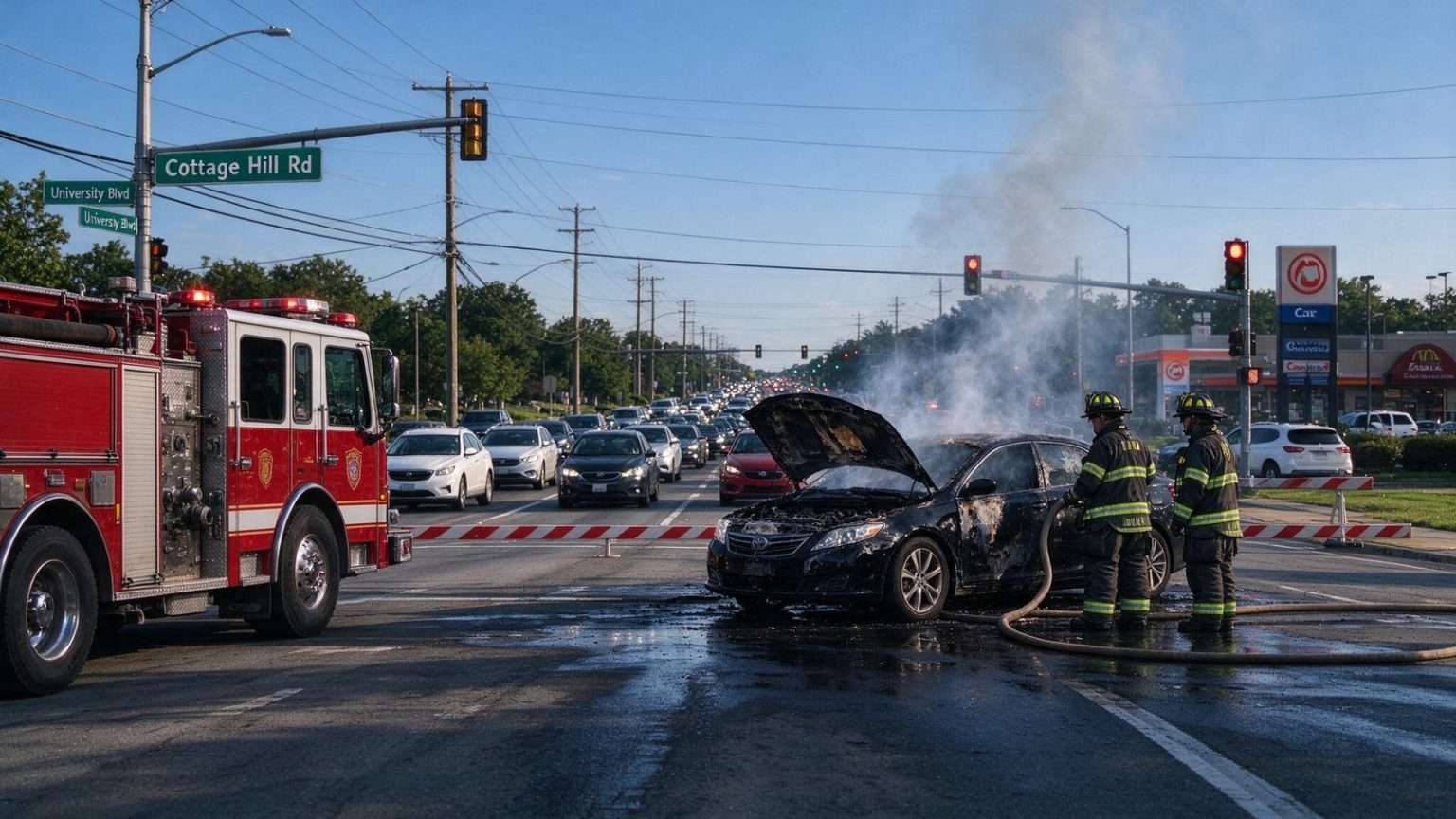
MOBILE, Ala. — A car caught fire Friday afternoon at one of west Mobile’s busiest intersections, snarling traffic for drivers in the area. The fire broke out around 2 p.m. at Cottage Hill Road and University Boulevard, where passing vehicles slowed to look at the burning car and traffic backed up along both corridors. Mobile firefighters extinguished the fire. Authorities had not said whether anyone was hurt.
The intersection where the fire occurred sits at the heart of one of the busiest retail and commuter corridors in west Mobile County. Cottage Hill Road runs east-west through a stretch of the city lined with shopping centers, restaurants, medical offices, and residential subdivisions, while University Boulevard carries traffic north toward the airport area and south toward the Spring Hill and Loop Road sections of the city. Because both roadways funnel drivers toward commercial destinations and neighborhood cut-through routes, the crossing routinely handles heavy volumes during the midday and afternoon hours, and any incident that shuts down a travel lane is quickly felt for blocks in every direction.
Drivers who were in the area Friday afternoon reported that the flames drew the attention of nearly every motorist passing through the crossing, a common and dangerous phenomenon known to traffic safety officials as rubbernecking. When drivers slow down to look at a crash or a fire, the effective capacity of the roadway drops sharply, and backups can extend far beyond the block where the incident actually occurred. That is what happened here, with congestion reported along both Cottage Hill Road and University Boulevard as the afternoon commute window began to build.
How firefighters respond to vehicle fires on busy corridors
Vehicle fires present a distinct set of challenges for fire crews, particularly when they occur at a major intersection rather than along a quiet residential street. Mobile firefighters responding to a burning car must position their apparatus to protect both the scene and passing traffic, often blocking lanes to create a safety buffer while they deploy hose lines. Extinguishing a car fire typically requires more water than many residents expect, because modern vehicles contain plastics, upholstery, tires, and fuel systems that burn hot and can reignite if not fully cooled.
Fire departments across the Gulf Coast, including Mobile Fire-Rescue, regularly remind motorists about what to do if their own vehicle begins to smoke or catch fire while driving. The standard guidance is to pull as far off the roadway as possible, shut off the engine, get every occupant out of the vehicle and away from it, and then call 911 rather than attempting to fight the fire personally. Engine compartments, in particular, should never be opened by a passing motorist, because introducing fresh air can cause a fire to flare suddenly.
While authorities had not said Friday whether anyone was hurt in the Cottage Hill Road incident, vehicle fires are among the most dangerous emergencies precisely because they can escalate in minutes. Fuel lines, batteries, and electrical systems can feed flames that spread from the engine compartment to the passenger cabin quickly, which is why fire crews treat every car fire as a potentially life-threatening call until they confirm otherwise.
What typically causes cars to catch fire
Although investigators had not released a cause in Friday’s blaze, vehicle fires generally stem from a handful of well-documented sources. Mechanical failures such as leaking fuel lines, degraded hoses, and faulty wiring are among the most common, along with overheating engines and catalytic converters that run hot enough to ignite nearby debris. Battery problems, particularly in vehicles with aging electrical systems, and collisions that rupture fuel or coolant components account for many of the rest. Regular maintenance and prompt attention to warning signs such as burning odors, smoke from the hood, or electrical malfunctions remain the best defense.
Gulf Coast weather adds its own stresses to aging vehicles. Long summers of high heat push cooling systems to their limits, and stop-and-go driving on congested corridors like Cottage Hill Road keeps engine temperatures elevated. Fire officials in the region consistently see an uptick in vehicle fire calls during the warm months, which is one more reason drivers are urged to take dashboard temperature warnings seriously instead of pressing on to their destination.
The ripple effect on the afternoon commute
For drivers caught in Friday’s backup, the experience was familiar to anyone who regularly travels west Mobile’s main corridors. A single incident can add thirty minutes or more to a trip that normally takes five, as queues build faster than they drain even after the roadway reopens. Navigation apps routinely rerouted drivers onto parallel streets, pushing cut-through traffic into residential areas and creating secondary congestion well away from the fire itself.
Local businesses along the affected stretch also feel the impact of such disruptions. Customers arriving from the east or west find access blocked or delayed, delivery schedules slip, and parking lot entrances that share a lane with backed-up traffic become difficult to reach. Merchants along Cottage Hill Road have experienced this dynamic repeatedly over the years during crashes, utility work, and signal outages, and Friday’s fire was a reminder of how tightly the corridor’s commerce is tied to the free flow of traffic.
Emergency responders, for their part, must also contend with the congestion their own response creates. Fire apparatus and rescue units approaching a busy intersection depend on other drivers yielding, and heavy traffic can slow the very crews racing to bring a fire under control. That is one reason officials ask motorists to move right and stop when they hear sirens, and to avoid following emergency vehicles or stopping to film the scene.
What drivers should keep in mind when passing an incident
Safety agencies offer a consistent set of recommendations for motorists who encounter a fire or crash scene. Slow down and move over where possible, giving emergency crews room to work. Keep windows up and stay inside the vehicle rather than approaching the scene, both for personal safety and to avoid interfering with operations. And never stop in a travel lane to watch or take photographs, a behavior that endangers everyone on the roadway and is a factor in secondary crashes across the country every year.
Alabama’s move-over law requires drivers to change lanes away from stationary emergency vehicles, or to slow well below the posted limit when a lane change is not possible, and violations carry fines and license points. The law applies to police, fire, rescue, and utility vehicles as well as tow trucks, and officials regularly publicize it in hopes of reducing the close calls that responders describe on the state’s busy roads.
By Friday evening, with the fire extinguished and the roadway cleared, traffic through the Cottage Hill and University intersection had returned to its normal rhythms. The episode, brief as it was in the life of the corridor, captured the everyday vulnerability of a busy suburban crossing: one disabled car, a few minutes of flames and smoke, and hours of accumulated delay for the thousands of drivers who count on two west Mobile arteries to get them home.
Why west Mobile intersections are so sensitive to disruptions
The Cottage Hill and University area is a case study in the traffic dynamics of west Mobile, a part of the city that grew rapidly in the second half of the twentieth century as subdivisions, schools, and retail centers spread outward from the old core. Unlike a grid of downtown streets, the west Mobile road network relies on a limited number of arterial corridors to carry nearly all through traffic. When one of those arteries is obstructed, drivers have few good alternatives, and cut-through traffic floods the secondary streets that were never designed for heavy volumes.
Cottage Hill Road itself connects neighborhoods and commercial strips from roughly Schillinger Road on the west toward University Boulevard and points east, passing several public schools whose afternoon pickup periods already slow traffic on a normal day. University Boulevard, meanwhile, links the Airport Boulevard corridor with Cottage Hill and continues south past residential areas toward Hillcrest Road. The crossing of the two roads is a signalized intersection that many west Mobile residents pass through daily, and Friday’s fire turned a routine trip into a lengthy delay for hundreds of drivers.
Traffic engineers and public safety officials have long noted that incidents at intersections compound delays in ways that roadside incidents do not. A car fire on a shoulder might barely slow a commute; the same fire in a travel lane at a signalized crossing blocks the movement of every approach and forces police or fire units to direct traffic manually until the scene is clear.
Situations like Friday’s also serve as an informal drill for the corridor itself. Traffic adjusts, responders clear the scene, and the lessons linger for residents who saw the smoke from a distance: keep a phone charged, know an alternate route, and remember that on a road this busy, a few minutes of caution is always cheaper than a collision at the edge of an emergency scene.


