
Car Slams Into Mobile Apartment Building, Injuring Child Before Driver Vanishes
A car struck a Mobile apartment building the day after Christmas, injuring a child inside. Witnesses say the driver hit two cars and fled.
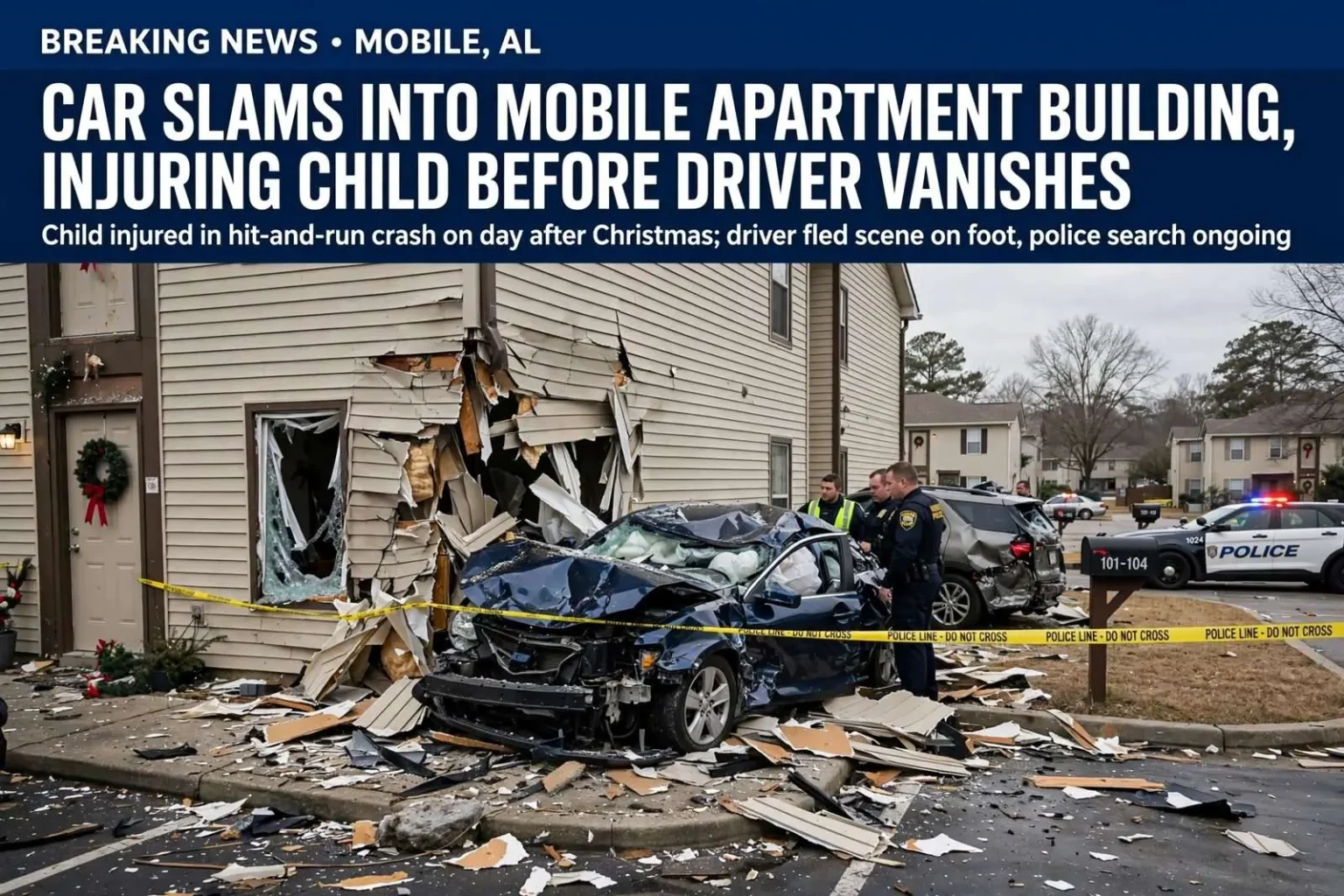
A frightening chain-reaction crash rocked a Mobile apartment complex the day after Christmas, leaving a child hurt and police still searching for the driver who sped away. Witnesses say the car first backed into a parked vehicle before careening into the front of the apartment building, then circled around and struck the back of the complex too, all before taking off down the road.
The sequence of impacts left residents shaken and a building damaged on two sides, and it unfolded in a matter of moments on an ordinary residential afternoon. What began as a collision in the parking lot escalated into a building strike, a second strike on the opposite side of the complex, and a driver fleeing the scene entirely, leaving the people who lived there to deal with the aftermath.
Children inside when the car hit
The front of the apartment is exactly where two grandchildren of resident Sabrina Labeaud were sitting when the impact came. Labeaud said her 13-year-old granddaughter had been lying on a sofa near the door while her younger grandson played a video game in front of the television. The location of the strike, directly against the portion of the building where the children were gathered, turned what could have been a fatal incident into a close call the family is still reckoning with.
The girl suffered minor cuts and bruises and complained of pain in her leg and ankle. Given where the car came to rest against the building and where the children were sitting, the family described the outcome as fortunate beyond what the circumstances promised. The younger grandson, who had been on the floor in front of the television moments before, was spared injury.
Labeaud got the call from her daughter as she headed to work and rushed to the scene in a panic, fearing the worst for the children inside. That drive, not knowing what she would find, is the part of the afternoon her family will remember longest. By the time she arrived, the immediate danger had passed, but the questions had only begun: who was driving, and why did they leave?
Neighbors describe the chaos
Nearby resident Terrance McCarty said he had just seen his neighbor pull out of the parking lot when he heard a loud boom. He described watching the car jump from one vehicle to the next before vaulting over a sidewalk and slamming into the house. The progression, parked car to curb to building, happened faster than anyone watching could react.
After striking the rear of the complex, witnesses said the car fled again and finally stopped at a nearby gas station. The final stopping point left a trail of damage across two locations, the apartment complex and the gas station where the vehicle came to rest, and gave investigators a physical record of the route the out-of-control car traveled.
The search for the driver
Police at the scene confirmed no one was in custody as of Thursday afternoon, and the driver has not been located. The investigation remained active as officers worked to identify the person behind the wheel of the car that had left the scene on foot or by other means after the final stop at the gas station.
A driver who flees a crash involving injuries faces serious potential charges under Alabama law, and the decision to leave the scene added a criminal dimension to what might otherwise have been treated as a traffic accident. Investigators typically pursue several threads in cases like this one: the registered owner of the vehicle, any surveillance video from the apartment complex and the gas station, and the accounts of the witnesses who watched the crash unfold.
The timing of the crash, the day after Christmas, added to the community’s frustration. Families were still gathering for the holiday week, children were home from school, and the parking lots and living rooms of the complex were more full than on an ordinary weekday. That the children inside escaped with minor injuries was the one piece of good news in an afternoon that otherwise offered little.
What witnesses saw
The accounts from Labeaud and McCarty line up on the essential facts: a car moving backward first, then forward with force, striking a parked vehicle, then the building’s front, then the rear of the complex, and finally departing the scene entirely. The consistency of those descriptions matters for investigators, because witness accounts are often the only narrative available in the first days of a hit-and-run investigation.
For the residents of the complex, the physical damage tells its own story. A car that has struck a building on two sides leaves structural questions that have to be answered before life returns to normal: whether the walls and floors near the impact points are sound, whether utilities were damaged, and what repairs the property will need. In the meantime, the neighborhood is left to process how quickly an ordinary afternoon turned dangerous.
McCarty’s description of the sound, a boom that drew his attention before he saw the car moving between vehicles, is the detail that sticks with neighbors. Everyone in the complex now knows that sound, and everyone knows how little time there was between it and the impact against the building where two children were sitting.
Vehicle-versus-building crashes and what they mean for residents
Crashes that put vehicles into occupied homes and apartments are more common than most people realize, and they follow patterns that safety experts know well. Parking lots and streets that run close to building fronts give an out-of-control car only a sidewalk or a strip of grass between the roadway and someone’s living room. When a driver loses control in one of those spaces, the building takes the impact that the street layout failed to provide room to absorb.
The injuries in such crashes are often determined by seconds and feet: where people were sitting, which wall the car hit, whether a sofa or a hallway stood between them and the point of impact. The Labeaud family’s experience fits that pattern exactly. A 13-year-old on a sofa near the door and a younger child in front of a television were in the direct path of the strike, and only the physics of the moment, the way the car came to rest against the structure, decided the outcome.
After a vehicle strike, buildings must be evaluated for structural damage before residents can be fully confident in their safety. Even when a wall looks intact, the force that moved a car across a sidewalk and into a building can crack framing, damage utility lines and shift the load paths a structure relies on. Property owners and inspectors treat any vehicle-versus-building strike as a structural event first and a cosmetic one second.
The investigation ahead
With no one in custody, the work of identifying the driver falls to detectives, and the evidence available to them is substantial. A car that backed into one vehicle, struck a building twice and stopped at a gas station has left paint transfer, video footage and witnesses at multiple points along its path. Investigators will also consider why the driver lost control in the first place, from speed and distraction to impairment, though no cause has been established publicly.
The family’s focus, meanwhile, remains on the children. A 13-year-old recovering from cuts, bruises and lingering leg and ankle pain is the human measure of the incident, and her grandmother’s account of rushing to the scene is the part of the story that resonates with every parent who has ever dropped a child off and gotten an unexpected call.
Anyone with information about the driver is the missing piece. Hit-and-run cases move when someone recognizes the vehicle, the sequence of events or the person who walked away from a car stopped at a gas station on the day after Christmas. Until then, the residents of the complex are left with a damaged building, a shaken neighborhood and a question that has not yet been answered.
The community response
In the hours and days after the crash, the residents of the complex did what neighbors in Mobile neighborhoods typically do in the aftermath of a scare: checked on each other, shared what they saw and began the practical work of recovery. For a community whose children play in the same parking lots and sit in the same living rooms every day, the event was personal rather than abstract.
Labeaud’s account has drawn particular attention because of how close it came to tragedy. Two children in the direct path of an out-of-control car, one of them injured but stable, is the kind of outcome families describe with relief and lingering disbelief in the same breath. Her rush from the road to the scene, fearing what she would find, ended with her grandchildren alive and, in the case of the youngest, untouched.
The damage to the building itself is a reminder of the crash’s force. A vehicle that strikes a parked car hard enough to continue moving, vaults a sidewalk and hits a building is traveling with serious energy, and it did so twice, at the front of the complex and the back. The residents living nearest the impact points spent the days after the crash dealing with the disruption that follows any structural incident.
Staying alert in residential areas
The incident is also a lesson in the realities of neighborhood traffic safety. Residential streets and parking lots are designed around ordinary driving, and they depend entirely on drivers maintaining control of their vehicles. When that assumption fails, the safety margins between a roadway and a living room reveal themselves to be thin.
For families in apartment communities, there is little to do about layout, but awareness matters: knowing which walls face traffic, keeping children’s play areas away from parking sightlines when possible, and reporting dangerous driving before it becomes a crash. None of that places responsibility on residents rather than drivers, but all of it reflects how neighbors look out for one another in practice.
For now, the Mobile Police Department’s search for the driver continues, and the residents of the apartment complex are waiting for the answer to the question that has hung over the neighborhood since the day after Christmas: who was behind the wheel, and why did they run? Until that question is answered, the boom McCarty heard and the damage left behind will stand as the last word on an afternoon no one in the complex is likely to forget.


