
Car Slams Into Vacant Home Off Rylands Street After Mobile Police Chase
A police chase ended when a car slammed into a vacant home off Rylands Street near MLK Avenue in Mobile; the driver was hospitalized.
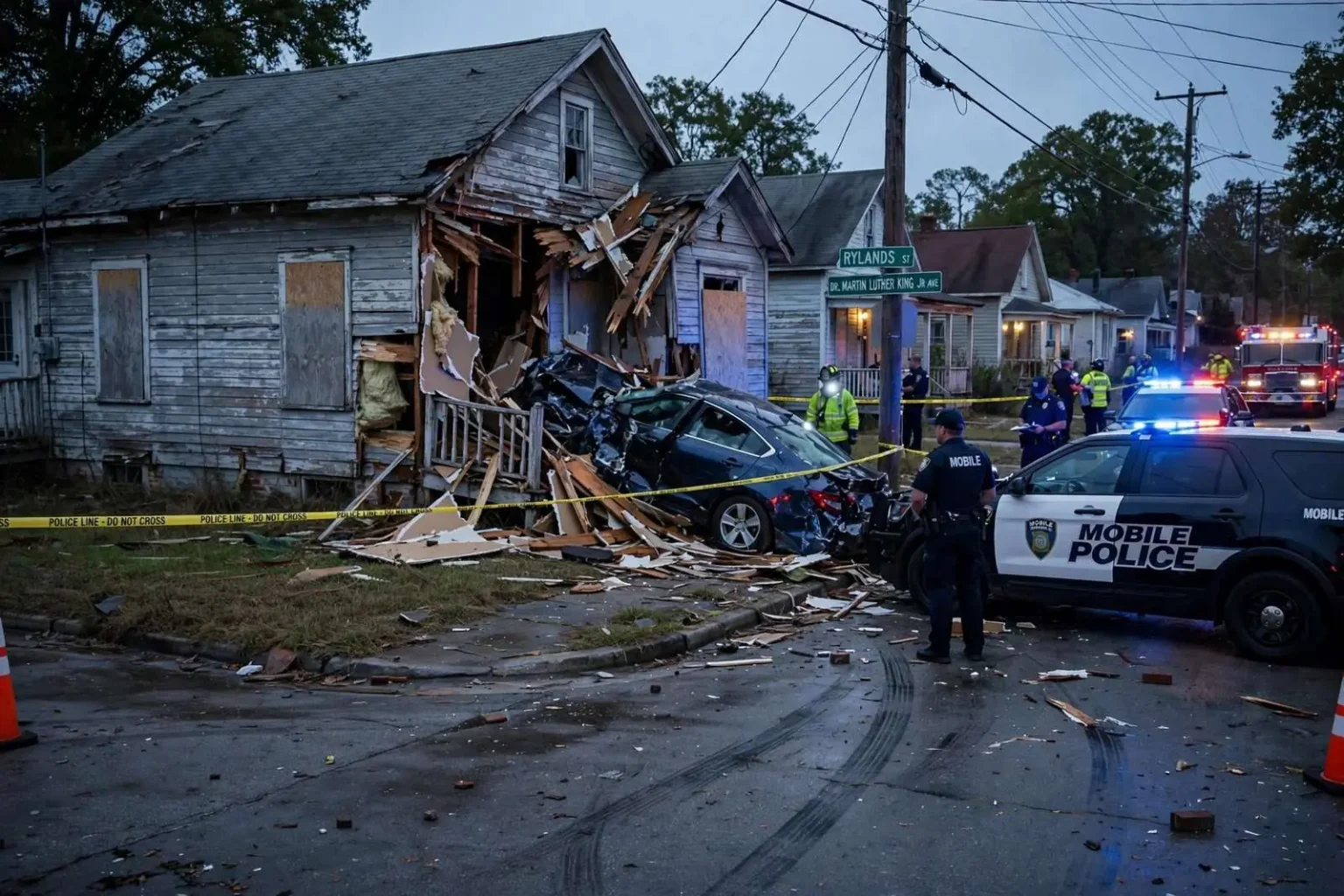
A driver led Mobile police on a brief chase that ended with the vehicle slamming into a home off Rylands Street, near Dr. Martin Luther King Jr. Avenue, according to authorities. Officers remained on scene into Monday evening as they worked the aftermath of the crash, which damaged the structure but caused no injuries to any residents.
Police confirmed the house was vacant at the time it was struck, and no injuries to residents were reported. The driver was taken to a hospital for treatment, though the extent of those injuries was not immediately known. Authorities had not said what prompted the pursuit or whether charges would be filed against the driver.
The crash occurred in a historically significant part of Mobile. Dr. Martin Luther King Jr. Avenue, formerly Davis Avenue, runs through neighborhoods just north of downtown that were once the commercial and cultural heart of the city’s Black community. The corridor and its side streets are lined with early- and mid-century homes, churches, and storefronts that date to the avenue’s heyday.
Rylands Street sits in that grid, a short residential street where through traffic is uncommon and speeds are typically low. A vehicle crashing into a house there points to the kind of sudden, high-energy end to a pursuit that investigators will now have to reconstruct from skid marks, vehicle damage, and witness accounts.
How Police Pursuits Work — and When They End
Police pursuits in Mobile are governed by departmental policy that instructs officers to balance the seriousness of the suspected offense against the danger a chase poses to the public. Officers weigh factors including traffic conditions, speeds, and whether the suspect is wanted for a violent crime, and supervisors can order a pursuit terminated at any point.
Short chases like the one described Monday are among the most common, ending within moments either because the suspect crashes, stops, or officers call off the pursuit. When a chase ends in a collision with a structure, the scene typically draws multiple responders: patrol officers, investigators, fire crews to check the damaged building, and medical personnel for anyone hurt.
Because the house was vacant, the immediate injury risk was limited to the driver, who was hospitalized. Still, crashes into buildings raise structural concerns, and fire department personnel routinely assess whether a struck home remains safe before leaving the scene.
Charges in pursuit cases depend on what investigators learn about why the chase began. A driver who flees a traffic stop faces different potential charges than one suspected of a felony, and investigators will examine whether impairment, an outstanding warrant, or the vehicle itself played a role.
Vacant Homes Along the Corridor
The neighborhood around Dr. Martin Luther King Jr. Avenue has wrestled for years with vacant and blighted structures, a problem that city government has attacked through condemnation, demolition, and redevelopment programs. Vacant homes present familiar hazards — fire risk, unauthorized entry, and, as Monday’s crash showed, no one home to notice a car coming through the wall.
City officials have made reinvestment along the King Avenue corridor a stated priority, pointing to new development, streetscape work, and the area’s proximity to downtown and the Africatown community to the north. Each incident involving a vacant property underscores the lag between blight removal and reinvestment in a neighborhood with aging housing stock.
The driver’s condition remained unknown Monday evening, and police did not release a name. In cases where a driver is hospitalized, investigators typically obtain blood samples under state law to test for impairment when the circumstances warrant it, and formal charges often wait until medical treatment is complete and the investigation is finished.
What Investigators Will Examine
Mobile police will work to establish the sequence of events that preceded the crash: where the pursuit began, how long it lasted, the speeds involved, and whether other vehicles or pedestrians were endangered along the route. Witness statements from residents along the path of the chase are typically central to that reconstruction.
The department will also review the pursuit itself under its internal policy, as it does whenever a chase ends in a crash. That review examines whether officers followed protocol in initiating and continuing the pursuit, and whether any procedural changes are warranted, though the results of such reviews are rarely made public in detail.
Damage to the home will need to be assessed by its owner, and responsibility for repairs generally becomes a matter for insurance or civil claims once fault is established. In the meantime, securing a structure that has been struck by a vehicle is a priority to prevent further deterioration or trespass.
Context: The Neighborhood Around King Avenue
The area near Rylands Street and Dr. Martin Luther King Jr. Avenue sits just north of downtown Mobile, close to Three Mile Creek and the route that connects downtown to Africatown, the historic community founded by the survivors of the Clotilda, the last known slave ship to reach the United States. Renewed attention to Africatown in recent years has brought new investment interest to the surrounding neighborhoods.
Residents there have long called for better street safety, improved lighting, and faster demolition of derelict buildings. Police presence along the corridor has varied over the years as the department adjusts patrol assignments, and incidents like Monday’s chase-and-crash tend to prompt renewed discussion between neighbors and the department’s precinct leadership.
For now, authorities had not released the driver’s name, the reason for the pursuit, or whether any charges are pending. Additional details are expected as the investigation moves forward and the driver’s condition becomes clearer.
Anyone with information about the pursuit or the crash is encouraged to contact Mobile police. As is standard in cases involving a hospitalization and a possible criminal investigation, the department is expected to release more information once investigators have spoken with the driver and reviewed the evidence.
Background: Pursuit Cases Under Alabama Law
Under Alabama law, fleeing or attempting to elude a police officer is itself a crime, and the charge can rise from a misdemeanor to a felony when the flight involves serious physical injury or other aggravating factors. Prosecutors weigh the underlying reason for the stop, the manner of driving, and the outcome when deciding what to file.
When a pursuit causes property damage, courts can also order restitution as part of any sentence, meaning the driver could ultimately be held responsible for the cost of repairing the home. Insurance coverage, however, is often complicated in pursuit cases, particularly if the vehicle was stolen or the driver was unlicensed.
Mobile police routinely process scenes like this one with support from the city’s traffic safety unit, which handles reconstruction work for serious crashes. Their findings — speeds, points of impact, and the path of the vehicle — typically form the factual basis for any charges that follow.
The case remains active, and the department said further details would be released as the investigation allows. Residents who saw the pursuit or its aftermath and have not yet spoken with officers can contact Mobile police or leave an anonymous tip through the department’s tip lines.
The scene drew attention from neighbors through the afternoon and into the evening, with officers keeping the immediate area cordoned off while the vehicle was removed and the damage to the home assessed. Utility crews were expected to check for any damage to service lines before the structure was fully secured.
Crashes into buildings are unusual but not rare in older urban grids like the one around Rylands Street, where homes sit close to the roadway and intersections are tightly spaced. National research on crash-into-building incidents has found that most occur at commercial sites from pedal errors, but residential strikes tied to pursuits and impairment are a persistent subset, and they tend to cause the most severe structural damage because of the speeds involved.
Local crews that specialize in boarding and securing damaged structures are typically called in after police clear the scene, shoring up walls and covering openings to keep weather and trespassers out. For a vacant home, the question then becomes whether the owner repairs the building or whether the city’s blight process eventually takes over if the property is abandoned.
Impact on the Street
For residents of the block, an evening of police tape and patrol cars is a disruption that lingers. Neighbors on streets near King Avenue have described being alert to cut-through traffic and late-night speeding, concerns that civic groups in the area have raised with the city’s traffic engineering staff in the past.
Speed humps, added signage, and targeted enforcement are the remedies most often requested. The city fields such requests through its traffic services operation, which studies crash history and traffic counts before making changes to residential streets.
Monday’s crash is likely to renew those conversations, particularly if investigators determine the chase reached high speeds before ending on the residential block. Police officials have previously noted that pursuits on narrow neighborhood streets carry elevated risk compared with chases that stay on arterial roads, which is why the department’s policy emphasizes ending chases when danger to the public outweighs the need to apprehend.
The investigation continues, and authorities said updates would follow as they become available.


