
Car Strikes House on Sweeneys Lane in Mobile; No Injuries Reported
A car struck a Sweeneys Lane home in Mobile; the driver told police his steering wheel locked up. No injuries were reported.
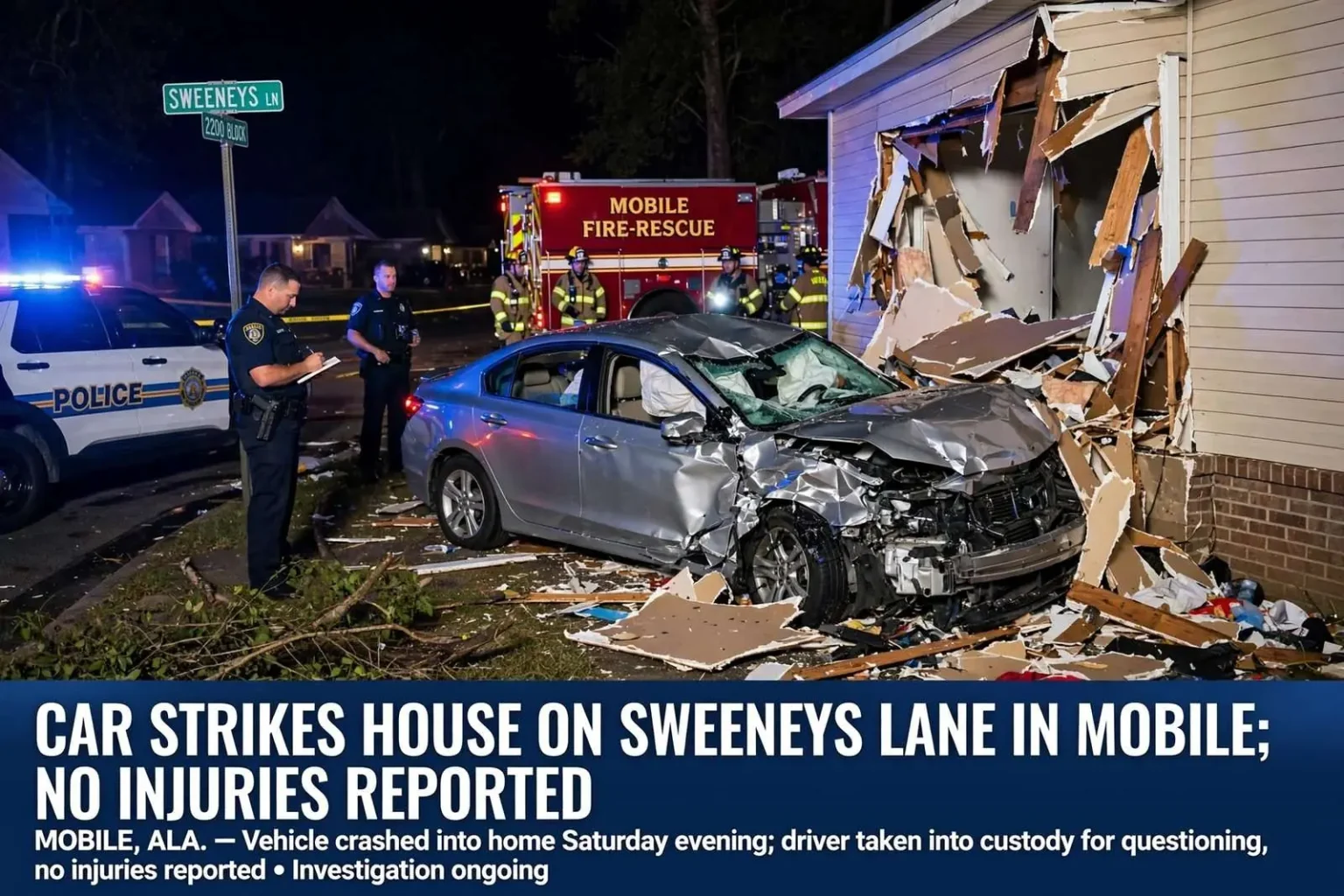
MOBILE, Ala. — A car crashed into a home on Sweeneys Lane in Mobile Saturday evening, but no one was hurt, according to Mobile police. The call came in around 7:15 p.m., as Saturday night traffic and early weekend activity were building across the city. Fire and rescue personnel checked the occupants of both the vehicle and the residence, and the absence of injuries in a crash that put a car inside a house’s footprint was the evening’s most fortunate outcome.
A man believed to be the driver was taken into custody for questioning by police at the scene. Officers routinely detain drivers at the scene of serious crashes while they work to establish the basic facts: who was driving, whether anyone else was in the vehicle, whether impairment or distraction played a role, and whether the account offered by the driver matches the physical evidence left behind. The man told authorities his steering wheel locked up before the crash, a claim investigators would need to evaluate against the condition of the vehicle and the crash scene itself.
Authorities had not said whether any charges would follow, leaving the case open pending the completion of the investigation. That posture is typical in Mobile for crashes involving property damage of this magnitude: officers gather statements, canvass for witnesses, and await the results of any evaluations before deciding whether the incident is a pure accident, a traffic violation, or a matter for criminal charges. Until that determination, the man taken into custody for questioning faced no announced charges in connection with the crash.
The Scene on Sweeneys Lane
Sweeneys Lane sits in a residential section of Mobile where houses line a street not designed for through traffic at high speed. When a vehicle leaves the roadway and strikes a house, the damage pattern tells investigators a great deal: the point of impact, the angle of entry, the direction of travel, and whether the driver braked before impact. Skid marks on the pavement, gouges in the yard, and the resting position of the vehicle form the physical record that investigators document with photographs and measurements before the vehicle is removed.
Crashes into structures also trigger a safety response beyond the collision itself. Fire crews check for ruptured fuel lines, damaged gas meters, and compromised electrical wiring, since a car striking a house can shear utility connections and create fire or explosion hazards that are not immediately visible. Building inspectors or on-scene fire officers evaluate whether the structure remains safe for occupants to remain inside, and in significant cases utilities are shut off until repairs can be made. Saturday evening’s occupants avoided injury, but the house itself faced an inspection and repair process that would unfold over days or weeks.
When a Vehicle Claims a Mechanical Failure
The driver’s statement that his steering wheel locked up before the crash is the kind of claim that receives careful, skeptical scrutiny from crash investigators. Sudden total steering failure in a modern passenger vehicle is rare, because steering systems are designed with redundant mechanical linkages that continue to function even if power assist fails. A loss of power steering makes the wheel heavy and difficult to turn, particularly at low speeds, but it does not lock the wheel in place. A true mechanical lock — where the steering binds completely — generally points to a severe component failure such as a seized steering column, a broken linkage, or interference within the steering gear itself.
Investigators approach such claims by examining the vehicle’s steering and suspension components for evidence of failure: heat discoloration, fractured metal, worn or separated joints, and fluid leaks. Insurance investigators and, if the claim is contested, mechanical experts may become involved as well. If the vehicle is found to have a genuine mechanical defect, the incident may end up reported to the manufacturer or added to the file of an existing recall investigation. If the examination finds the steering system intact, the account loses credibility and the investigation shifts toward other explanations, including speed, distraction, impairment, or pedal error.
Custody for Questioning, Not Necessarily Charges
Taking a driver into custody for questioning after a serious crash is an investigative step, not a determination of guilt. Mobile police, like departments across the country, use short investigative detentions to secure a scene, prevent a driver from leaving before basic identification and testing decisions are made, and allow officers to develop probable cause if the evidence points that way. Officers may conduct field sobriety evaluations if impairment is suspected, and they may seek a warrant for blood or breath testing in serious crashes where impairment is in question.
The decision about charges, when they come, typically follows the completion of the on-scene investigation and any laboratory results. In a crash with property damage but no injuries, possible outcomes range from no charges at all to citations for violations such as failure to control speed, reckless driving, or, if impairment is established, driving under the influence with accompanying charges. Prosecutors weigh the physical evidence, witness statements, and any mechanical findings before moving forward. Until one of those outcomes was announced, the Saturday night crash on Sweeneys Lane remained an open investigation with an undetermined cause.
What Homeowners Face After a Car Comes Through the Wall
For the residents of the struck house, the aftermath involves a series of practical and financial steps that few homeowners ever expect to navigate. The first is structural: a licensed contractor or structural engineer assesses whether the impact damaged load-bearing walls or the foundation, and temporary shoring may be needed before anyone reoccupies the affected part of the house. Next comes the insurance claim, in which the homeowner’s policy typically covers the damage to the dwelling, with the insurer then pursuing reimbursement from the driver’s auto liability coverage where applicable.
Neighborhood response matters too. Crashes into houses prompt familiar questions from neighbors about cut-through speeds, sight lines at nearby intersections, and whether anything more than luck kept this incident from becoming a tragedy. Traffic engineers can be asked to review a street for speed humps, signage, or other calming measures, and in Mobile, requests of that kind flow through the city’s traffic engineering division. For now, the residents of Sweeneys Lane were left with a damaged home, a story to tell, and the quiet relief that comes from the report no one expected but everyone hopes for: everyone walked away.
Weekend Crash Patterns in Mobile
Saturday evening is among the busiest windows of the week for crash responses in Mobile. The combination of dusk lighting, social travel, and higher rates of impaired driving makes the hours between 6 p.m. and midnight a recurring peak in police and fire dispatch logs. Crashes involving fixed objects — trees, utility poles, and houses — are a consistent subset of those calls, and they tend to produce the most severe property damage precisely because the vehicle leaves the roadway entirely rather than colliding with another vehicle that can absorb part of the impact.
Mobile police investigate thousands of crashes a year across a city whose road network mixes high-speed arterials with older residential grid streets. In residential neighborhoods like the one around Sweeneys Lane, the classic crash-into-building scenario involves a driver losing control at moderate speed on a street where homes sit close to the roadway. Building codes and setbacks vary across the city’s older neighborhoods, and in many blocks the distance between the curb and a home’s front wall can be measured in a few car lengths, leaving little margin for a vehicle that departs the pavement.
The Road Ahead for Everyone Involved
In the days after a crash like this one, the threads pull apart in different directions. The driver’s vehicle goes to an impound or inspection facility, where the steering components can be examined before it is repaired or released. The homeowners meet with adjusters and contractors. Witnesses who saw the car before impact may be contacted to confirm its speed and direction of travel, and any nearby security or doorbell cameras that captured the crash can supply an objective record that either supports or contradicts the mechanical-failure account. Crash reconstruction results, when they are completed, translate all of that into a formal findings document that follows the case wherever it goes next.
For the neighborhood, the crash on Sweeneys Lane will likely be remembered in the way such events always are: as the night a car ended up in a living room, and the night everyone involved somehow walked away. Police had not announced a cause of the crash or any charges as of the latest reports, and the man’s account of a locked steering wheel remained just that — an account, waiting on the mechanical evidence to confirm or refute it. Until the file closes, the case stands as a reminder of how many questions a single out-of-control car can raise in the space of a few seconds on a quiet residential street.
No injuries were reported in the Sweeneys Lane crash, and no damage estimate for the home was released. The investigation remained active, and police had not identified whether the driver taken into custody for questioning would face any charges. What the evening left behind was a household dealing with structural damage, an impounded vehicle at the center of a mechanical question, and a neighborhood briefly reminded that the line between an ordinary Saturday night and an extraordinary one can be as thin as a car leaving the road.


