A Punch on the Senate Floor, and a Standing Ovation in Birmingham
State Sen. Charles Bishop was publicly condemned for punching a Democratic colleague on the Alabama Senate floor. At a Republican dinner in Birmingham, he got a standing ovation, and Mobile Democrats were appalled.
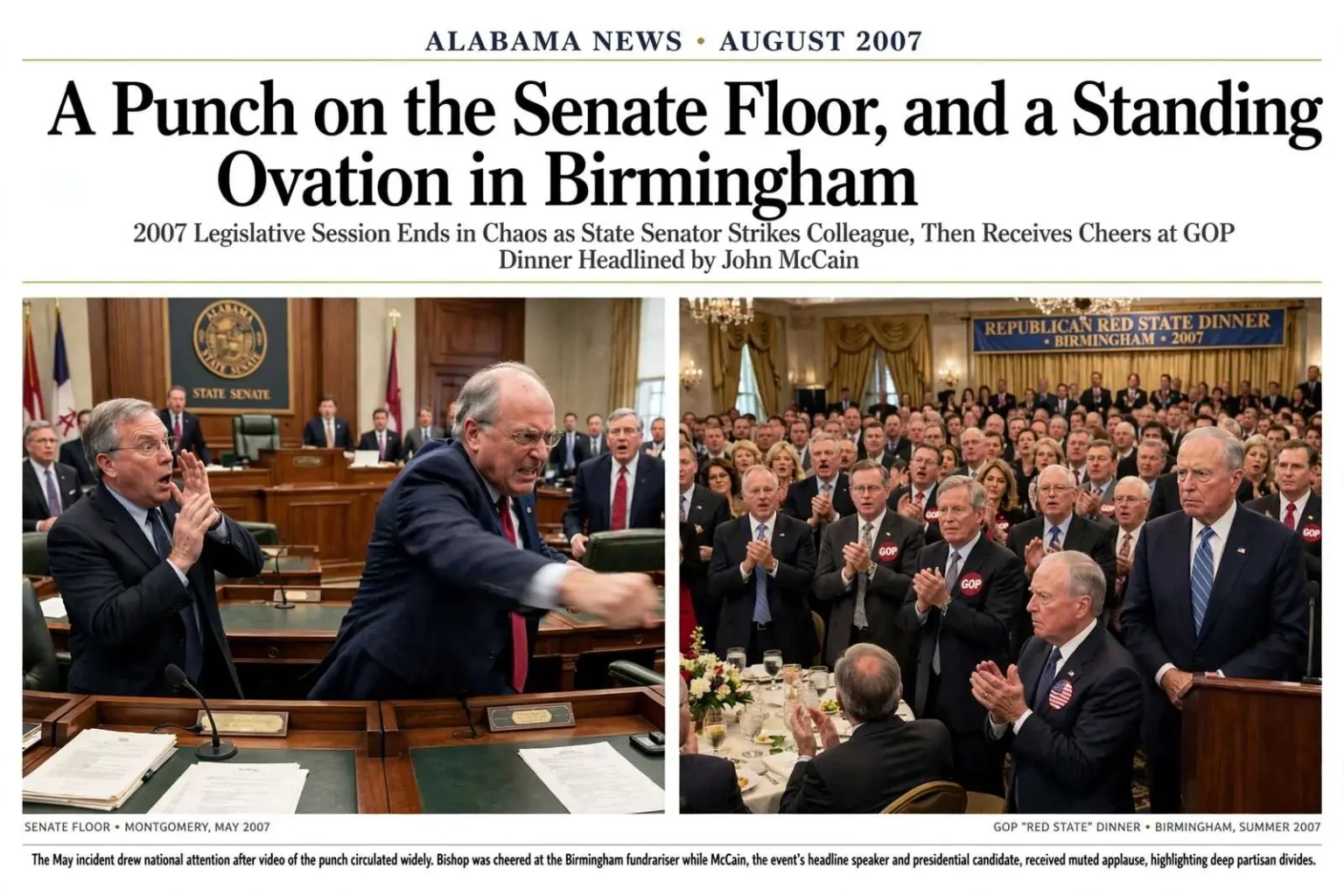
The 2007 regular session of the Alabama Legislature ended the way it had largely been conducted: badly. On the final day, Republican state Sen. Charles Bishop of Jasper turned and struck Democratic Sen. Lowell Barron in the jaw on the Senate floor, an act that made the chamber a national punchline and drew a torrent of public criticism. Not everywhere, though. Within his own party, Bishop’s standing did not merely survive the incident. It rose.
The punch itself was over in a second — a quick turn, a swing, a jaw — but the footage did not go away. Television stations replayed it for days, late-night comics worked it into their monologues, and Alabama’s part-time citizen Legislature found itself discussed on the same national broadcasts as the professional ones. In a session that had already produced more gridlock than legislation, the final day gave the state a symbol of its own dysfunction that no one could ignore.
Louder than McCain
According to a member of the state Republican executive committee, Bishop received a standing ovation from the more than 500 people attending a summer Republican “Red State” dinner in Birmingham. The evening’s featured speaker was U.S. Sen. John McCain, then campaigning for the Republican presidential nomination. By this account, McCain drew a perfunctory welcome and a courtesy ovation after his remarks, while the recognition given Bishop was “long and loud with applause, cheers and support.”
The contrast was not lost on anyone in the hall. McCain was a sitting U.S. senator, a national figure and a war hero seeking the presidency, and he had come to Birmingham as the headliner of his party’s event. Bishop was a state senator from Jasper whose principal claim to the evening’s applause was having thrown a punch. That the room honored the second man more warmly than the first said something about the partisan temperature of the moment that no poll could measure.
The committee member was candid about the gap between what Republicans said publicly and what they felt privately. Many would call the punch ghastly, horrid or ridiculous in public, the official said, while behind closed doors “we all cheered.” It was a rare admission of the theatrical nature of partisanship — the same audience performing condemnation for the cameras and celebration among friends.
Mobile Democrats respond
That candor did not sit well downstate. Mobile County Democratic Chairman Brad Warren called it a sad day for Alabama when such audacious behavior draws applause. “No wonder they continue to be the minority party in our state with such malice and hatred in their hearts,” Warren said. Whatever the rancor between the two senators, Warren argued, Barron was an elected official whose position commanded more respect than a “sissy punch.”
He said Bishop should be ashamed and the Republican Party embarrassed at having given a standing ovation for a cheap shot while giving short shrift to a former prisoner of war seeking the party’s highest nomination. Warren’s rebuke had two edges — one for Bishop’s conduct and one for his party’s priorities — and the second cut deeper. A party that cheered its brawler over its decorated veteran, Warren suggested, had its values inverted in a way that voters would eventually notice.
Warren also pressed the argument that would have resonated most in Mobile, where economic development officials were then courting international manufacturers. “Alabama is on a roll with industrial recruiting worldwide,” he said. “This is an embarrassment of the highest order.” The point was practical rather than partisan. Mobile’s recruiters were selling the state to corporate decision-makers who watched the same news footage as everyone else, and every replay of a legislator swinging on the Senate floor was a bad frame in Alabama’s own commercial.
How the session got there
The punch did not come out of nowhere. The Senate that year was split between an 18-member Democratic majority and a coalition of 12 Republicans and five dissident Democrats who believed the chamber had been organized against them punitively. The minority responded with stalling tactics; the majority grew frustrated; and foul and threatening language repeatedly marred exchanges across a session that produced very little. The floor fight was the physical expression of a chamber that had spent months refusing to function.
Bishop maintained that Barron had provoked him with an obscenity. Democratic senators and Barron’s allies who were within hearing distance disputed that claim. The conflicting accounts mattered legally as well as politically, since the question of who started it would shape whether the incident was treated as an unprovoked assault or an ugly exchange that escalated. The video captured the swing, but not the words that preceded it, and both sides spent the summer filling in the audio.
An ethics committee that had never met
A complaint against Bishop was referred to the Senate’s Committee on Ethics and Conduct, a body that, by all reports at the time, had neither met nor organized itself. Its five members included Republican Sen. Scott Beason, listed as chairman for no better reason than that his name came first alphabetically, and Sen. Jim Pruitt, a Democrat and a key member of the dissident minority coalition. The venerable Senate secretary, McDowell Lee, referred to Beason as chairman in a letter to committee members, according to one Republican senator, though whether Beason would actually preside once the panel convened was an open question.
The committee’s composition guaranteed a fight over process before any judgment on the merits. Members drawn from the same fractious coalition that had produced the session’s warfare would be asked to judge one of its casualties, and any ruling was likely to be read as a partisan act by whichever side it disappointed. Under the rules, expelling a senator would require four of the committee’s five members to favor the ouster, a threshold that made any serious sanction unlikely given the panel’s composition.
Barron said he would await a ruling from the Senate before deciding whether to pursue criminal or civil charges. The math of the ethics committee gave him little reason to hurry: the same arithmetic that made expulsion nearly impossible made a hasty complaint look futile, and the Senate’s own review would come first in any event.
“I expect to be reprimanded”
Bishop, for his part, did not ask to be excused. He said he expected a reprimand and believed he deserved one, acknowledging that he had done something the Senate could not tolerate on its floor. He added, pointedly, that he expected Barron to be reprimanded as well. Both men were in their sixties, two veterans of Montgomery’s long wars trading blows — literal and procedural — in a chamber where they had both served for years.
The episode became one of the most durable images of Alabama’s legislative politics in that era, a moment when partisan paralysis in Montgomery stopped being an abstraction and became a fist. For the Mobile area, which was in the middle of the largest industrial recruitment run in its modern history, the timing could hardly have been worse, and local Democrats made sure to say so. The standing ovation in Birmingham, coming on top of the punch itself, ensured that the story was no longer about two men’s tempers — it was about a party, and a state, and what each was willing to cheer.
The national punchline
National media could not resist the footage, and neither could the state’s own citizens, who found their Legislature mocked in contexts that had nothing to do with policy. For a state that had spent a decade trying to convince automakers, aerospace companies and shippers that it was open for serious business, the video was a brand problem in a way a hundred press releases could not fix. Economic recruiters in Mobile and Huntsville watched the same replays as everyone else and understood exactly what potential clients were thinking.
The standing ovation in Birmingham converted the embarrassment into something worse: evidence that the behavior was not an aberration but a credential. When 500 party activists rise to their feet for a man who threw a punch on the Senate floor — and give the visiting war hero a cooler reception — the story stops being about anger management and becomes about values. Warren’s criticism, whatever its partisan source, identified the real damage precisely. The punch had humiliated the state; the applause suggested the state’s dominant political audience had enjoyed it.
In the years that followed, the episode kept its grip on Alabama’s political memory. It surfaced in every later debate about legislative decorum, in every argument about the ethics committee’s usefulness, and in every recounting of the 2007 session’s failed agenda. Bishop’s punch became shorthand for a chamber that could not govern itself — and for an era when the line between Alabama’s political combat and physical combat, however briefly, disappeared entirely on the floor of its own Senate.