
Chatom Man Killed in Three-Vehicle US 43 Crash That Injured NFL Draft Prospect
Charles Dunn of Chatom died in a three-vehicle head-on crash on US 43 near Mount Vernon that injured NFL draft prospect Michael Jefferson.
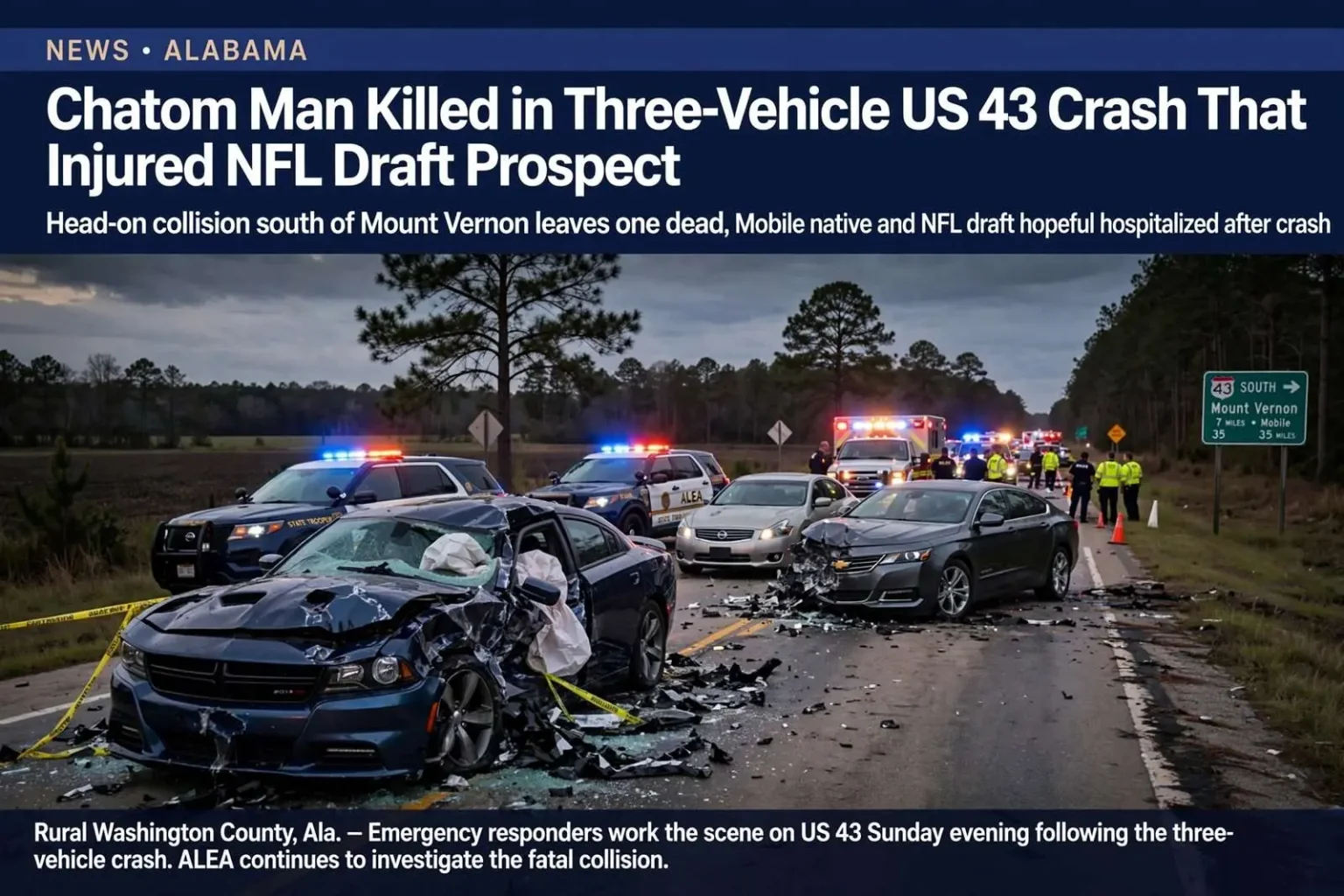
A head-on crash on US 43 south of Mount Vernon left a Chatom man dead and derailed the NFL dreams of a Mobile native headed for the draft. According to the Alabama Law Enforcement Agency, Charles A. Dunn, 55, was driving a 2014 Dodge Charger on US 43 around 7:55 p.m. Sunday when it collided head-on with a 2019 Chevrolet Impala. A third vehicle, a 2008 Nissan Maxima, then struck Dunn’s car in the aftermath.
Dunn, who was not wearing a seat belt, was pronounced dead at the scene. The collision occurred on a stretch of US 43 that runs through rural Washington County between Mount Vernon and the communities to the south, a two-lane highway where head-on crashes remain among the most lethal crash types the Highway Patrol investigates.
NFL prospect among the injured
The driver of the Impala was identified as Michael Antonio Jefferson, 23, a Mobile native and Murphy High School graduate who was projected as a likely mid-round pick in that month’s NFL Draft. His agent told ESPN’s Adam Schefter that Jefferson was undergoing multiple surgeries after the wreck.
Jefferson caught on at Louisiana after three seasons at Alabama State, and had been preparing for the draft, which was set for April 27 in Kansas City. His route to that point was one of persistence: he built his profile as a receiver at Alabama State, a historically black university in Montgomery, before transferring to the University of Louisiana at Lafayette, where he developed into a prospect whose size and catching radius drew scouting attention.
Scouts had flagged Jefferson as a mid-round value in a draft class deep at receiver, and his pre-draft process — pro days, team visits and private workouts — had gone well enough that multiple clubs were monitoring him. The crash threw all of it into uncertainty three weeks before the draft was to begin, and his surgeries meant that even his participation in rookie minicamps was suddenly in question.
Investigation continues
ALEA’s Highway Patrol Division said its investigation into the crash remained ongoing. Investigators work such scenes methodically: reconstructing vehicle paths from skid marks and debris, examining the vehicles themselves for mechanical factors, and awaiting toxicology results before determining what charges, if any, might apply.
The collision marked one of the region’s deadliest spring wrecks, claiming the life of the Washington County man and leaving the young receiver’s football future suddenly uncertain. For the small communities along US 43, the aftermath was felt close to home — Dunn was a Chatom resident, and the crash site sits within the patrol beats that local responders know well.
Head-on crashes on rural two-lane highways are a persistent safety problem in Alabama. US 43 carries a mix of local traffic, commuters and commercial vehicles between Mobile and Washington County, and portions of the corridor lack the divided cross-section that separates opposing directions of travel. State safety engineers have targeted such corridors for shoulder widening, rumble strips and passing-lane improvements in recent years.
Jefferson’s road to the draft
Jefferson’s rise was a Mobile story. A Murphy High School graduate, he came up through the city’s rich football tradition — a program history that has sent dozens of players to the college ranks and the NFL. From Murphy he went to Alabama State, where he spent three seasons developing in the SWAC before making the jump to the Football Bowl Subdivision at Louisiana.
His lone season with the Ragin’ Cajuns turned him from a small-school curiosity into a genuine draft prospect. Receivers with his frame and catch radius always draw attention in April, and by the time the crash occurred his name had appeared in mock drafts projecting him in the middle rounds. The pre-draft circuit — the East-West style showcase games, his pro day performance and team interviews — had positioned him for the moment.
Instead, the draft weekend arrived with Jefferson recovering from multiple surgeries, his agent’s statement to ESPN’s Adam Schefter confirming the seriousness of the injuries. Teams weighing a mid-round pick on a receiver must now weigh medical information that did not exist when their boards were first drawn. The NFL’s medical evaluations of draft prospects injured before the draft follow a defined process, with clubs obtaining records and specialists reviewing the outlook for a return to play.
The crash in context
The sequence described by ALEA — a Charger crossing into the path of the Impala head-on, followed by a Maxima striking the Charger — illustrates how quickly a single vehicle’s mistake becomes a multi-car catastrophe on a two-lane road. Secondary impacts are common in such crashes, as following vehicles have seconds at most to react to debris and stopped or disabled cars in the travel lane.
Seat belt use, or the lack of it, is a recurring factor in Alabama’s rural fatalities. Dunn was not wearing a seat belt at the time of the crash. State data year after year shows unbelted occupants are dramatically overrepresented among those killed at the scene, and Alabama’s Click It or Ticket enforcement campaigns target corridors like US 43 precisely for that reason.
Mount Vernon sits in the northeastern corner of Mobile County on the edge of Washington County, and the US 43 corridor there serves traffic between Mobile and the Tennessee-Alabama line communities. The route’s traffic mix and geometry make it a familiar entry on ALEA’s regional crash logs, particularly during evening hours when visibility drops and oncoming headlights can blend into the skyline.
What happens next
ALEA’s investigation will ultimately produce a crash report that assigns contributing factors, and Mobile County prosecutors review fatal crash files for potential charges when negligence or impairment is indicated. That process takes weeks to months, and authorities have released no findings beyond confirming the investigation’s scope.
For Jefferson, the path forward runs through surgery, rehabilitation and the league’s medical review process. Players have returned from pre-draft injuries before — some to productive careers after slipping in the draft, others to practice-squad routes back onto rosters. His football future remains uncertain, but his agent’s public updates signaled confidence in his recovery.
For the family of Charles A. Dunn, the investigation’s conclusions will not change what the Sunday evening crash took away. Community members along the corridor expressed condolences, and the wreck stands as another entry in the region’s all-too-familiar ledger of rural highway losses.
Rural highway safety on the Gulf Coast
The crash adds to the annual toll on Alabama’s rural two-lane network, which consistently accounts for a majority of the state’s traffic deaths despite carrying a minority of its total miles driven. Higher speeds, fewer dividers, limited lighting and longer emergency response times all contribute to the disparity, and head-on collisions are disproportionately deadly when they occur at highway speed without separation between directions.
ALDOT’s safety programs address such corridors through targeted countermeasures: centerline and edge-line rumble strips that alert drifting drivers, improved signage and pavement markings, guardrail upgrades and passing lanes that reduce risky overtaking. Engineering analyses after fatal crashes feed into that pipeline, determining whether a segment warrants treatment.
Local responders along US 43 — volunteer and municipal fire departments, county EMS and state troopers stationed in the region — train for exactly the kind of multi-vehicle scene this crash produced. Coordination among agencies determines how quickly the injured reach definitive care, and in rural trauma medicine those minutes matter most of all.
The draft and its aftermath
The NFL Draft in Kansas City proceeded at the end of the month as scheduled, with Jefferson’s situation among the storylines teams monitored into the final rounds. Prospects injured in the weeks before the draft face a unique limbo: too late for clubs to schedule their own medical re-checks at the combine, and too early for teams to see the recovery arc that would inform a decision. Medical grades, not just positional need, decide where such players land — if they hear their names called at all.
Jefferson’s case also drew attention across Alabama’s football community, where his path from Murphy High to Alabama State to Louisiana had been followed closely. Players from HBCU programs who rise into draft consideration carry particular significance for the state’s fan bases, and well-wishes poured in from teammates and coaches at both of his college stops.
The ESPN report from Adam Schefter that first detailed Jefferson’s surgeries highlighted how quickly a prospect’s fortunes can turn. One moment on a rural highway separated a likely mid-round selection from an uncertain recovery, a reminder that the draft’s precise machinery of grades and projections operates on the assumption that its players remain healthy until the picks are made.
Remembering the victims of the corridor
Behind every fatal crash report is a community count. Charles A. Dunn, 55, was a Chatom man — a resident of the Washington County seat area, where US 43 is the main artery — and his death was felt among neighbors, coworkers and family across the county. The Highway Patrol’s confirmation that he was not wearing a seat belt entered the public record as part of the crash summary, a detail advocates cite each year in belt-use campaigns.
Authorities urged drivers in the region to treat the crash as a caution: stay in your lane, wear your belt, slow down for oncoming traffic on two-lane stretches and never assume the road ahead is clear. The Highway Patrol Division’s investigation remains the authoritative account of what happened on US 43 that Sunday evening, and its conclusions will close the official chapter on a collision that changed two families’ lives in an instant.


