

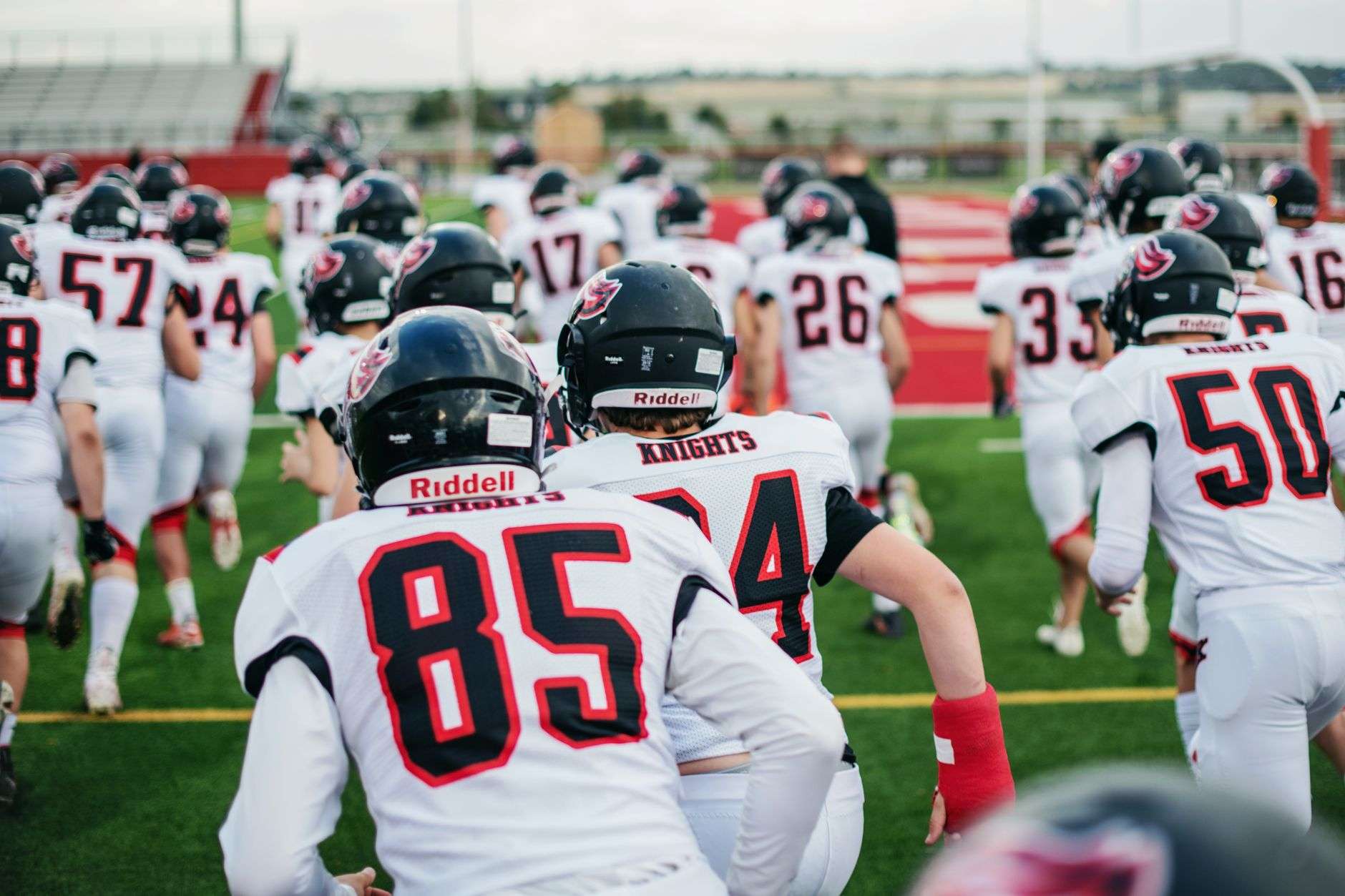
The Chickasaw Chieftains are heading into a football season with a lot of unfamiliar faces around them. When the Alabama High School Athletic Association reshuffled its classifications, Chickasaw landed in Class 2A, Region 1 alongside six other programs, and just one of them — Clarke County — is a team the Chieftains squared off against a year ago. For a program still building its identity, a nearly complete region reset means new opponents, new travel routes across five counties, and a fresh set of benchmarks for what a successful season looks like.
The change stems from the AHSAA’s decision to separate public and private schools when determining state champions. The reclassification redrew the maps across the state, and Chickasaw’s former regionmates St. Luke’s and Bayshore Christian have both moved to AHSAA’s Private Class A, Region 1, while Washington County and Central-Hayneville have shifted to other regions entirely. In their place, Chickasaw now shares the region with Clarke County, J.U. Blacksher, Luverne, Thomasville, Monroe County and Hillcrest-Evergreen.
Three of those programs — Thomasville, Hillcrest-Evergreen and Monroe County — played Class 3A a year ago before dropping down, meaning Chickasaw is inheriting opponents from a higher classification. The reclassification cut both ways for the Chieftains: they lost familiar, manageable region games against nearby private schools, and gained a slate against rural programs with decades-deep football histories.
A Sprawling New Map
Geographically, the new region is a sprawling one, pulling from five different counties. Chickasaw is the only Mobile County-Baldwin County program in the group. Clarke County and Thomasville both represent Clarke County, Luverne comes from Crenshaw County, and Hillcrest-Evergreen, Monroe County and J.U. Blacksher all hail from Monroe County. Every region game except the ones against Clarke County now requires a long bus ride — deep into the Black Belt’s small-town football country, where Friday nights are the centerpiece of the community calendar.
That geography matters competitively as well as logistically. The programs Chickasaw joins are the kind that have played each other for generations, with established rivalries, established pipelines and established expectations. The Chieftains arrive as the metro-area newcomer in a region of small towns, and every road trip doubles as an introduction.
A Young Program With a Short History
Chickasaw’s program is still relatively young, with just 12 seasons of football in its history and six different head coaches during that span. The Chieftains carry a 54-72 all-time record and have qualified for the playoffs seven times, but they have never won a postseason game. Their only three winning seasons came in 2019 (6-4), 2021 (6-4) and 2022 (7-4).
Those three winning seasons are the program’s proof of concept — evidence that Chickasaw can build a winning roster in the right years. The stability question is the other side of that ledger: six head coaches in 12 seasons means the program has rarely had the continuity that lets a system, a strength program and a class pipeline compound over time.
Last season, Chickasaw made the playoffs again but lost in the first round to Cottonwood, finishing 4-7 overall and 3-3 in region play. Head coach Sumpter enters his third season at Chickasaw carrying an 0-1 career playoff record and a 7-14 mark at the school. Before arriving in Chickasaw, he went 3-7 in a single season at Blount in 2021 and spent nine seasons (2012-20) at Williamson, going 40-55 with an 0-5 playoff record there.
Year three is the traditional checkpoint for a high school coach — long enough for his recruits and system to fill the roster, close enough to his arrival that the early seasons’ records still count against him. A new region gives Sumpter something coaches rarely get: a slate where the past’s results count for nothing, and where a .500 region record might mean something very different than it did in the old alignment.
The Region’s Heavyweights
The Chieftains won’t lack for tough competition in their new region. Luverne stands out as the class of the group, having reached the playoffs 43 consecutive years and won Class 2A state titles in 1991 and 1997, with additional title-game appearances in 1994, 2003 and 2018. The Tigers, whose program dates to 1920, went 12-1 last season with their only loss coming in the third round of the playoffs, averaging 51.5 points per game while allowing just 10.6 and posting six shutouts.
A program with a 43-year playoff streak is the kind of institution small-town Alabama builds its identity around, and Luverne’s scoring margin last season — five touchdowns a game on one side of the ball, barely one allowed on the other — marks it as the measuring stick every other region team will be judged against. For Chickasaw, the trip to Luverne will be the hardest game on the schedule and the clearest test of where the Chieftains actually stand.
Clarke County, which won the Class 2A state championship in 2021 with a 13-2 record, has made the playoffs six straight seasons. Under first-year head coach Jason Massey last season, the team opened 0-2 before reeling off seven straight wins, finishing 7-4 overall and 6-0 in region play before a first-round playoff loss. Clarke County’s program dates back to 1917.
Clarke County is the one familiar face on Chickasaw’s new slate, and the Bulldogs’ 6-0 region record a year ago says what the standard is. A program that has been winning region titles for a century — the 1917 founding predates most of the state’s schools — enters every season with championship expectations, and its games against Chickasaw will be the Chieftains’ most direct comparison to a proven 2A contender.
J.U. Blacksher went 8-3 last season after an 8-1 start and has reached the playoffs 10 times over the past 12 seasons, though the program has only one playoff win and seven winning seasons in that stretch. Hillcrest-Evergreen has made the playoffs 10 times in the past 13 seasons but just once in the last four, finishing 3-7 and missing the postseason last year. Davern Williams takes over as head coach this season. The program’s high point remains a 2017 Class 3A state championship with a 14-1 record, and it also reached the state semifinals in 2015.
The pair represents the region’s middle tier — programs with playoff habits and recent history that ranges from a 3A title to a rebuilding present. Hillcrest-Evergreen’s new coach is the variable: Williams inherits a program that knows how to win big but has lost the habit in recent seasons, and turnaround jobs in this region have historically moved fast.
Thomasville, a program that first fielded a team in 1916, has reached the playoffs in six straight seasons and 23 of the past 24. The team went 6-5 last season and finished fourth in Class 3A, Region 3 at 4-3, before losing to Glenwood in the first round — the first time under head coach Clint Anderson that the team failed to win at least one playoff game. Anderson is 36-12 in four seasons at Thomasville, his only head coaching job.
Thomasville’s consistency is the quiet threat in the region: a .750 winning percentage over four seasons and a playoff habit broken only by a first-round upset. Dropping from 3A to 2A with Anderson’s roster gives the Tigers a reasonable claim to being Luverne’s closest challenger, and Chickasaw’s home date with Thomasville will be one of the region’s more consequential games.
The Region’s Long Struggle
Monroe County has struggled for two decades. The Tigers went 3-7 last season after three 1-9 seasons in the previous four years and a 2-8 finish in between. Monroe County hasn’t posted a winning record since going 8-4 in 2003 — also the last time the program reached the playoffs, 22 seasons ago. Its only other winning season since 1995 was a 6-5 finish that year. Under first-year head coach Robert Wilkerson last season, the team started 1-7 before closing on a two-game winning streak.
Monroe County’s slide is the kind that small-town programs know well: shrinking enrollment, coaching turnover and the sheer difficulty of competing against tradition-rich neighbors. The late-season two-game winning streak under Wilkerson is the most encouragement the program has had in years, and it gives the region’s struggling side a foundation to build from — even if the first months of a new alignment will still be about stopping losing streaks.
What It All Means for Chickasaw
With just one true regional peer returning from a year ago and a lineup that includes a 43-year playoff streak and multiple recent state champions, Chickasaw will have plenty to prove as the outsider in Class 2A, Region 1 this fall. The Chieftains’ realistic path runs through the region’s middle tier — games against programs like Blacksher and Hillcrest-Evergreen that have playoff habits but recent inconsistency — while the Luverne and Thomasville dates test how far the program has come.
The realignment also changes what success means locally. In the old region, Chickasaw’s 3-3 region record earned a playoff berth against familiar opponents; in the new one, .500 region play would likely require beating at least one of the drop-down 3A programs or knocking off a Blacksher team that won eight games a year ago. The Chieftains’ path to a fourth winning season in program history now runs through towns the program has rarely visited, on fields where the home crowd’s memory of Chickasaw begins this fall.
There is opportunity in the unfamiliarity. Chickasaw enters the new region with no reputation to defend — the other six programs have no recent results to measure the Chieftains against, which means every early win buys credibility that would have taken years to accumulate in the old alignment. For a young program trying to build a stable identity under a third-year coach, a fresh start against fresh opponents is precisely the kind of reset that realignments occasionally hand to teams willing to seize them.
The season ahead will answer the questions the realignment raises. Can Sumpter’s program hold its own in a region where two teams won state championships within the last decade? Can the Chieftains turn the region’s soft spots — Monroe County’s two-decade slide, Hillcrest-Evergreen’s recent misses — into the wins a playoff berth requires? And can a program with one home-county ally in a five-county region turn long bus rides into an identity of its own? The answers start on the first Friday night, and for a team with everything new around it, that is both the challenge and the opening.