Dauphin Island Sea Turtle Nesting Season Ends With 388 Hatchlings After Stormy Year
Share the Beach – Dauphin Island says the 2026 sea turtle nesting season produced 388 hatchlings from 22 nests, with storms destroying earlier nests and the final nest yielding five hatchlings from 120 eggs.
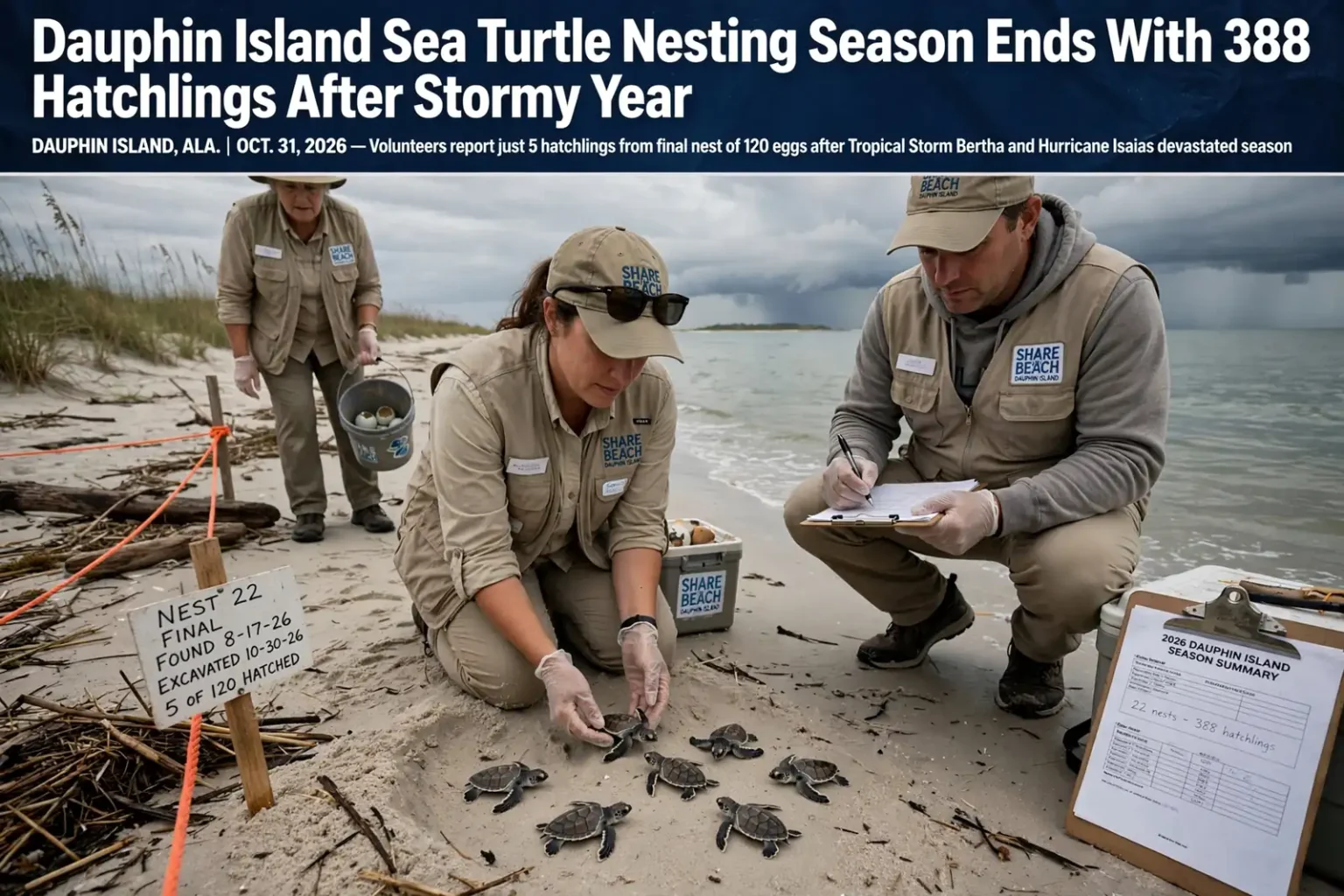
DAUPHIN ISLAND, Ala. — The 2026 sea turtle nesting season on Dauphin Island has come to a close, and the volunteers who spent months watching over the island’s nests are calling it a difficult year. Share the Beach – Dauphin Island reported that only 388 hatchlings made it to the water from 22 nests this season, a total shaped in large part by tropical weather that wiped out some nests before they could hatch.
The volunteer team announced the end of the season on Saturday, Oct. 31, one day after excavating the last remaining nest on the island.
A last nest with a small payoff
That final nest had a story of its own. Volunteers found it on Aug. 17, after Tropical Storm Bertha had already passed through and destroyed earlier nests. When Hurricane Isaias brushed the coast in October, the nest appeared to have come through in good shape, giving the team reason for hope.
The results were sobering. Of the 120 eggs in the nest, only five hatched. Even so, the group said it was glad those five made it out, noting that every hatchling counts for a species that faces long odds from the moment it leaves the egg.
The group described 2026 as a rough season but said setbacks like this are part of nature, and that they are exactly why the work of protecting sea turtles remains so important. Share the Beach – Dauphin Island thanked residents and visitors for doing their part and supporting the effort throughout the year.
The season by the numbers
- Nests that produced hatchlings reaching the water: 22
- Hatchlings that reached the water: 388
- Final nest: Found Aug. 17, excavated Oct. 30
- Final nest results: 5 hatchlings from 120 eggs
- Storms that affected the season: Tropical Storm Bertha and Hurricane Isaias
How storms take a toll on nests
Sea turtle nests are especially vulnerable to tropical weather. Female turtles bury their eggs in the dry sand above the normal high-tide line, but storm surge, heavy surf and prolonged high water can wash over a nest, scour away the sand covering it, or leave the eggs soaked in saltwater for too long. Eggs that are flooded or uncovered often fail to develop.
Dauphin Island’s low-lying west end is particularly exposed. When Hurricane Isaias approached the Gulf Coast in early October, the island saw saltwater flooding, mostly on the west end, along with sand washed over side streets and Bienville Boulevard. Isaias made landfall the night of Oct. 9 near Destin, Fla., as a Category 2 storm, far enough east that Dauphin Island was spared the worst of the damage. That track may help explain why the season’s last nest appeared to survive the storm intact.
Even when a nest is not washed away, a storm can affect what happens inside it. Temperature and moisture in the sand play a major role in how embryos develop, and a nest that looks fine on the surface can still produce few hatchlings.
Why volunteers excavate nests
Excavation is the final step in monitoring a nest. After hatchlings emerge, or after enough time has passed that they should have, trained volunteers carefully dig into the nest to count hatched eggshells, unhatched eggs and any hatchlings still inside. Stragglers that are healthy enough are allowed to make their way to the Gulf.
Those counts are what allow a team to report exactly how many hatchlings reached the water and how successful each nest was. Over many years, the data help biologists understand how nesting populations are faring along the Alabama coast and how threats such as storms, lighting and beach disturbance affect them.
Incubation for sea turtles on Dauphin Island typically runs between about 55 and 75 days, though weather can speed it up or slow it down. Volunteers begin checking nests around day 55 and stand by when a hatch appears close so they can help make sure the hatchlings reach the water safely. A nest found in mid-August and excavated at the end of October fits a long, weather-affected incubation.
Who nests on Dauphin Island
Loggerhead sea turtles are the most common nesters on Dauphin Island. Kemp’s ridley and green sea turtles also nest on the island’s beaches on occasion. All three species are protected under the federal Endangered Species Act: Kemp’s ridleys are listed as endangered, while the loggerheads and green turtles that nest in this region are listed as threatened.
A sea turtle nest holds about 110 eggs on average, roughly the size and shape of ping-pong balls, which makes the final nest’s 120 eggs a fairly typical clutch. Only a small share of hatchlings survive to adulthood, which is one reason conservation groups put so much effort into giving each nest the best possible chance.
Once a female lays her eggs and covers them, she returns to the water and does not come back to tend the nest. Females are known to return as adults to nest on the same general stretch of coast where they hatched.
About Share the Beach
Share the Beach is Alabama’s volunteer sea turtle conservation program, coordinated by the Alabama Coastal Foundation and working within federal sea turtle recovery guidelines alongside the U.S. Fish and Wildlife Service. Volunteer teams monitor beaches from Dauphin Island to Fort Morgan, Gulf Shores and Orange Beach.
On Dauphin Island, volunteers patrol the beaches every morning at daybreak beginning May 1. Patrols are divided into half-mile sections, and the island’s west end is covered by utility vehicle. Volunteers look for crawls, the distinctive flipper tracks a female leaves as she climbs the beach, lays her eggs and returns to the water. When a nest is found, the area is roped off and marked. Nests in danger of being reached by the tide may be relocated by trained volunteers.
Daily nesting patrols typically end Aug. 31, but volunteers continue monitoring remaining nests through Oct. 31, the official close of the season. This year’s final excavation came right at the end of that window.
How the public can help
The off-season is a good time for beachgoers and property owners to learn how to help when nesting resumes next spring. Wildlife officials and volunteers recommend:
- Keep the beach dark at night. Hatchlings use the natural light of the night sky over the water to find their way to the Gulf. Bright lights from homes, condos and flashlights can draw them the wrong way. Turtle-friendly lighting and red-filtered flashlights help.
- Fill in holes and knock down sandcastles. Holes can trap nesting females and hatchlings alike.
- Remove beach gear at the end of the day. Chairs, tents and toys left overnight can block a turtle’s path.
- Give marked nests plenty of room. Never disturb a roped-off nest, eggs or hatchlings.
- Cut down on litter and plastics. Trash in the water and on the sand threatens turtles and other marine life.
Anyone who sees a sea turtle on the beach, a possible crawl, or a sick, injured or hooked turtle should call 1-866-SEA-TURTLE (1-866-732-8878). In October, a loggerhead and a green sea turtle that had been hooked at a Gulf Shores fishing pier were released from Dauphin Island’s west end after rehabilitation, a reminder that the hotline works year-round, not just during nesting season.
Looking ahead to 2027
With the last nest excavated, the Dauphin Island team will turn its attention to the next season, which begins with the return of morning patrols on May 1, 2027. In the meantime, the group plans to keep sharing articles and information about sea turtles with its followers.
People interested in volunteering with Share the Beach can find information about training and team opportunities through the Alabama Coastal Foundation, which typically holds volunteer training ahead of each nesting season.
For a team that watched storms erase nests and then saw a single surviving nest yield just five hatchlings, the message heading into the off-season is a simple one: every turtle that reaches the water matters, and next year is another chance.