Oyster Shell Recycling Program Turns 10, Credited With Restoring 120 Acres of Alabama Reef
The Alabama Oyster Shell Recycling Program marked its 10th anniversary in Spanish Fort, with about 30 restaurants returning shells to the water and roughly 120 acres of reef restored.
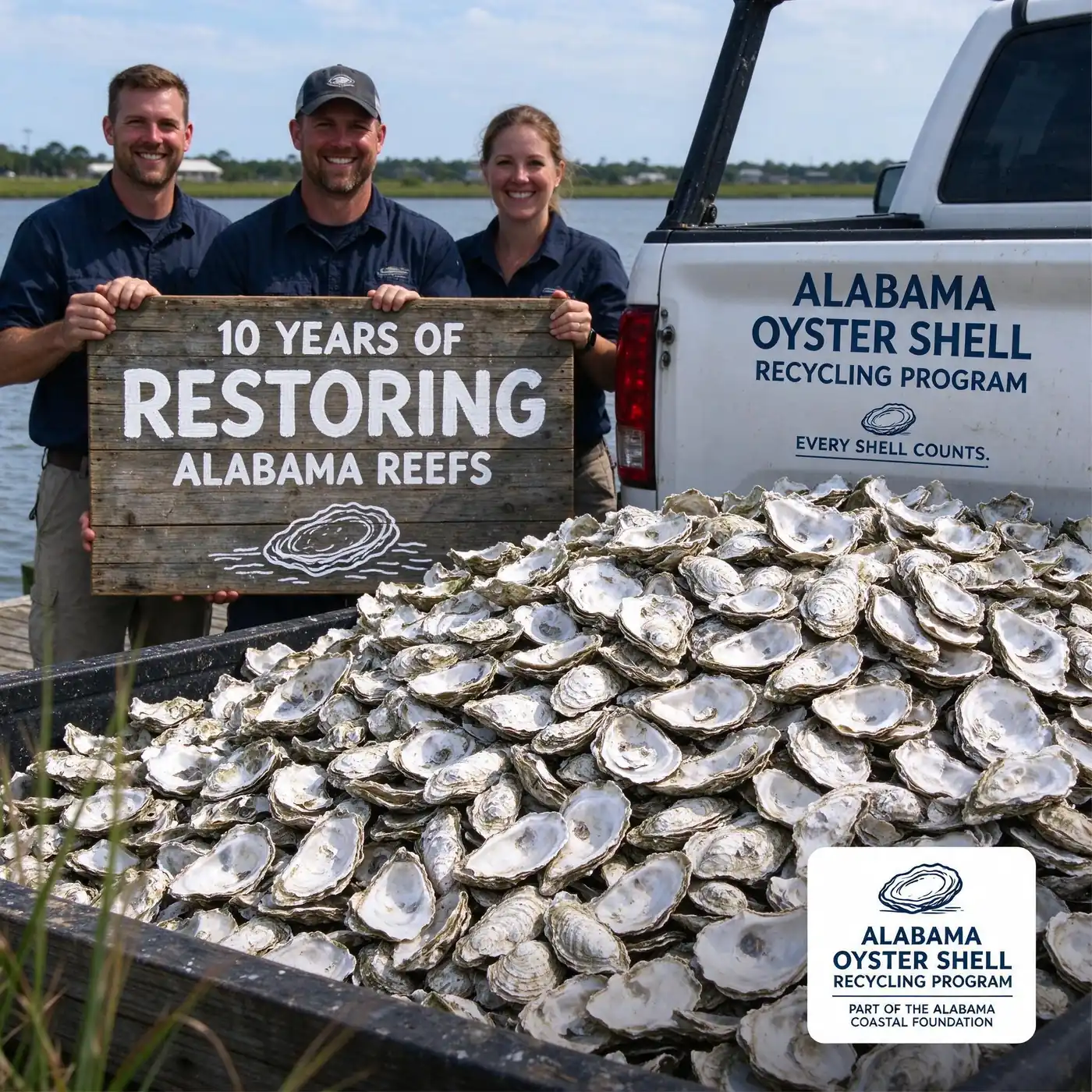
SPANISH FORT, Ala. — A decade ago, the empty shells left on platters at Alabama oyster bars usually ended up in a landfill. Today, thousands of them are headed back to the bottom of Mobile Bay, and the Alabama Oyster Shell Recycling Program says that work has now helped restore about 120 acres of oyster reef.
The program marked its 10th anniversary Friday, Oct. 30, with a 10 a.m. celebration on the Alabama Oyster Trail at the Alabama Wildlife Federation Delta and Bay Conservation Center at 5 Rivers in Spanish Fort. Organizers framed the milestone as more than a conservation success. They described it as a communitywide commitment to protecting the Gulf Coast reefs that support local fishermen, seafood businesses and a way of life that stretches back generations along the Alabama coast.
“So the great news is that we have about 120 acres worth of oyster reefs that we’ve helped to restore. And we hope to continue to do that every single time. Every shell counts,” said Mark Berte, executive director of the Alabama Coastal Foundation, which runs the program.
From the landfill back to the bay
The idea behind the program is simple. Restaurants that serve oysters on the half shell generate a steady stream of empty shells, and before the program began, most of them paid to have those shells hauled to the landfill along with the rest of their trash.
“That program works with restaurants that sell oysters on the half shell that used to throw those away and pay somebody to take them to a landfill. Now they basically recycle those shells so we can get them back into the Alabama waters to help more oysters grow,” Berte said.
About 30 restaurants now take part, from Birmingham to the Gulf Coast, according to the foundation. Instead of tossing their shells, participating restaurants set them aside for collection. The shells are then gathered and allowed to season, or cure, in the open before they go back into the water. That curing period helps ensure the shells are clean and safe to return to the bay, where they become the foundation for new reef.
For the restaurants, the arrangement also removes a cost. Rather than paying to dump heavy loads of shell, they hand them off to a program that puts them to work.
Why oysters need old shells
Oyster shell is not just waste; it is the material reefs are built from. When oysters spawn, their free-swimming larvae drift in the water for a period before they settle and attach to a hard surface for the rest of their lives. The best surface for that settlement is other oyster shell. Once attached, the young oysters, known as spat, grow into adults that eventually spawn themselves, and over time the clustered shells build up into a reef.
“This program, with oyster shell recycling, allows us to collect those oysters from the restaurants and put them back out so when the oysters spawn in the spat or the baby oysters, they have a place to settle on, to grow,” said Chris Blankenship, former commissioner of the Alabama Department of Conservation and Natural Resources.
Removing shell from the water through harvest, without putting any back, gradually leaves fewer places for young oysters to take hold. Recycling closes that loop by returning shell to the bay bottom instead of burying it on land.
A keystone species for the coast
Scientists consider oysters a keystone species, meaning the rest of the coastal ecosystem depends heavily on them. Oyster reefs filter water as the animals feed, provide shelter and habitat for fish, crabs, shrimp and other marine life, and support the commercial and recreational fishing and tourism that drive much of the coastal economy.
“As a keystone species, the oysters and the reefs that they create, if we don’t have those, the rest of the ecosystem will not function wisely,” said P.J. Waters with Auburn University.
Reefs also offer some protection to shorelines by breaking up wave energy, and the many small creatures that live among the shells become food for larger fish that anglers target. For a region whose identity is closely tied to seafood, healthy reefs underpin everything from a dozen raw on the half shell to the charter fishing trips that bring visitors to the coast.
Business and the environment working together
The Alabama Coastal Foundation, a nonprofit dedicated to improving and protecting Alabama’s coastal environment, said the anniversary shows that conservation and commerce do not have to be at odds.
“The 10-year milestone demonstrates Alabama Coastal Foundation’s (ACF) sustainable model that protects our seafood industry and proves that business success and environmental stewardship work hand in hand,” the foundation said.
The program relies on cooperation among many groups: restaurants that change how they handle their waste, crews that collect and cure the shell, scientists who study where reef restoration will do the most good and state agencies that manage Alabama’s public oyster reefs. Diners play a part too, simply by choosing to eat oysters at participating restaurants.
A timely milestone as oyster season opens
The anniversary arrives just days before Alabama’s wild oyster season opens Monday, Nov. 2. This year’s season is limited to three harvest areas, the Cedar Point East, Cedar Point West and Heron Bay grids, because state surveys show oyster populations on public reefs remain low. Read more about this year’s season and harvest rules.
State marine biologists have tied the long decline to a series of environmental stresses since the early 2000s, including extended droughts, heavy flooding in the Mobile Bay watershed and extreme summer heat. Those conditions make it harder for reefs to recover on their own, which is part of why returning shell to the water matters. Every bushel of recycled shell adds hard surface where new oysters can settle once conditions allow.
At the same time, oyster farming has grown along the Alabama coast in recent years, giving restaurants another source of local oysters. Whether the oysters on a platter come from a wild reef or a farm, the shells left behind can still be recycled and returned to the bay.
How residents can help
The program’s leaders stress that the effort only works when shells make it back to the water. Residents and visitors who want to support reef restoration can:
- Choose restaurants that participate in the Alabama Oyster Shell Recycling Program when ordering oysters.
- Ask their favorite oyster bar whether it recycles its shells, and encourage it to join if it does not.
- Learn more about the program and other coastal conservation efforts through the Alabama Coastal Foundation.
- Follow state harvest rules during oyster season, including size limits that leave smaller oysters on the reef to grow and spawn.
Raw, smoked, fried or stewed, every oyster starts in a shell. After 10 years, the program’s message remains the same one Berte repeated at the anniversary: every shell counts.