
Chickasaw Civic Theatre Stages Come From Away as the Nation Marks 25 Years Since 9/11
Chickasaw Civic Theatre opened its production of the musical Come From Away on Thursday night, telling the true story of the air travelers stranded in Gander, Newfoundland, after the Sept. 11 attacks. The run closes Sept. 20.
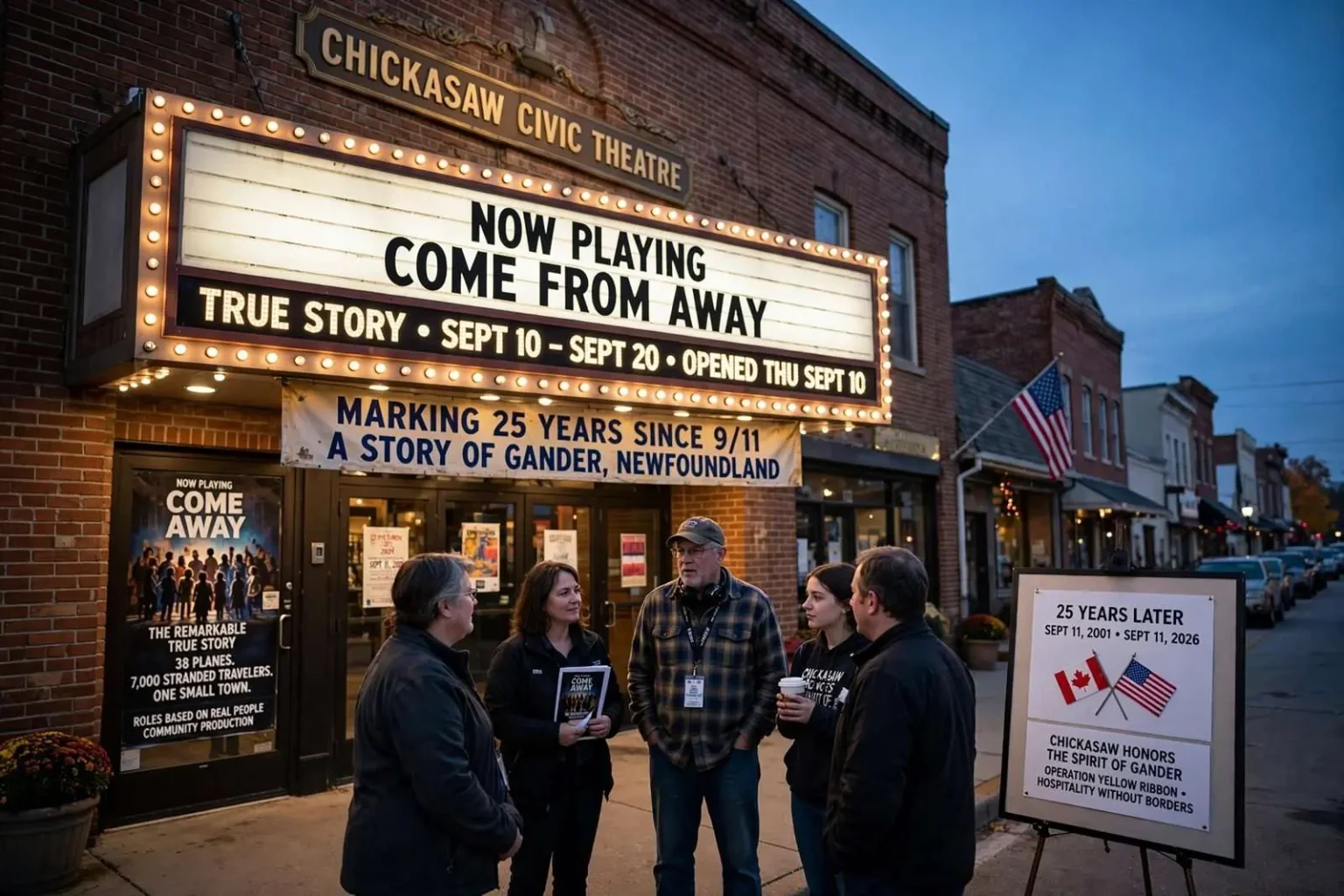
The Chickasaw Civic Theatre opened its production of the musical “Come From Away” on Thursday night, staging the true story of the airline passengers stranded far from home by the Sept. 11 attacks in the same week the country marks 25 years since that morning.
The show, which follows travelers whose planes were grounded on Sept. 11, 2001, and the community that took them in and gave them shelter, runs through Sept. 20 at the Chickasaw Civic Theatre. Every role in it is based on a real person.
“Come From Away” was nominated for seven Tony Awards, a rare level of recognition for a musical with no star vehicle, no spectacle and a subject most writers would have considered untouchable.
What ‘Come From Away’ Is About
The musical takes place almost entirely in and around Gander, Newfoundland, a town of roughly 10,000 people on the eastern edge of Canada.
When United States airspace was closed on the morning of Sept. 11, 2001, every civilian aircraft over or approaching North America had to land somewhere immediately. Transatlantic flights already out over the ocean and too far along to turn back were directed to Canadian airports, and 38 of them were sent to Gander. They carried roughly 7,000 passengers and crew members — a number that came close to doubling the town’s population overnight.
What follows in the show is not a story about the attacks themselves. It is a story about a small place absorbing a crowd it had no plan for. Residents of Gander and the surrounding communities opened schools, churches, legion halls and their own homes. They cooked, did laundry, found medications, located kosher and halal food, walked the animals that had been riding in cargo holds, and lent out phones and showers to strangers who could not tell their families where they were.
The passengers, who came to be known locally as the “plane people,” were on the ground for days. The musical follows both groups at once — the stranded and the hosts — and the roles were built from interviews with the actual people involved.
The title comes from Newfoundland vernacular. Someone who “comes from away” is an outsider, a person not from the island — a phrase that can be said warmly or coolly depending on who is saying it. Using it as the name of a show about a week when several thousand outsiders arrived all at once, and were treated as guests rather than as a burden, is the whole argument of the piece compressed into three words.
Why 38 Planes Landed in a Town of 10,000
Gander’s part in the story was not an accident of geography alone. The town has an unusually large airport for its size because Gander International was built as a transatlantic refueling stop in the era before jets could cross the Atlantic nonstop. For decades it was one of the busiest airports in the world, a mandatory fuel stop where ocean-crossing aircraft came down, took on fuel and went back up.
Jet range eventually made that role obsolete, but the runways stayed. On Sept. 11, 2001, Gander was one of the few places in northeastern North America with enough pavement, ramp space and air traffic control capacity to take dozens of wide-body aircraft at once.
The diversions were part of a broader Canadian response, coordinated under the name Operation Yellow Ribbon, that put hundreds of aircraft down at airports across Canada while U.S. airspace stayed shut. Gander took one of the heaviest loads relative to its size, and that disproportion is the engine of the story: a town that had spent half a century as a place where planes stopped briefly suddenly had to keep several thousand people for the better part of a week.
A Musical That Argued for a Different Kind of 9/11 Story
“Come From Away” was written by the Canadian team of Irene Sankoff and David Hein, who interviewed Gander residents and returning passengers and built the book, music and lyrics out of what they were told.
The result is structurally unusual. It is performed without an intermission by a small ensemble in which the same actors play both the townspeople and the passengers, switching between them in front of the audience with little more than a change of posture or a jacket. The score leans on the folk tradition of Newfoundland — fiddle, accordion, bodhran, driving rhythm — rather than on conventional Broadway orchestration.
The show reached Broadway in 2017 and drew seven Tony Award nominations, winning for Best Direction of a Musical for Christopher Ashley. Among the best-known numbers is one built around Beverley Bass, the American Airlines captain who was flying one of the diverted planes and who had been the airline’s first female captain.
What made the musical land, for most audiences, was its refusal to dramatize the attacks. The events of that morning happen offstage and largely secondhand, reported to characters who are confused, frightened and increasingly aware that something enormous has occurred that they cannot see. The show is about the response instead — about what a few thousand ordinary people in a remote town decided to do with a week they did not ask for.
Staging It in the Week of the 25th Anniversary
The timing of the Chickasaw Civic Theatre run is impossible to miss. The production opened Thursday, Sept. 10, and Friday marked 25 years since the attacks.
A quarter century is a meaningful threshold for this material. Anyone born after September 2001 has no firsthand memory of the day, which now includes every American under 25 — a group that takes in most high school and college students and a growing share of the adult working population. For that audience, Sept. 11 is history rather than recollection, and the way it gets told matters more than it did when everyone in the room remembered it themselves.
“Come From Away” is a particular kind of telling. It does not ask an audience to relive the attacks, and it does not treat the day primarily as a wound. It offers instead a story of hospitality extended without conditions to people who were, in the most literal sense, strangers off the street. That is a difficult tone to sustain about Sept. 11, and it is much of the reason the show has kept finding audiences.
Anniversary weeks along the Gulf Coast tend to fill with services, wreath layings, stair climbs and moments of silence. A musical is a different register — longer, communal, and one where the audience leaves having laughed as well as cried. Programming it for this particular week is a choice, and a defensible one.
What Community Theatre Means in a Town the Size of Chickasaw
Chickasaw is one of Mobile County’s smaller municipalities, a compact city north of Mobile that grew up around industrial and shipbuilding work along the river. It is not a place with a professional performing arts market, and it does not have the population base to support one.
What it has is a community theatre, and that distinction is worth spelling out. Community theatre is built on volunteers — people who audition after work, learn a score in evenings and weekends, build sets on Saturdays, run lights, sew costumes, sell tickets at a folding table and strike the whole thing when the run ends. Nobody involved is doing it for a living.
That model has consequences for what small towns can put on stage. A show like “Come From Away,” with its large ensemble, its rapid role-switching and its live folk-inflected band, is genuinely demanding. Taking it on is a statement about what a volunteer company believes it can do.
It also has consequences for the audience. In a town of Chickasaw’s size, the people onstage are neighbors, coworkers and members of the same congregations as the people watching. That proximity changes the experience of a show whose entire subject is a small community deciding to take care of people it did not know. The parallel is not subtle, and it does not need to be.
Small-city theatres in south Alabama also do work that is easy to overlook. They give young performers a stage before they are old enough to audition anywhere else, keep a downtown building lit and occupied on nights it would otherwise be dark, and put material in front of local audiences that would otherwise require a drive to a larger city and a considerably larger ticket.
What the Announcement Does Not Say — and Where to Get It
The information released about this production is limited, and it is worth being straightforward about the gaps.
No cast list, director or production staff were named in the announcement. No showtimes were given for the individual performances between opening night and the Sept. 20 close, and no ticket prices, box office hours or seating details were provided. Readers looking for those specifics should contact the Chickasaw Civic Theatre directly, which is also the place to confirm whether particular dates remain available.
What is known is the essential part: the production is running now, it closes Sept. 20, and it is telling the story of 38 planes, roughly 7,000 stranded travelers and a Newfoundland town that decided the right response was to open the doors.