Chickasaw Family Dollar Temporarily Closes for Deep Cleaning
The Chickasaw Family Dollar temporarily closed for a thorough sanitizing procedure, working with CDC and local health officials guidance.
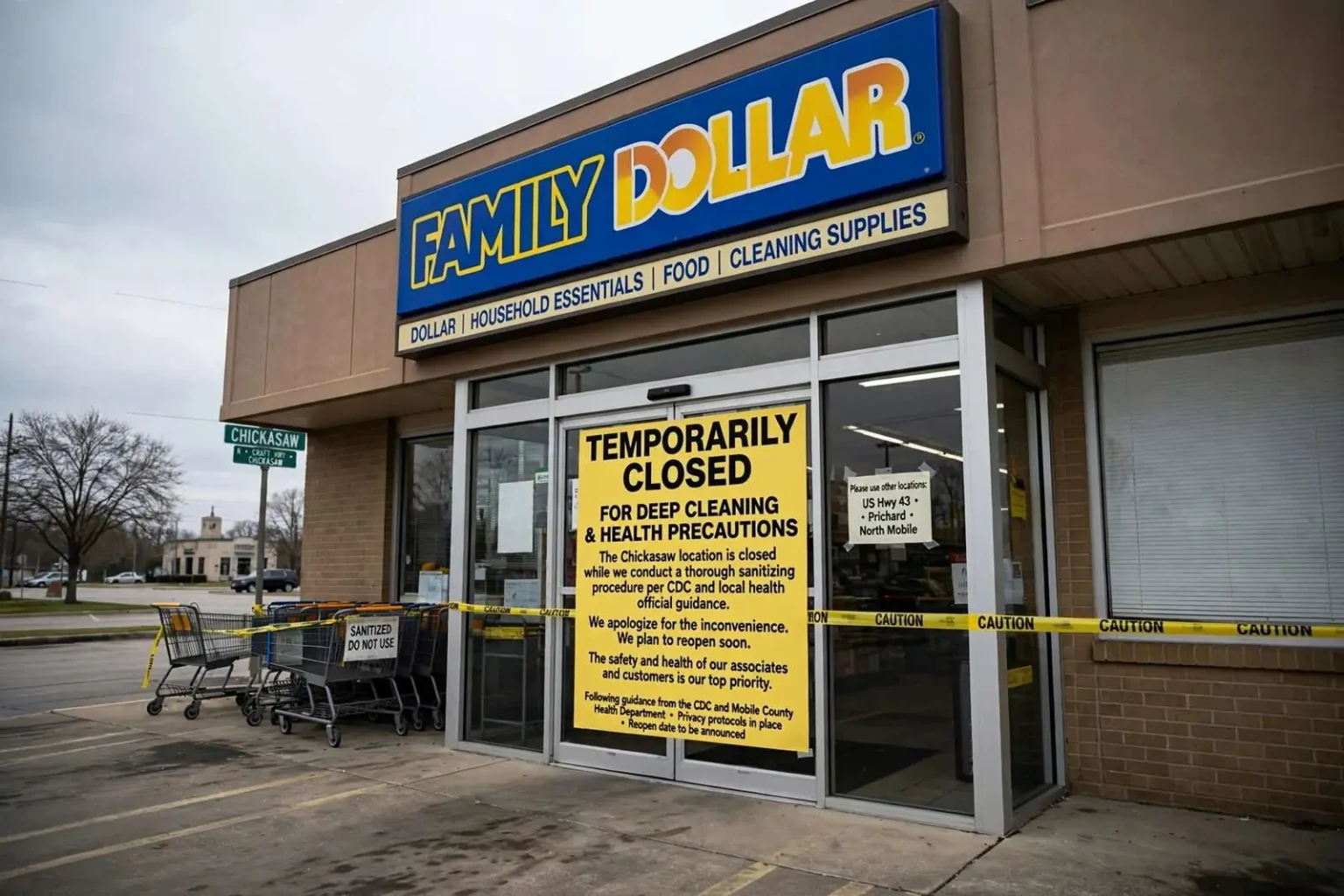
The Family Dollar in Chickasaw shut its doors Thursday, with the company citing only “health precautions” for the sudden closure. A company spokesperson said the store is undergoing a thorough sanitizing procedure and plans to reopen soon, leaving shoppers in the Chickasaw community to find alternatives while the work was completed. In a statement, the retailer said it was working closely with the Centers for Disease Control and Prevention and local health officials, and following their guidance during the cleaning process.
Family Dollar declined to elaborate on what prompted the closure, saying that “for privacy purposes” it could not share details about specific employee matters, wording that suggested the move involved store personnel, though the company did not confirm any details. “The safety and health of our associates and customers is our top priority,” the statement read. The phrasing followed the pattern retailers adopted throughout the early coronavirus period: confirm the closure, describe the cleaning, invoke privacy for anything involving employees and defer to health authorities.
The Early Days of the Pandemic on the Gulf Coast
The closure came during the early weeks of the COVID-19 pandemic, when retailers across the Gulf Coast were scrambling to sanitize stores and protect workers as cases spread through Mobile County communities like Chickasaw. Those first weeks brought a cascade of adjustments that no retailer had planned for: limits on the number of customers allowed inside at one time, empty shelves where cleaning supplies, paper products and canned goods had been, plexiglass going up at registers and hourly wipe-downs of carts, door handles and checkout counters becoming part of every shift.
Chickasaw, a small city surrounded on most sides by the city of Mobile in the county’s northern reaches, felt the disruption in ways typical of close-knit suburban communities. Its Family Dollar served as a convenient, walkable option for residents picking up groceries and household essentials, and its sudden closure meant a longer trip to neighboring stores at a moment when many residents were trying to minimize outings altogether. Across Mobile County in those weeks, residents lined up outside stores before opening, older shoppers were given dedicated early hours, and every closure, however brief, was noticed.
Deep Cleaning as Protocol
The “thorough sanitizing procedure” Family Dollar described was by then a familiar industry response when an employee or customer with the virus was suspected or confirmed in a store. Deep cleaning protocols called for closing the location, disinfecting high-touch surfaces throughout the building, treating the sales floor, stockroom and checkout areas with EPA-approved products and allowing appropriate contact time before reopening. The big-box chains and discount retailers adopted versions of the same playbook, guided by CDC recommendations for community and retail settings.
The speed of such closures sometimes caught communities off guard, with stores closing overnight or mid-day once the company learned of a potential exposure. Retail workers were on the front lines of the pandemic from the start, interacting with hundreds of customers per shift in a period when little was known about how the virus spread, before vaccines existed and while testing was scarce. The privacy language Family Dollar used reflected both legal constraints around employee medical information and a corporate instinct to avoid confirming the presence of the virus at a specific address.
The retailer’s statement that it was working with the CDC and local health officials aligned with how corporate chains handled suspected exposures in the pandemic’s first months. Health departments were advising businesses to close affected areas, disinfect and screen employees for symptoms, and companies operating thousands of stores nationwide standardized their responses so that individual store managers had clear procedures to follow. For a discount chain like Family Dollar, whose stores are embedded in neighborhoods and serve essential everyday needs, keeping locations open safely was both a public health matter and a core part of the company’s role during the emergency.
Family Dollar stores in communities like Chickasaw carry an outsized share of essential shopping. The chain’s discount model, low prices on food, household goods, cleaning supplies and personal items, serves customers who rely on it for weekly needs rather than occasional trips, and in a small city with limited retail options the local store functions almost as a neighborhood grocery. That role became more visible during the pandemic, when families managing job disruptions and school closures leaned harder on nearby discount stores to stretch household budgets.
What the Wording Revealed
The company’s choice to cite “specific employee matters” while refusing to confirm details told residents most of what they needed to know without violating anyone’s privacy. Businesses during the pandemic walked a narrow line: workers and customers wanted to know whether they had been exposed, while health privacy rules and employment law limited what could be said about an individual’s medical status. The standard resolution was to close, clean, reopen and let the health department handle any contact tracing, which is the course Family Dollar’s statement described.
Local health officials in Mobile County were coordinating with businesses throughout that period, providing guidance on cleaning standards, advising on when employees should quarantine and tracking cases as testing capacity slowly expanded. The early weeks of the pandemic were marked by genuine uncertainty, recommendations shifted as understanding of the virus developed, and businesses that closed for cleaning one week were adjusting mask policies and occupancy limits the next. The Chickasaw closure was one small instance of that larger, evolving response.
The Community Impact of a Closed Store
For the days the Chickasaw store was dark, residents diverted to other locations along the nearby commercial corridors, U.S. Highway 43 and the streets that connect Chickasaw to Prichard and north Mobile. Those detours added time to errands that families were already trying to consolidate to reduce exposure, and for residents without cars the closure was more than an inconvenience, since the walkable local store is precisely what makes it essential to a small community. The episode underlined how much everyday retail infrastructure matters during a public health emergency.
The store’s expected reopening, following the sanitizing procedure, would return that access, presumably with the new normal in place: masks on staff and customers, occupancy limits, sanitizing stations and the other measures stores adopted nationwide in spring 2020. For Chickasaw, the closure and cleaning were a brief disruption within a much longer disruption, one chapter in the pandemic period that reshaped shopping, work and daily routine across Mobile County and the Gulf Coast. The company’s closing words in the statement, that the safety and health of associates and customers is the top priority, were the same ones being posted in store windows across the country that week, and in Chickasaw as elsewhere, residents watched for the doors to open again.
Discount retail chains played a distinctive role in the pandemic’s early weeks, one that deserves a closer look. Unlike restaurants and entertainment venues, which closed entirely, and unlike large grocery chains with robust supply chains, dollar-format stores stayed open as essential businesses while absorbing enormous new demand. Their customers disproportionately included essential workers, hourly employees and seniors, the very populations at highest risk, and their stores absorbed the panic-buying surge that emptied shelves of cleaning products and shelf-stable food. A single store’s temporary closure, therefore, rippled outward in a way it might not have in calmer times.
The sanitization protocols the chains deployed were adapted from existing food-safety and biohazard practices, scaled up to full-store treatments. Crews used disinfectants on the EPA’s registered list, paid particular attention to point-of-sale terminals, refrigeration handles, shopping carts and restrooms, and documented the work so reopening could be certified against company and health guidelines. Employees returning after a deep cleaning typically faced new screening questions about symptoms, and stores began logging staff temperatures in some chains as the weeks went on.
Chickasaw’s Place in Mobile County
Chickasaw itself is a community with a distinct identity within Mobile County. Incorporated as a city in its own right, with its own city hall, police department and schools, it retains a small-town character despite being hemmed in by its larger neighbor. Its commercial base is modest, and neighborhood-oriented stores like the local Family Dollar serve a resident population that values proximity. During the pandemic, small cities like Chickasaw also navigated their own emergency proclamations alongside the county’s and the state’s, adding layers of local decision-making about parks, meetings and public buildings.
The pandemic period tested communities like this one in familiar ways: residents who commuted to jobs in Mobile faced changing workplace rules, seniors in the community, among the most vulnerable to the virus, relied on neighbors and family for errands, and the schools closed for in-person instruction in the spring of 2020, upending routines for families across the city. A retail closure for health precautions fit into that broader pattern of adjustment, noticed by everyone but understood by few in detail, precisely because the privacy constraints worked as intended.
Lessons From the First Wave
Looking back on closures like the one in Chickasaw, public health observers have noted both what worked and what fell short. The deep-cleaning approach gave businesses a concrete, visible action to take, and it reassured customers enough to keep the retail system functioning. On the other hand, the emphasis on surface disinfection, understandable at the time, later proved less central than ventilation and airborne transmission, which were underappreciated in the early weeks. The privacy protections for affected employees were legally sound, but they left customers to guess at their own exposure risk, a tension that recurred at businesses nationwide.
What the episode preserved, in the end, was continuity: the store reopened, as the company planned, and residents regained their nearby source of affordable essentials. That continuity was the quiet achievement of the early pandemic’s retail response. Stores closed briefly when precautions required it, cleaned thoroughly, reopened and kept serving, and communities like Chickasaw passed through the disruption with their neighborhood infrastructure intact. The “health precautions” that closed the doors on a Thursday were, within the logic of that spring, exactly the measures residents were asking their local businesses to take.
A Snapshot of an Unusual Season
The Chickasaw Family Dollar closure stands as a small, precise snapshot of an extraordinary period: a Thursday in the early weeks of a global pandemic, a discount store closed for sanitizing, a corporation citing privacy and health guidance, and a small city adjusting its shopping habits accordingly. None of the larger story, the case counts, the supply chains, the school closures, is visible in the statement the company issued, but all of it stands behind the phrase “health precautions.” For the residents of Chickasaw, the event was one more piece of the new normal, handled with patience, detours to other stores, and attention to the next announcement about when the doors would open again.