Chickasaw Lifts Citywide Curfew Effective Immediately, Police Confirm
Chickasaw Police Captain Tommy McDuffie confirms the Mobile County city's curfew has been lifted effective immediately as of Saturday.
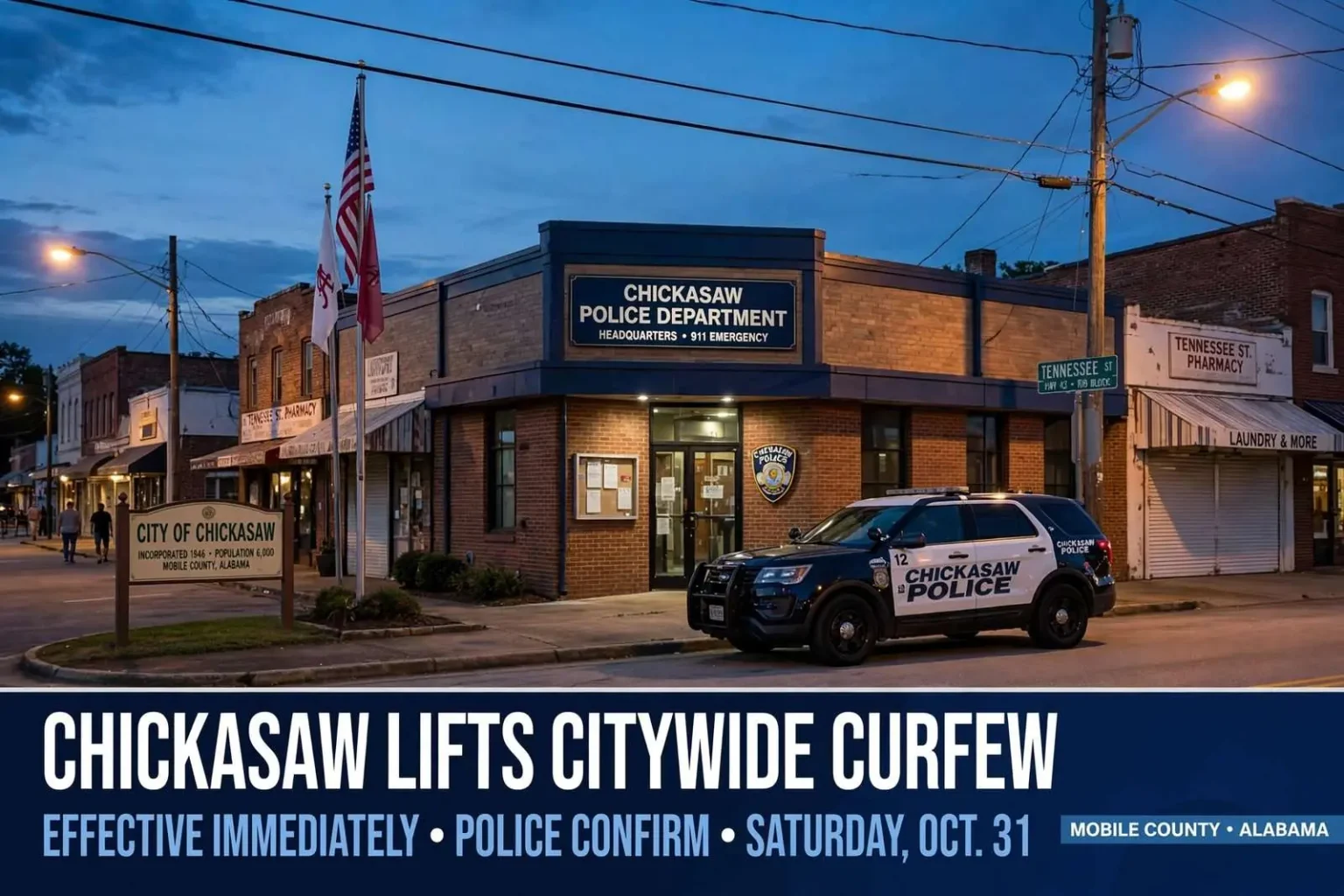
The city of Chickasaw has lifted its curfew effective immediately, according to Captain Tommy McDuffie of the Chickasaw Police Department. The announcement, made Saturday, Oct. 31, ends the nighttime movement restrictions that had been in place in the small Mobile County city. Residents are now free to move about without curfew limits.
The lifting of the order came without a detailed public explanation. Officials did not detail what prompted the original order or the specific conditions behind lifting it, leaving residents to learn of the change through the police department’s announcement. What matters practically for the city’s residents is simple: the overnight restrictions that had governed movement in Chickasaw no longer apply, and normal comings and goings have resumed.
What the Curfew Meant
Curfews of the kind Chickasaw had in place typically restrict overnight travel — setting hours after which residents may not be on streets, sidewalks or other public places except for specific purposes. The standard exceptions cover work commutes for those with jobs during curfew hours, medical emergencies and necessary travel, and often include allowances for travel to and from work with documentation. Enforcement generally falls to patrol officers, who may stop, question and in some cases cite or detain people found in violation.
For a city the size of Chickasaw, a curfew is a significant imposition on daily life. Evening routines shift, businesses close early or lose late customers, and residents who work night shifts carry proof of their routes. That burden is precisely why municipal officials treat curfews as extraordinary tools, adopted for defined situations rather than kept in place indefinitely — and why their lifting is announced as quickly as their imposition.
Chickasaw police confirmed residents are now free to move about without curfew limits, ending the restrictions that had shaped evenings in the city. The department’s announcement carried the practical news without commentary, and no further conditions or phased relaxation were described.
Curfews as a Municipal Tool
Curfews have been a tool Chickasaw and other Mobile County municipalities have used in recent years to combat spikes in crime or respond to emergencies. In public-safety contexts, a curfew aims to reduce the overnight activity — gatherings, cruising, opportunistic crime — that can drive violence or property offenses in a concentrated area, giving police a lawful basis to clear streets during the hours when problems have been occurring.
In emergency contexts, curfews serve a different purpose. After storms or other disasters, they help keep residents off damaged streets, protect property in evacuated or powerless neighborhoods and simplify security operations while utilities and services are restored. Mobile County communities have experienced both kinds of situations in recent years, from crime surges that prompted municipal responses to hurricane seasons that brought overnight restrictions to parts of the region.
The legality and structure of municipal curfews in Alabama rest on the powers cities have to protect public health, safety and welfare. When a city council or authorized officials impose one, the order typically specifies the hours covered, the exceptions allowed and the duration — often with renewals as conditions warrant. Lifting the order, as Chickasaw has now done, is the formal end of that structure.
About Chickasaw
Chickasaw is a small city in Mobile County, bordered by Prichard, Saraland and the Mobile city limits, with a population of roughly 6,000 residents. Incorporated as a city in 1946, it grew up around the industrial corridor along U.S. Highway 43 and the Tennessee Street district, and it retains a compact, small-town character despite sitting within the Mobile metropolitan area. The city operates its own police department, which handles law enforcement for the community and serves as the primary point of public-safety communication for residents.
Because Chickasaw sits between larger municipalities, its streets carry both local traffic and through-travelers moving between Mobile and the northern suburbs. The city’s commercial corridors and residential neighborhoods are within a short distance of one another, which is characteristic of the older, established communities along the Highway 43 corridor. City government in Chickasaw has historically emphasized close communication with residents, and police announcements — such as the one lifting the curfew — are among the most direct channels the city uses to reach the public.
The Chickasaw Police Department is headquartered in the city and provides patrol, investigations and community policing services. Departments of this size rely heavily on residents’ cooperation — reporting suspicious activity, complying with emergency orders and staying informed — which is why public-safety notices carry weight in a community of this scale.
What Residents Should Know Now
With the curfew lifted, residents can resume normal evening and overnight activity without restriction. For those who had adjusted schedules — workers with night shifts, families planning evening events, businesses with late hours — the announcement restores the routine that preceded the order. Any special conditions that might remain in place were not detailed in the announcement, and residents with questions about the change can contact Chickasaw Police Department headquarters for current information on any remaining restrictions.
Police departments typically recommend that residents confirm the status of emergency orders rather than rely on secondhand information, particularly when orders change quickly. In Chickasaw’s case, the department’s own announcement is the authoritative word: the curfew is lifted, effective immediately, as of Saturday, Oct. 31.
For neighboring communities and Mobile County residents who travel through Chickasaw, the lifting of the order removes the overnight restrictions that applied within city limits. Travelers should keep in mind that municipal orders can differ from one city to the next, and that any future orders would be announced through the affected municipality.
How Communities Respond When Orders End
The end of a curfew is often greeted with relief in a community, but it also marks a return of responsibility to residents and businesses. Overnight activity resumes, and the police department returns to normal enforcement priorities rather than curfew enforcement. For Chickasaw’s small department, that means patrol resources shift back to the routine work of covering the city’s neighborhoods and commercial corridors.
Public-safety officials generally pair the lifting of such orders with a request that residents stay engaged — continuing to report suspicious activity and looking out for neighbors. The communication channel that carried the announcement remains the same one residents should use for follow-up questions: the Chickasaw Police Department itself. Calling headquarters rather than 911 is appropriate for questions about restrictions; 911 remains reserved for emergencies and crimes in progress.
Businesses that adjusted hours under the curfew can resume their regular schedules, and community organizations that postponed evening gatherings can plan without the overnight restrictions in mind. In small cities, the cumulative effect of a curfew — even a short one — touches churches, schools, youth sports and family routines, so the restoration of normal hours is felt across community life.
Looking Ahead
Whether Chickasaw officials impose a curfew again would depend on circumstances they have not detailed, and municipalities across Mobile County retain the tool for future emergencies or public-safety situations. The recent history of curfews in the county’s cities suggests that when conditions warrant — a crime spike, a storm recovery, a public-safety emergency — orders can be adopted quickly and lifted just as quickly once officials judge the situation resolved.
For now, the message from Chickasaw police is straightforward: the curfew that had been in place is over, effective immediately, and residents are free to move about the city at all hours. Those with lingering questions about the order or any remaining restrictions are encouraged to contact the Chickasaw Police Department headquarters directly for the most current information.
Residents can also stay informed about future public-safety announcements through the department’s official channels. As with any municipal order, the department’s own statements — not rumors or secondhand accounts — are the reliable source for what rules apply and when they change. With Saturday’s announcement, Chickasaw joins the routine of a city whose streets are open around the clock once again.
The Decisions Behind Curfew Orders
When a city considers a curfew, officials weigh the restrictions against the conditions prompting them. An order strong enough to clear streets is also disruptive enough that most municipalities avoid keeping one in place longer than circumstances require. The decision to lift the order usually follows the same logic in reverse: police observe conditions, leadership assesses whether the restriction is still serving its purpose, and the order ends when that purpose is met. Chickasaw officials did not detail those internal conditions, but the effective-immediately announcement suggests the department was ready to return the city to normal operations without a transition period.
Curfew announcements in small cities also tend to travel fast. Residents hear about orders and their endings through police notices, local news coverage, social media and word of mouth, and a community the size of Chickasaw — where many residents know their neighbors and their officers — processes these changes quickly. The department’s confirmation that residents are free to move about without curfew limits settles the practical question everyone had.
Public cooperation during such orders is often what makes them short. When residents comply, report what they see and give police room to address the underlying situation, the conditions that prompted the order can ease sooner. Departments in Mobile County have generally thanked residents for that cooperation when orders end, and the pattern holds whether the order stemmed from crime-fighting or storm recovery.
Staying Informed in a Small City
Chickasaw’s experience is a reminder of how public-safety information moves in small municipalities. A single announcement from the police department is often the definitive word, and residents who miss it may hear conflicting versions from friends and social media. The department’s guidance — contact headquarters with questions about the change and any remaining restrictions — is the reliable path for anyone uncertain about what applies now that the curfew has been lifted.
Regional residents should note that emergency and public-safety orders are municipal matters: a curfew in one city does not extend to neighboring communities, and each municipality announces its own orders. Drivers and residents who move among Chickasaw, Prichard, Saraland and Mobile should check with the relevant city if they are unsure whether any order is in effect there.
With the curfew ended, Chickasaw’s evenings return to normal — storefronts and streetlights on their usual schedule, and a police department back to its regular rounds. The episode closes with the city’s small-town routine restored, and with the reminder that in communities like Chickasaw, the police department’s word remains the final authority on the rules of the road.