Child Airlifted to Hospital After Burn Injury in Irvington
A child was flown by Lifeflight to the hospital after a burn injury in Irvington. Officials could not confirm reports an alcohol can exploded.
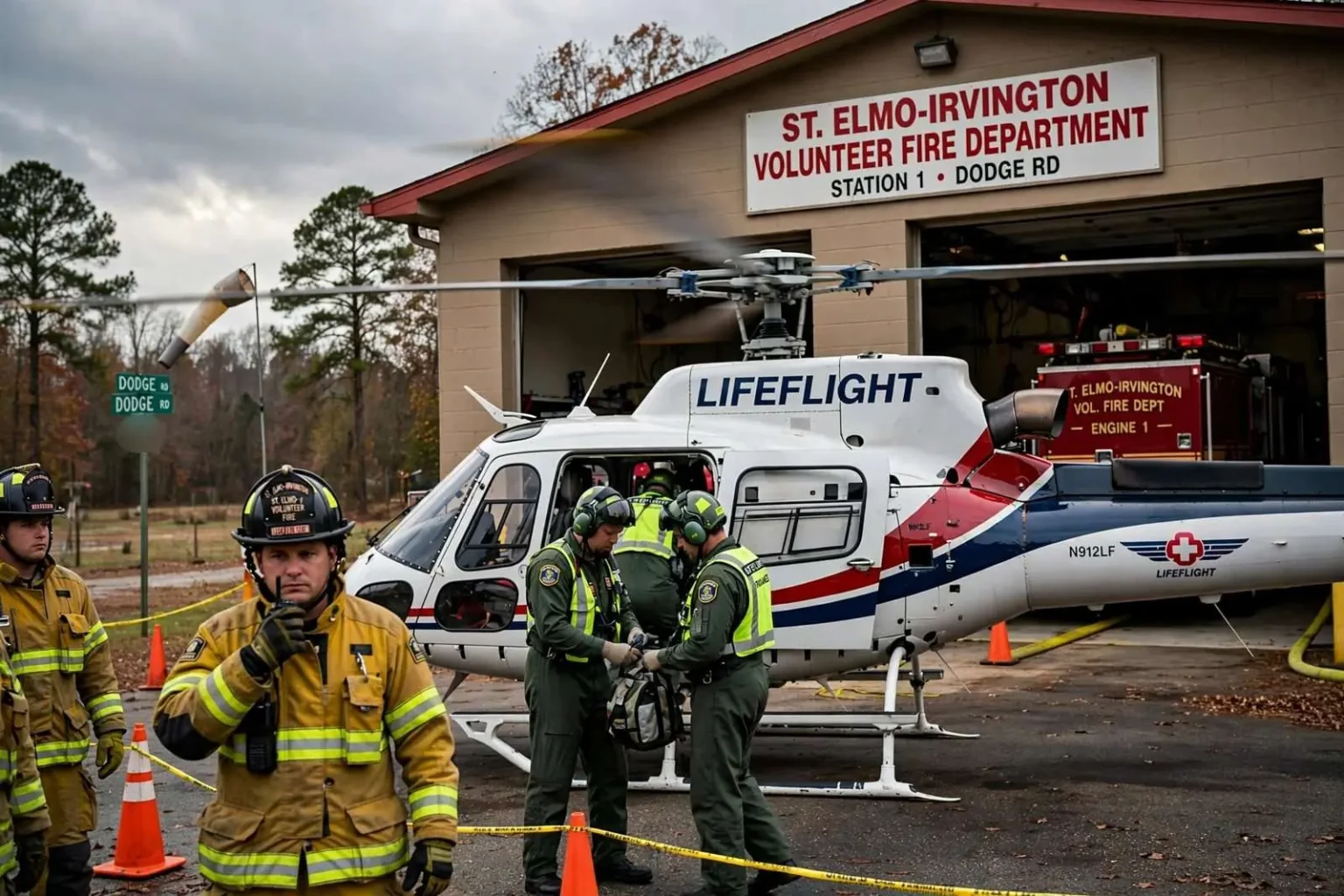
IRVINGTON, Ala. — A child was flown by medical helicopter to a hospital after suffering burns in the Irvington area of south Mobile County on the afternoon of November 3, 2018 — an emergency response that brought a helicopter to a volunteer fire station and left a small community with more questions than answers.
The St. Elmo-Irvington Volunteer Fire Department reported that the incident occurred sometime after 3 p.m. The medical helicopter — Lifeflight — landed at the fire department’s Dodge Road station to pick up the patient, turning the neighborhood station into an improvised landing zone while crews worked to get the injured child into the air as quickly as possible.
For a rural volunteer department, that kind of call exercises every part of its training at once. Firefighters established the landing zone, secured the area and managed the handoff to the flight crew, work that unfolds in minutes and depends on precise coordination between ground responders and the helicopter’s pilot and medical team. Air transport is used when minutes matter and a patient’s condition makes the ground trip to a trauma or burn center too slow or too rough.
What Officials Could — and Could Not — Confirm
An initial account from a source indicated the child was burned when a can of alcohol exploded, but officials with the volunteer fire department could not confirm those details. What they could confirm was that one person, transported by air ambulance, had been taken to the hospital for treatment of burn injuries.
The distinction between a circulating account and a confirmed one is a familiar tension in emergency response coverage. In the first hours after an incident, reports travel quickly through neighborhood social media and word of mouth, and details that sound authoritative often arrive before investigators have verified them. Fire and rescue officials are deliberately cautious in what they release, especially when the patient is a child, and they declined to endorse the explosion account.
The child’s name, age and condition were not released, and no further information about how the incident occurred was made available at the time. That restraint is standard practice when the patient is a minor; identifying details are withheld both to protect the family’s privacy and to allow investigators — including, where warranted, state and county child-protection authorities — to establish what happened before any public account hardens into fact.
Why Volunteer Fire Departments Anchor Rural Response
The St. Elmo-Irvington Volunteer Fire Department serves a stretch of south Mobile County where distances are long and professional career-staffed fire coverage is thin. Volunteer departments like it are the backbone of fire and first-response coverage across rural Mobile County, staffed by residents trained to firefighting and first-responder standards who respond from their homes and workplaces when the tones sound.
Stations like the Dodge Road facility do more than house trucks. They are pre-designated helicopter landing zones — a fact that matters enormously in time-critical medical emergencies across south Mobile County, where the drive to Mobile’s hospitals can take 30 minutes or more by ground. When Lifeflight or another medical helicopter can land at a neighborhood station, crews can transfer a patient directly from ambulance to aircraft within sight of the station doors.
Air medical transport works on a simple calculation: a helicopter cruises at well over 100 miles per hour in a straight line, cutting a 40-minute ground transport to a fraction of the time. For burn patients, that speed matters more than for almost any other category of injury. Burn care is time-sensitive in its own way — fluids, temperature control and infection prevention all begin in the first hours — and specialized burn treatment is available only at designated centers, making rapid air evacuation a routine decision when burns are severe.
Anatomy of a Medevac Call
From the moment the call reached the St. Elmo-Irvington volunteers, the sequence ran on rehearsed steps. First responders arrived to find and stabilize the patient, then requested air support — a decision made quickly when burns are serious. Communications officials notified Lifeflight, which launched from its base while ground crews selected and prepared the landing site, in this case the fire department’s own Dodge Road station.
Preparing a landing zone is its own discipline. Crews clear loose debris that could become airborne under rotor wash, mark obstacles like wires and antennas, set up a wind indicator and keep bystanders back. When the helicopter touches down, the ground crew escorts the flight medics to the patient, and the transfer of care begins — a briefing on the patient’s condition, injuries and treatment so far, followed by loading and a rapid lift-off toward the hospital.
The entire ground phase, from arrival to wheels-up, often takes less than 20 minutes. That efficiency is the quiet achievement of rural departments: without a trained local crew holding the system together, the speed advantage of air transport would never materialize.
Burn Injuries and the First Hours of Care
Burn injuries are among the most demanding emergencies a small department can face. Responders must stop the burning process, protect the wounds from contamination, manage pain and begin fluid support — all while assessing whether airway involvement makes the case even more urgent. Burns involving children draw particular caution, because a child’s skin and body surface area make even smaller burns proportionally more serious than the same injury in an adult.
The severity of a burn determines where the patient is ultimately treated. Minor burns can be managed at community hospitals; larger or deeper burns are referred to designated burn centers, where specialized teams handle wound care, fluid management and reconstruction. The Gulf Coast region’s burn capability centers on Mobile’s medical community, which serves as the referral point for serious burns from south Alabama and the surrounding areas — one reason an air transport from Irvington pointed toward Mobile’s hospitals rather than a closer community facility.
The flight itself is a mobile intensive care unit. Flight nurses and paramedics aboard medical helicopters carry ventilators, IV equipment and medications that allow them to begin hospital-level treatment before the aircraft ever lands. The handoff at the Dodge Road station marked the point where the child’s care shifted from volunteer first responders to that flight crew, and from there to the hospital’s emergency and burn teams.
South Mobile County’s Emergency Network
The Irvington area sits among the communities of south Mobile County — St. Elmo, Grand Bay, Theodore and Tillmans Corner among them — where volunteer fire departments, county sheriff’s deputies and county EMS units together form the emergency network. Incidents in one community routinely draw resources from neighbors, and mutual-aid agreements mean the nearest available unit responds regardless of jurisdiction.
That structure has been tested by everything from house fires to hurricane response, and it depends heavily on volunteers who live in the communities they serve. Departments like St. Elmo-Irvington recruit and train local residents, and their familiarity with the area’s roads, hydrants and hazards is a resource no outside agency can replicate. When a call ends with a helicopter lifting off from a neighborhood station, it is usually the product of that local knowledge layered under regional air support.
For residents, the episode was also a reminder of the risks that surround everyday items. Flammable liquids, including alcohol-based fuels and solvents commonly found in homes and garages, are a recurring source of serious burns, and safety officials across the Gulf Coast repeatedly warn against storing or handling them near flames, heaters or sparks. Investigators had not confirmed how the Irvington child’s burns occurred, but the general safety lessons apply everywhere: flammables stay sealed and stored away from heat, and children stay far from them.
What Was Known at Day’s End
By the end of the day, the confirmed picture was simple: a child in the Irvington area had suffered burns serious enough to warrant air transport, had been flown by Lifeflight from the fire department’s Dodge Road station, and had been taken to the hospital for treatment. The account of an exploding can of alcohol remained unconfirmed, and officials made clear they could not verify it.
Departments rarely issue detailed follow-ups in cases involving minors, and any findings about the cause would typically come through investigator channels rather than the initial response reports. In the absence of confirmation, the community was left with the facts of the response itself — a fast call to 911, a volunteer crew that prepared a landing zone, and a medical helicopter that carried a hurt child toward the specialized care that burns demand.
For south Mobile County, the response demonstrated the system working as designed: a rural department doing the first minutes right, and a regional air medical network closing the distance between a community station and the burn care only a major hospital can provide.