
Citronelle Crews Knock Down Pre-Dawn Blaze on Bud Odom Road; No Injuries Reported
Citronelle Fire Rescue and three volunteer departments battled a 1:30 a.m. building fire next to a home on Bud Odom Road; everyone escaped unhurt.
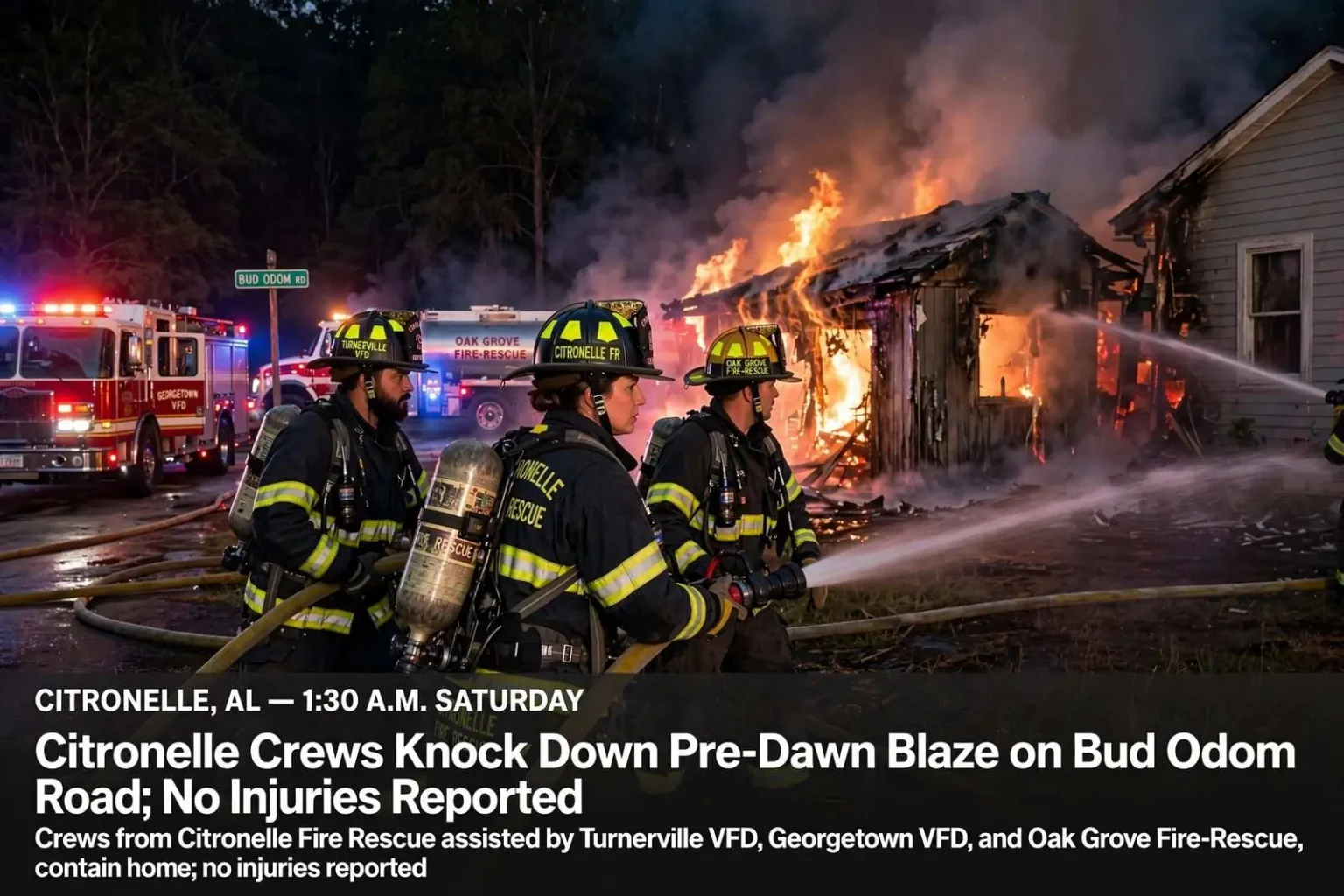
CITRONELLE, Ala. — Citronelle Fire Rescue crews responded around 1:30 a.m. Saturday to a fire at a building next to a home on Bud Odom Road, and everyone made it out unhurt. The department shared helmet-camera video of the response on Facebook, showing firefighters attacking the blaze from two sides to bring it under control. Given the size of the response, neighboring departments pitched in: crews from the Turnerville Volunteer Fire Department, Georgetown Volunteer Fire Department and Oak Grove Volunteer Fire-Rescue all assisted at the scene Saturday morning. No injuries were reported in the fire.
The early morning alarm pulled firefighters out of bed and into the dark in one of the northernmost communities in Mobile County. Citronelle sits near the Washington County line, roughly thirty minutes north of downtown Mobile, and like most small Gulf Coast cities its fire protection depends on a mix of career staff and volunteer responders who leave their homes at all hours when the tones sound. A call that comes in around 1:30 a.m. tests that system in a way daytime calls do not, because every responder arriving on the scene is doing so after being roused from sleep.
What awaited them was a fire in a building situated next to a residence on Bud Odom Road, a local road in the Citronelle area. Fires in detached buildings near homes carry a double threat: the structure burning and the structure beside it. Winds, radiant heat and burning debris can carry fire from one building to another in minutes, which is why crews attacked the blaze from two sides, a positioning that both contained the original fire and shielded the neighboring home from the spread.
The department’s helmet-camera video, posted to Facebook after the scene was brought under control, gave residents a rare first-person look at what a rural fire response actually involves. Helmet-mounted cameras have become common tools for fire departments to document their work, and the footage showed firefighters moving in low visibility, stretching hose lines and directing water onto the burning structure from separate angles. For a community that rarely sees the inside of a fire scene, the video served as both transparency and a quiet demonstration of the work volunteers do overnight while the rest of the town sleeps.
Mutual aid from three neighboring departments
The size of the response required help, and in rural Mobile County that help comes through mutual aid agreements that connect neighboring volunteer departments. Crews from the Turnerville Volunteer Fire Department, Georgetown Volunteer Fire Department and Oak Grove Volunteer Fire-Rescue all responded to the scene Saturday morning, adding water, personnel and equipment to the effort. The three departments serve communities near Citronelle in the northern reaches of the county, and their automatic or requested response to large fires is standard practice across the region.
Mutual aid exists because no single small department can staff a major fire on its own. A structure fire demands a continuous water supply, rotating crews to keep firefighters fresh, and enough personnel to run multiple hose lines while checking for extension into nearby structures. A rural department might field a handful of responders on a weekend overnight call, so agreements ensure that additional engines, tankers and firefighters arrive quickly rather than hours later. The system depends on relationships built over years of shared training and shared responses.
Water supply is the perennial challenge in rural firefighting. Areas outside municipal hydrant networks depend on tankers hauling water to the scene and portable drop tanks where engines can refill, a relay that must be sustained for as long as the fire burns. A fire attacked from two sides with multiple departments feeding the operation consumes water at a rate that only a coordinated tanker shuttle can satisfy, and the three neighboring departments that assisted provided exactly that capacity.
The outcome — everyone out unhurt and no injuries reported — reflects the combination of an early detection and response window and the manpower mutual aid provided. Fire officials routinely note that the first minutes of a fire response decide much of what follows, and a 1:30 a.m. dispatch with crews arriving and committing to an aggressive two-sided attack kept a dangerous incident from becoming a fatal one.
Firefighting in northern Mobile County
The region’s landscape shapes the risk. Northern Mobile County is a mix of small-town lots, pasture and woodland, with homes set on roads where the nearest neighboring department may be ten minutes or more away. A structure fire in such a setting grows quickly before the first engine arrives, and brush-covered land adds the threat of fire escaping into woods during dry stretches. Departments in the area train for both scenarios, and many of their members hold certifications earned through the Alabama Fire College or local training nights held after regular working hours.
Overnight structure fires are among the most dangerous calls a department answers. Darkness slows every task, from finding hydrants or draft sites to spotting collapse indicators in the burning building. Fatigue compounds the difficulty for crews who were asleep when the call came. Incident commanders on scenes like the one on Bud Odom Road must account for who is on the fireground, rotate crews through rehabilitation and track the water supply, all while the fire itself is being knocked down from multiple angles.
What the video showed
The helmet-camera footage shared by Citronelle Fire Rescue on Facebook captured the mechanics of a two-sided attack. Viewers could see firefighters advancing hose lines toward the burning structure, positioning themselves on separate exposures and directing streams into the fire. The two-sided approach serves several purposes at once: it applies water where it will do the most good, it interrupts the fire’s path toward the adjacent home, and it allows crews on either side to watch each other for hazards such as structural movement or changing smoke conditions.
Protecting exposures is a foundational priority in structure fires, and the fact that the building sat next to a home made that priority explicit from the first minutes. Fire travels toward oxygen and fuel, and a neighboring structure offers both. Crews committed lines between the burning building and the home, wetting down surfaces as needed and watching for embers that could ignite siding, decks or nearby vegetation. The social media post confirmed the result: the blaze was brought under control and the home next door was saved from the fire’s reach.
Publicizing response footage has become a familiar practice for Gulf Coast fire departments, and it fills a real need in communities where residents see the results of fire work but not the work itself. The Citronelle video gave the community a look at its own neighbors fighting a fire in the dark, and it acknowledged by name the three departments that answered the call for help — the kind of public credit that keeps mutual aid partnerships strong.
The quiet work of prevention
A fire that ends with no injuries is the outcome every department works toward, and the conditions that produced it are worth naming. The call reached crews quickly enough for an effective response. The building’s separation from the occupied home gave crews space to work. The mutual aid system delivered enough personnel to fight the fire from two sides without exhausting the first-arriving crew. Each element is the product of planning that happens long before a pager goes off at 1:30 a.m.
Fire officials across Alabama use incidents like this to reinforce basic prevention messages to rural residents: working smoke alarms in every sleeping area, clear addresses and driveways that emergency vehicles can find and enter at night, and situating detached buildings far enough from homes to give firefighters room. Rural departments also urge residents to call early rather than investigating smoke themselves, because the minutes a caller spends checking can be the minutes a fire needs to double in size.
Citronelle Fire Rescue operates in a part of Alabama where fire departments are woven tightly into community life. The city and its surrounding area are covered by a department that handles everything from house fires and brush fires to medical first responses and wreck scenes on the rural roads that thread through the longleaf pine country north of Mobile. Volunteers in departments like Turnerville, Georgetown and Oak Grove answer the same kinds of calls in their own districts, and the boundaries between them matter less than the shared mission when a fire is burning.
The investigation into the fire’s cause was not detailed in the department’s public post, which focused on the response and the departments that assisted. Cause determinations in building fires can take time, particularly when the structure is heavily damaged, and fire investigators work from burn patterns, witness accounts and the building’s condition to establish an origin.
What the community took from the night was simpler. A fire broke out next to a home on Bud Odom Road in the dark hours of Saturday morning, and the response — Citronelle Fire Rescue joined by Turnerville, Georgetown and Oak Grove — held the damage where it started and sent everyone home safe. The helmet-camera video preserved the proof, and the thanks the department extended to its neighboring departments reflected the reality that in northern Mobile County, no fire crew fights alone.


