Citronelle High School teacher, coach charged with sexual contact with student
A Citronelle High School teacher and coach faces two misdemeanor charges after a confidential informant reported an inappropriate relationship with a.
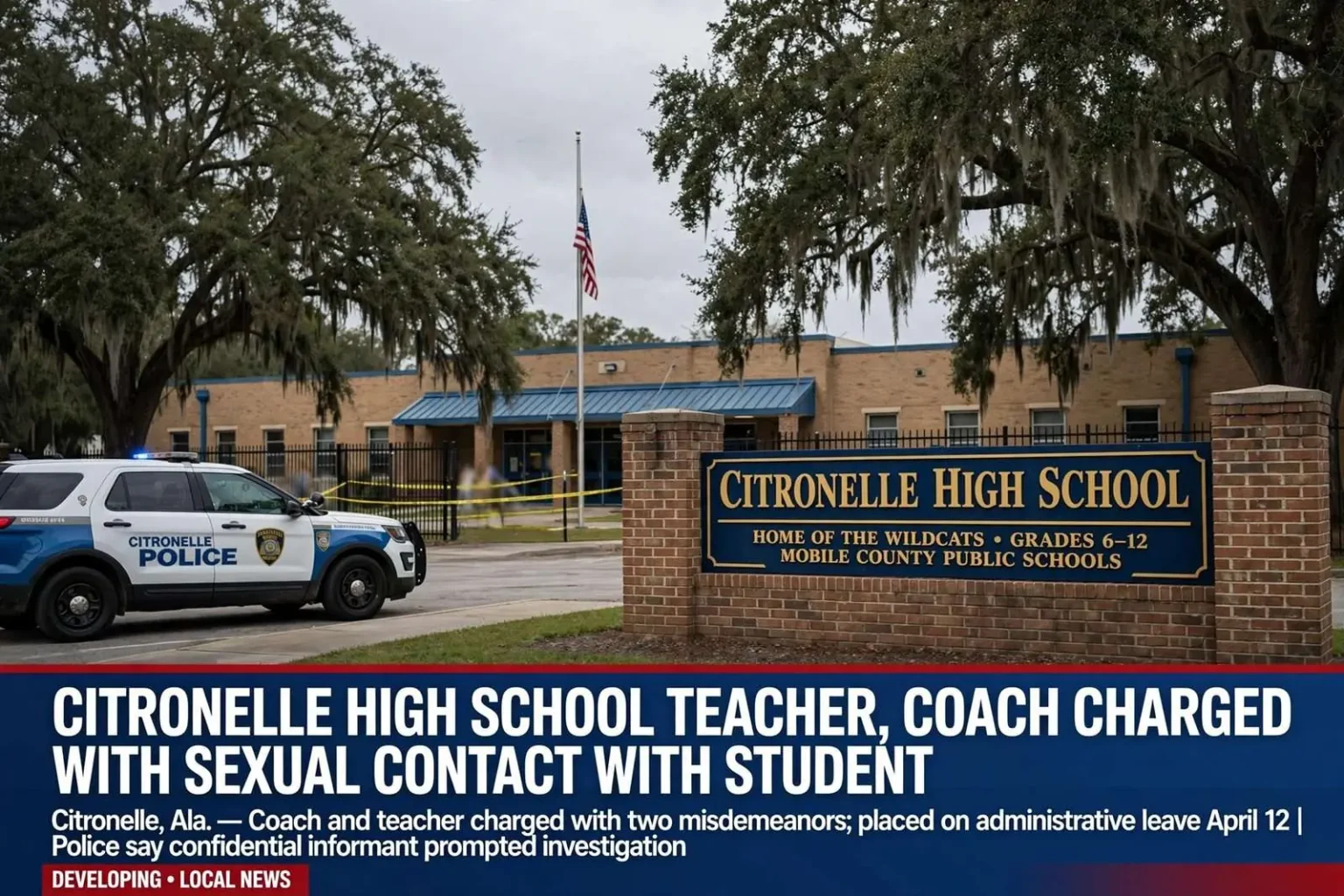
CITRONELLE, Ala. — A Citronelle High School teacher and coach has been accused of having an inappropriate sexual relationship with a student, according to police. Waylon Rowell, who also coaches at the school, faces two misdemeanor charges: sexual contact with a student and school employee distributing obscene material to a student.
The accusations came to light when a confidential informant reported the information to police earlier this month. That tip set in motion an investigation by the Citronelle Police Department, a small municipal agency that handles the law enforcement needs of the northern Mobile County city, and within days the department had gathered enough information to bring the charges against Rowell.
Citronelle Police Chief Tyler Norris said Rowell was removed from campus immediately and placed on administrative leave the morning of April 12. The swift removal reflected the standard sequence in Alabama school cases: once an allegation of misconduct involving a student reaches administrators or police, the employee is separated from students while the investigation proceeds, and the school system moves in parallel with the criminal process through its own employment procedures.
Chief Norris: “It Hits You in the Gut”
Norris said the accusation was a difficult one to investigate. “This is one of those things that kind of really hits you in the gut,” he said. “You see these kind of situations in the news all the time and you think ‘well that don’t happen here.’ Well indeed it does.”
The chief’s comments captured the particular weight such cases carry in a small city. Citronelle, with a population of roughly 3,900 people in northern Mobile County, is the kind of community where the school sits at the center of civic life — Friday football games, school board meetings, and the everyday familiarity of a town where teachers and coaches know students’ families. An allegation against a teacher and coach there is not a distant news item but something that touches neighbors, teammates, and classmates directly.
The Charges Against Rowell
Rowell faces two misdemeanor charges under Alabama law. The first, sexual contact with a student, applies when a school employee is accused of sexual contact with a student at the same school. The second, school employee distributing obscene material to a student, applies when an employee is accused of sending or giving a student obscene material — a charge that in modern cases often involves messages, images, or other content sent electronically. Both offenses exist specifically to address the authority relationship between school employees and the students in their care, regardless of a student’s age or claimed willingness.
As misdemeanors, the charges carry lighter potential penalties than felony offenses — up to a year in jail per count under Alabama’s classification system, along with fines. Prosecutors with the Mobile County District Attorney’s Office would review the police report and evidence before the case moved through Municipal Court or to a higher court depending on how the charges were filed. An arrest is not a conviction, and the charges against Rowell remained accusations as the legal process began.
How the Case Reached Police
The case began not with a report from the school or from the student’s family, but with a confidential informant who brought the information to Citronelle police earlier in the month. Confidential informants play a significant role in small-department investigations, where agencies lack the personnel to monitor situations proactively and depend on people willing to come forward. In cases involving school employees, tips frequently come from students who hear about a relationship through classmates, from parents, or from others on the margins of the situation.
Investigating an allegation against a teacher presents challenges that Chief Norris alluded to when he called it difficult. Investigators must work around the school calendar, interview students with care — typically involving parents and, where appropriate, school counselors — and handle electronic evidence such as messages between the employee and the student. The employee’s removal from campus, which happened the morning of April 12, protects students during that process, but it also signals to a small community that something serious is underway, which raises the stakes for everyone involved.
Citronelle High School and the Community It Serves
Citronelle High School serves students in grades 6 through 12 within the Mobile County Public School System, the largest school system in Alabama. The school is the focal point of the city, which sits near the Washington County line about 40 miles north of downtown Mobile. Its athletic teams compete in the Alabama High School Athletic Association, and coaching positions there carry the community visibility common to small-town Alabama, where a coach may teach classes during the day and lead the gym or the field in the afternoon — meaning that students, players, and their families all interact with the same person across multiple settings.
That overlap is one reason Alabama’s student-protection statutes draw no distinction between a teacher’s classroom role and other roles at the school. The law treats any school employee — teacher, coach, aide, or administrator — as holding authority over students, and it applies the same prohibitions regardless of which role the employee occupies. An allegation against a coach, in other words, is treated with the same seriousness as one against a classroom teacher.
What Administrative Leave Means
Being placed on administrative leave pending an investigation is a personnel action, not a determination of guilt. The Mobile County Public School System’s procedures allow the superintendent to suspend an employee with or without pay while allegations are investigated, and the outcome — reinstatement, termination, or a resignation — depends on what the investigation finds and on the employee’s rights under state tenure law. Alabama’s teacher tenure provisions give experienced teachers due-process protections that play out through hearings and, if necessary, appeals, so the employment question can take longer to resolve than the criminal case.
Separately, any certified educator facing charges of this kind falls under the review of the Alabama State Department of Education’s Office of Certification, which can suspend or revoke an educator’s certificate based on misconduct findings. A certificate action is independent of the criminal process: the state can move against a certificate even while criminal charges are pending, and a conviction is not required for the department to discipline an educator whose conduct violates the state’s educator code of ethics.
The Broader Pattern of Student-Protection Laws
The charges against Rowell fall under statutes Alabama has strengthened repeatedly since the early 2000s, when the legislature began closing gaps in the law that had treated relationships between school employees and students more leniently than the public expected. The modern framework makes it a crime for a school employee to have sexual contact with a student at the same school, and it separately criminalizes the distribution of obscene material to a student — an offense written to capture the electronic communication that so often accompanies such cases in the era of cell phones and social media.
Legislators who sponsored the earlier versions of those laws described them as responses to cases across the state in which employees avoided serious charges because the students involved were near the age of consent or because the conduct did not fit older statutory definitions. The laws now apply without regard to consent, on the theory that a student cannot meaningfully consent to a relationship with someone who grades their work, coaches their team, and holds authority over their school life.
How Small Departments Handle These Cases
For the Citronelle Police Department, a case like this one is among the most demanding it can face. Small municipal agencies in Mobile County operate with a handful of officers and limited investigative staff, and an investigation involving a school, a student, and electronic evidence requires coordination beyond the department’s own resources — with the district attorney’s office, with forensic examiners who analyze phones and accounts, and sometimes with the county school system’s own security personnel.
The department’s decision to move the employee off campus the same morning the investigation reached that stage, and the chief’s willingness to speak publicly about the case, reflected the balance small-town departments strike: proceed carefully enough to protect the rights of the accused and the privacy of the student, and move visibly enough to reassure a community that the school’s students are being protected. Norris’s acknowledgment that such cases do happen “here” — in towns that assume otherwise — was directed squarely at that second goal.
What Comes Next
As of the announcement, Rowell had been charged but the case was in its earliest stages. The misdemeanor charges would proceed through the court system, where he would have the opportunity to answer the accusations, and the presumption of innocence applied to every element of the case. The school system’s employment process, the police investigation, and the courts each move on their own track, and outcomes in one do not automatically determine outcomes in the others.
For Citronelle, the case joined the list of hard episodes small towns absorb: a trusted position under accusation, a student at the center of it, and a community relearning the lesson its police chief put into words — that the situations people see in the news are not confined to places far away. The department’s message, delivered through the charges and the chief’s comments, was that its response to such reports would be the same as any larger city’s: investigate, protect the students first, and let the courts decide.