
Citronelle Home Destroyed in Overnight Fire on Woodland Drive; No One Hurt
Citronelle Fire & Rescue found a Woodland Drive home fully ablaze around 2 a.m.; the house was a total loss but no one was injured.
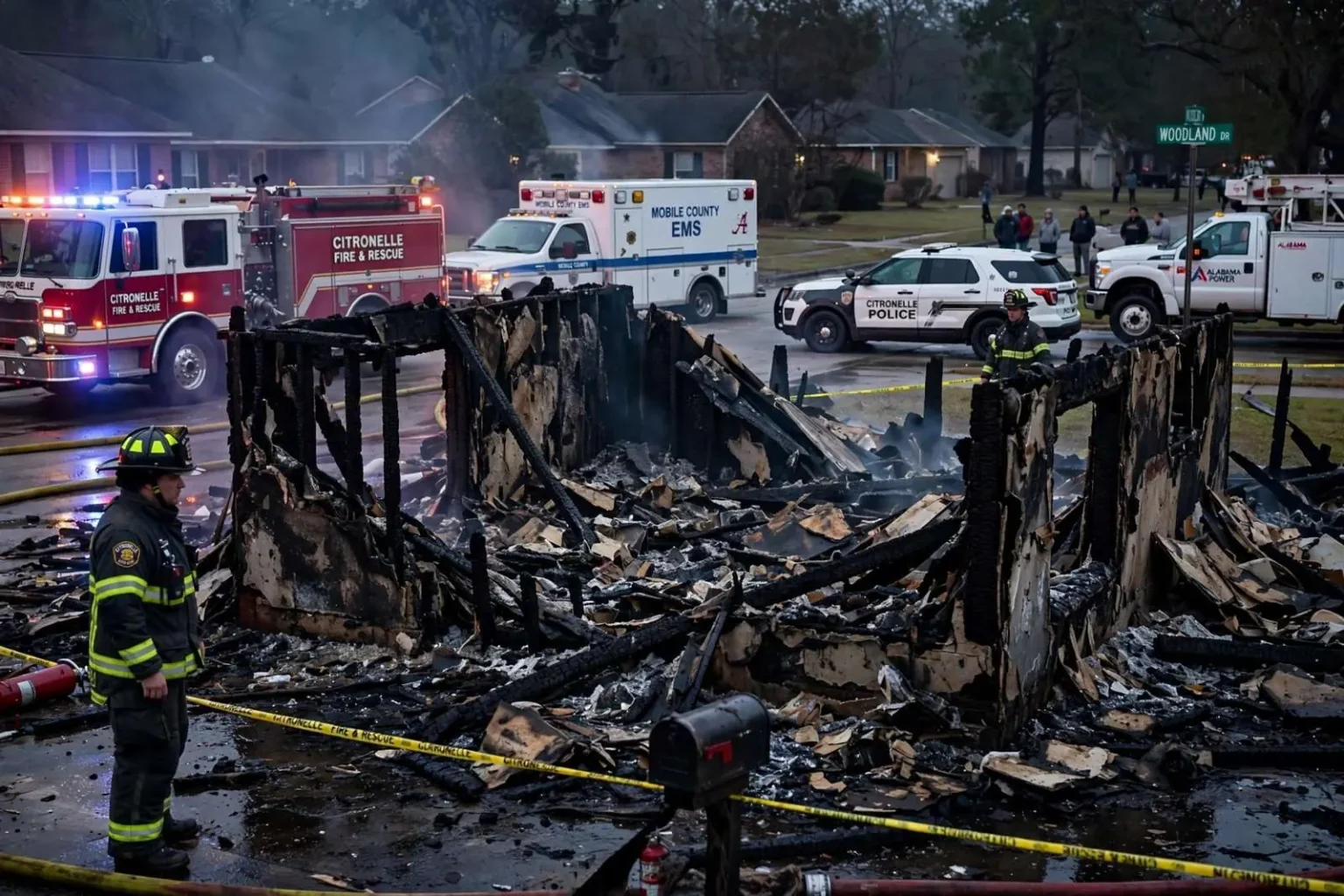
CITRONELLE, Ala. — A Citronelle home was destroyed in an overnight fire on Woodland Drive, though everyone made it out safely before the blaze consumed the structure. The pre-dawn fire left a family displaced and a north Mobile County neighborhood gathered in the street as firefighters worked through the early hours.
Citronelle Fire & Rescue crews were dispatched around 2 a.m. and arrived to find the house fully involved in flames. A fully involved structure fire — one that has spread through the home’s rooms and into the attic space before crews arrive — leaves little to be done but protect nearby exposures and knock the fire down from the outside before an interior attack becomes possible.
Despite the intensity of the blaze, no injuries were reported. The occupants’ escape before crews arrived made the difference between a house fire with no casualties and the kind of overnight blaze that too often ends in tragedy, and it stood as the central fact of an otherwise destructive morning.
The home was later declared a total loss. Several agencies assisted at the scene, including Mobile County EMS, Mobile County dispatchers, Alabama Power and the Citronelle Police Department — a multi-agency response typical of fires in the county’s smaller municipalities, where mutual aid fills the gaps that a single small department cannot cover alone.
Citronelle and Its Fire Service
Citronelle sits in the far northern reaches of Mobile County, a city of a few thousand residents that serves as the commercial center for the communities around it. Its distance from Mobile — roughly 30 miles — means its fire protection rests primarily on its own department, supplemented by the volunteer-staffed companies that cover the surrounding rural county.
Citronelle Fire & Rescue operates as the city’s combination fire service, responding to structure fires, medical calls, and the vehicle fires and wrecks that come with the highways that pass through town. A 2 a.m. structure fire call brings out the department’s on-call members from their homes, with the first engine rolling while personnel converge on the station.
Rural and small-town fire departments across south Alabama face the same arithmetic: long travel distances, limited staffing, and water supply that depends on hydrants where they exist and on tanker shuttles where they do not. By the time a small-town crew reaches a house that is fully involved, the structure is usually beyond saving — which is why the department’s priorities in those minutes are life safety first, exposures second, and the burning structure itself last.
Anatomy of an Overnight House Fire
Overnight fires are the deadliest kind, and the reasons are well documented. Families are asleep, smoke detectors may be silent or missing, and fires that start in or spread through the home’s unseen spaces — attics, wall voids, utility rooms — can burn for many minutes before anyone wakes. A fire that has a house fully involved when the fire department arrives is one that started well before the first call was made.
Modern home construction adds to the speed. Lightweight engineered lumber and synthetic furnishings burn faster and collapse sooner than the materials of older homes, giving occupants a smaller window to escape than in generations past. Fire-safety educators point to the arithmetic repeatedly: the time available to get out of a burning house has shrunk to a few minutes at most.
That everyone in the Woodland Drive home got out is the part of this fire that matters most. Escaping a fully developed house fire requires either an early warning or extraordinary luck, and the difference between the two is why fire departments across the country keep pressing the same message: working smoke detectors on every level, outside every sleeping area, checked regularly.
Crews arriving to a fully involved house work in a standard pattern. The first-arriving engine positions to protect any neighboring structures, establishes a water supply, and begins knocking the main body of fire down. Later-arriving units handle the water shuttle or relay, lighting, and the interior attack once the fire is darkened down enough to enter safely.
The Supporting Agencies on the Scene
The list of agencies that assisted tells the story of how a small-city fire actually runs. Mobile County EMS stood by on scene to evaluate firefighters and any residents — a standard standing assignment at working fires, where exhaustion, heat, and minor injuries are common even when no one is transported. Having an ambulance on scene from the start means a firefighter who overheats or a resident who needs evaluation is treated in minutes rather than waiting on a second call.
Mobile County dispatchers were part of the response from the first ring of the phone. Dispatchers coordinate the multiple agencies on shared radio channels, page in mutual-aid companies as requested, and keep the incident’s resource list current — the unglamorous work that keeps a multi-agency scene from descending into confusion in the middle of the night.
Alabama Power’s role at a house fire is routine but essential. Crews disconnect or secure electrical service to the burned structure, eliminating the hazard of energized lines that have fallen into the fire debris and protecting the firefighters who will be working in water around the property. Utility response is one of the first mutual-aid calls made at any structure fire.
The Citronelle Police Department handled the other half of the night’s work: traffic control around the scene, crowd management as residents gathered, scene security once the fire was knocked down, and the initial law-enforcement questions that accompany any house fire — whether everyone is accounted for and whether anything about the fire seemed out of the ordinary.
After the Fire Is Out
A house declared a total loss leaves a family with the immediate problems of the next morning: a place to stay, clothing, and the paperwork of starting over. In the Gulf Coast region, that support typically comes from family and neighbors first and from disaster-relief organizations that respond to house fires at all hours with emergency lodging, food, and assistance navigating the aftermath.
The fire’s cause had not been determined in the initial report. Investigators from the fire service and, where warranted, the state fire marshal’s office work through the debris to establish where the fire started and what ignited it — a process that can take days for a structure burned as thoroughly as this one.
Fires in North Mobile County
Structure fires in Citronelle and the surrounding county are the kind of incident that tests a small fire service differently than an urban one. Response areas stretch for miles, water supply beyond the city’s hydrant grid depends on tankers, and a night fire draws members from their beds rather than from a ready crew at the station. Departments across north Mobile County train together and call on one another routinely for exactly this kind of fire.
The rural fire problem in south Alabama is persistent: heating equipment, electrical systems in older homes, cooking fires that spread overnight, and the region’s frequent lightning and storms all feed an annual toll of house fires. Winter months are the peak season, when heating loads are highest and overnight fires are most common.
Fire educators in the region keep the prevention message simple because it is what saves lives in the first minutes: working smoke alarms, a family escape plan with two ways out of every room, and a meeting place outside. The occupants of the Woodland Drive home had those minutes and used them — the outcome that every fire department’s prevention work aims for, even when the house itself cannot be saved.
A Total Loss and a Safe Outcome
The measure of this fire, for the department and the community, is the one written in the outcome rather than the damage. A home was destroyed — everything from the family’s daily life inside it went with it — and no one was hurt. That combination, a total loss with zero injuries, is the best ending available to a fire that reaches full involvement overnight.
For the firefighters who ran the 2 a.m. call, the scene was familiar: a house fire in a residential neighborhood, agencies stacked around the block in support roles, and the slow work of overhaul and salvage as dawn approached. The assistance from Mobile County EMS, county dispatchers, Alabama Power, and the Citronelle Police Department closed out the kind of coordinated response that small-city departments execute on nights like this.
The investigation into the cause of the Woodland Drive fire continued after the scene was cleared. What was settled by morning was the part that matters most to the people who lived there: everyone got out, the community’s fire service did its work, and the rebuilding could begin from a place of safety rather than grief.


