Citronelle Police Search for Man Accused of Shooting at Ex-Girlfriend Inside Her Home
Citronelle police are hunting Joshua Skipper, wanted on felony warrants after allegedly firing a shot at his ex-girlfriend inside her home.
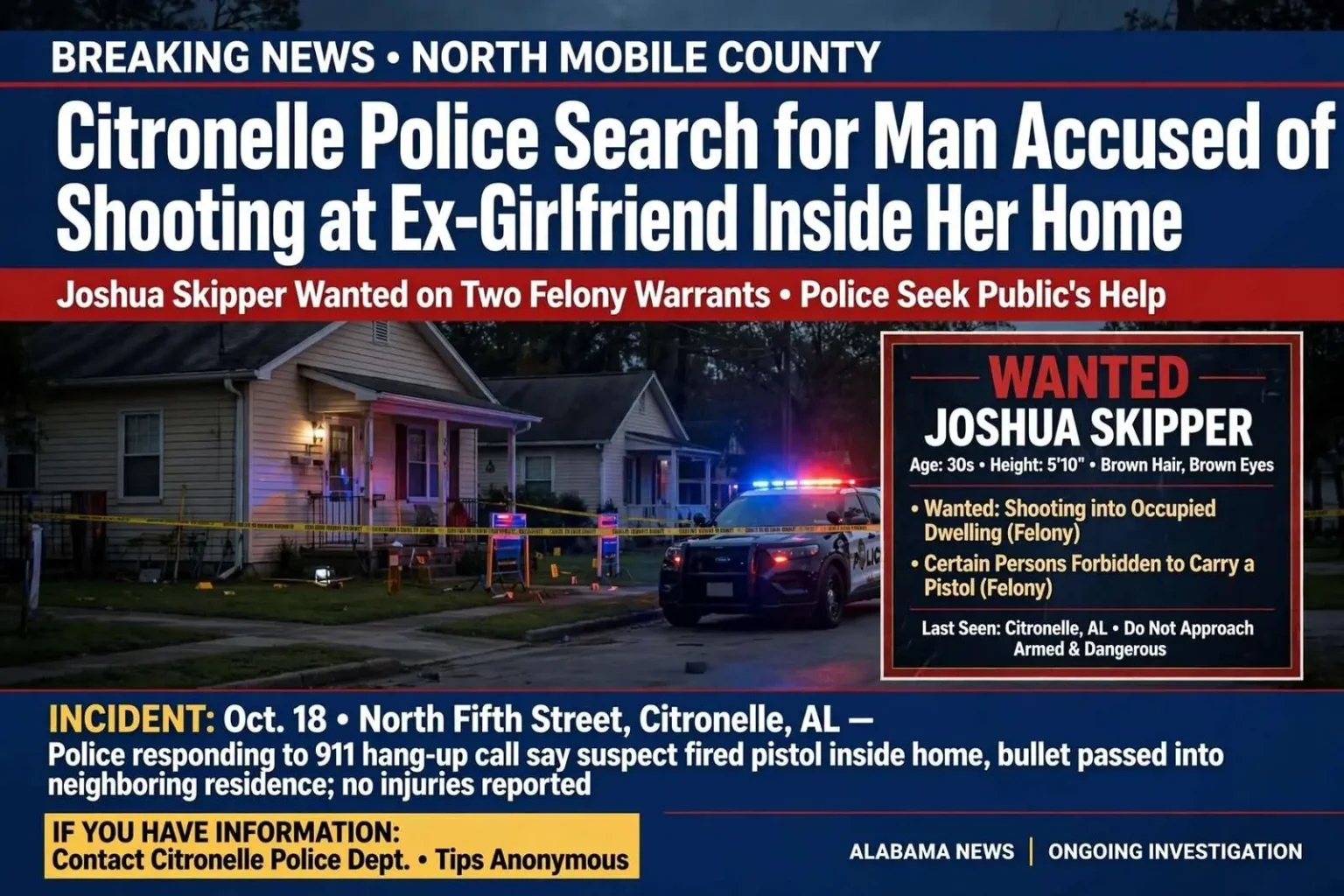
Citronelle police are searching for a man facing two felony warrants after authorities said he shot at his ex-girlfriend inside her home. Joshua Skipper is wanted on warrants for shooting into an occupied dwelling and for certain persons forbidden to carry a pistol, according to the department, and investigators say additional charges are expected as the case continues.
The charges carry serious weight under Alabama law. Shooting into an occupied dwelling is a felony that covers firing a weapon at a home where people live — regardless of whether anyone inside is struck — because the act itself puts every occupant at risk. The second warrant, for certain persons forbidden to carry a pistol, reflects state law that bars specific categories of people from possessing firearms, which means Skipper allegedly had no legal right to be holding a handgun at all on the night of the shooting.
What police say happened
Officers were sent to a home on North Fifth Street Oct. 18 after a 911 hang-up call. The detail matters more than it might appear. Dispatch centers treat hang-up calls as potential emergencies because they are sometimes made by someone who cannot speak freely — a person hiding from an intruder, or reaching for a phone under duress — and the standard protocol is to send officers to the address to check. In this case, the protocol put police on the way to the scene before anyone had formally reported a shooting.
Before they arrived, police said they reached the woman, who reported that Skipper shot at her inside the home. According to the news release, the pair argued before Skipper pulled out a handgun and pointed it at her. Investigators believe she ducked as he fired, and the bullet missed her, passed through the wall behind her and entered a neighboring home. No one — including a resident of that second home — was injured.
The bullet’s path illustrates how narrow the margin was. A round that misses one person inside a house does not stop at the exterior wall; it travels on through drywall and siding, and in this case crossed into an adjacent residence where another family was living their own evening. Two homes, two potential victims, and a difference of inches between a fatal outcome and property damage. That is precisely why the charge of shooting into an occupied dwelling exists as a standalone felony rather than a lesser offense tied only to injury.
Skipper had left by the time officers arrived. The scene police found — a bullet hole through the wall, a frightened woman, a neighbor with a round in their home — became the documentary foundation for the warrants, worked up by Citronelle investigators in the days that followed.
The search in Citronelle
The department has asked anyone with information on Skipper’s whereabouts to contact Citronelle police. Small-city departments in north Mobile County operate with limited patrol staffing across a wide geography, and locating a suspect who has left the scene usually depends on tips — someone who saw him, knows where he stays, or spots a vehicle connected to him. Publicizing the warrants is how those tips get generated, and it keeps pressure on anyone considering helping the suspect hide.
Citronelle sits at the northern edge of Mobile County, near the Washington County line, a community of a few thousand people built around timber and railroad history and far from the density of the city of Mobile. Distances matter in cases like this: the nearest larger law enforcement presence is a county sheriff’s patrol and state troopers covering rural highways, and a suspect leaving town has a head start measured in miles of two-lane road. That is why municipal police departments rely on partners — the Mobile County Sheriff’s Office, ALEA, and the U.S. Marshals Gulf Coast Regional Fugitive Task Force, which routinely picks up warrant subjects who cross jurisdictional lines.
Police said the investigation is ongoing and additional charges are expected. In domestic violence cases, prosecutors often add charges as the full picture emerges — evidence collected at the scene, statements from the victim, prior history that factors into enhancement statutes. The two warrants already issued give police the legal basis to arrest Skipper on sight, and each additional day of investigation can widen the list.
The 911 lifeline
Domestic violence advocates in Alabama stress the same guidance this case inadvertently demonstrates: call, even if you cannot talk, even if you have to hang up. A 911 hang-up is never dismissed as an accident in Mobile County — dispatchers attempt callbacks, and when those fail, officers respond. The woman on North Fifth Street reached police because that system treats a silent call as an emergency, and the officers dispatched on the hang-up call became the ones who documented the scene and started the warrant process.
The case also underscores what advocates describe about escalation in domestic situations. An argument becoming a shooting inside a home is not a sudden event in most cases; it is the end of a pattern. Anyone in a relationship where a partner has threatened them with a weapon is urged to contact law enforcement and advocacy resources before an argument turns physical — though, as Citronelle police have made clear in this case, the immediate priority remains finding the man now wanted in the shooting.
Anyone with information on Skipper’s location is asked to contact the Citronelle Police Department. Callers can provide information anonymously, and tips about a wanted suspect’s location — a car, an address, a sighting — are the most direct way residents can help bring the case to an arrest.
The north Mobile County jurisdiction involved here runs a lean operation compared with the major departments to its south, and that reality shapes how a manhunt proceeds. A municipal department can issue warrants, work leads, and coordinate with county and state partners, but covering a rural community around the clock means the department’s reach is amplified by whoever else is looking. Deputies on patrol, troopers on the highways, and investigators from neighboring agencies all become extensions of the search once warrants are entered into the system.
Neighbors along North Fifth Street experienced the other side of that bullet’s journey. Living next door to a shooting — even one where no one is hurt — changes how a street feels, and the charge structure in this case reflects the risk the neighboring household absorbed without knowing it. Police investigating a shot fired inside one home treat the adjacent property as a second scene, documenting where the round traveled and who was inside, because those facts matter to prosecutors deciding what charges fit.
The firearm charge layered on top of the shooting charge also sends a specific message in rural Alabama, where gun ownership is common and lawful. The statute does not restrict ordinary citizens; it applies to people legally barred from possessing a handgun because of prior felonies, certain protective orders, or other disqualifying conditions. Prosecutors use it to add accountability when a person who was never supposed to have a gun in hand picks one up — a charge that stands independently of what happens with the trigger.
For now, the case stands at the stage where police publicity is the working tool. The warrants are active, the suspect is aware of them, and every public reminder — the department’s release, local news coverage, community sharing — narrows the space a fugitive can operate in. Someone in Citronelle or a neighboring community knows where Joshua Skipper is, and the department’s request is straightforward: tell police what you know, and let the charges do the rest.
Warrant-based searches like this one follow a predictable rhythm in south Alabama. Once the paperwork is entered, the subject’s name goes into local, state, and national databases, meaning any traffic stop anywhere in the country can turn into an arrest. Most fugitives from small-town warrants are caught within the region — staying near family, familiar places, and the people willing to help — and the fastest route to an arrest is almost always a tip from someone in that circle.
The domestic violence context also brings mandatory considerations that ordinary assault cases do not carry. Federal and state laws add penalties when a firearm is involved in a domestic incident, protective orders become easier for victims to obtain, and prosecutions proceed even when a victim’s cooperation wavers, because the case belongs to the state once charges are filed. Investigators building this file know that the warrants issued so far are likely just the opening set, with the full accounting of charges to come once Skipper is in custody and the evidence review is complete.
Residents of the neighborhood where the shooting happened got a demonstration of how quickly a quiet street can become a crime scene. The response that night — officers dispatched on a hang-up call, reaching the victim before arrival, documenting the bullet’s path through two homes — is the standard playbook executed by a small department working a serious case. The next phase belongs to the wider system: prosecutors reviewing the file, deputies and task force officers chasing the warrant, and a community whose information can shorten the search.
Until an arrest is made, Citronelle police keep the case open and active, and the standing request remains the same one issued when the warrants were announced: anyone who knows where Joshua Skipper is should contact the department. Anonymous tips are accepted, and in cases involving domestic violence, the anonymity matters — it allows the people closest to a situation to act without exposing themselves, and it is how many of these cases end, with a knock on a door and a warrant finally served.