Citronelle Police Search for Missing 17-Year-Old Girl
Citronelle police and ALEA are searching for India Newman, 17, last seen Aug. 25 near Lebaron Avenue. Tips: 251-866-5596.
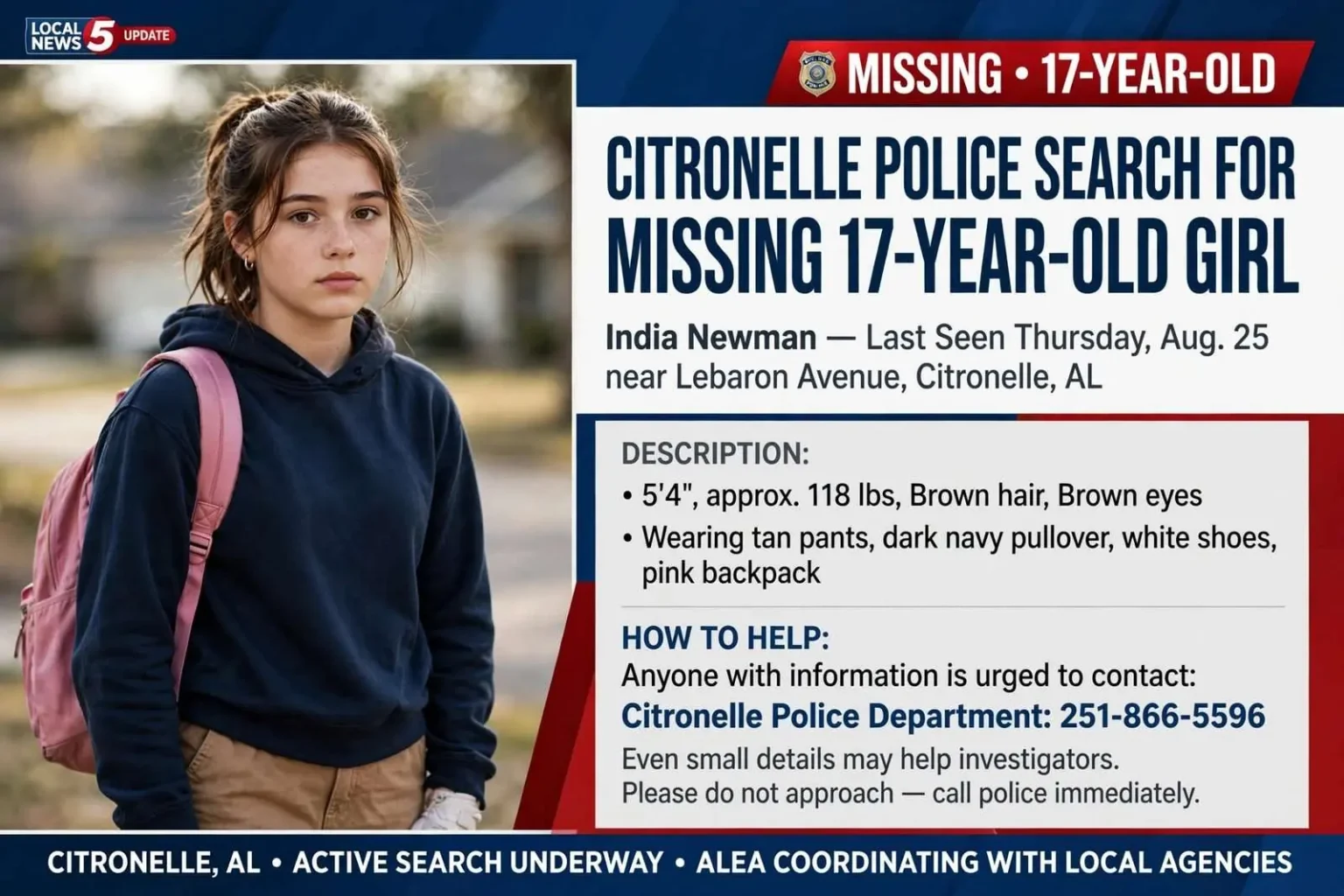
Citronelle Police Ask for Public’s Help Finding Missing 17-Year-Old Girl
Citronelle police are asking for the public’s help finding a 17-year-old girl who was reported missing. India Newman was last seen Thursday, Aug. 25, near Lebaron Avenue in Citronelle, and the department has been working with other agencies to determine her whereabouts since the report came in.
According to the Alabama Law Enforcement Agency, she was wearing tan pants, a dark-colored pullover and white shoes, and was carrying a pink backpack. Newman is described as 5-foot-4 and about 118 pounds, with brown hair and brown eyes. Those details, distributed through law enforcement channels, are intended to help residents recognize her if they see her and to give searchers a clear description to work from.
Anyone with information on her whereabouts is asked to call the Citronelle Police Department at 251-866-5596. Even small details — a sighting, a direction of travel, a conversation with someone who may have seen her — can be meaningful in a missing-person case, and investigators urge anyone who thinks they have seen her not to hesitate to make the call.
The Search in Citronelle
Citronelle is a small city in the far northern reaches of Mobile County, sitting near the Washington County line roughly 35 miles north of downtown Mobile. With a compact downtown and surrounding rural neighborhoods, the community is the kind of place where residents notice unfamiliar faces and out-of-pattern movement, which is why local police departments in towns like Citronelle rely heavily on public cooperation in cases involving missing young people.
The area around Lebaron Avenue, where Newman was last seen, is part of the city’s residential fabric. Canvassing in a case like this typically involves officers going door to door in the neighborhood where the person was last observed, asking about sightings, checking whether any home security cameras captured movement, and tracing the hours between the last known sighting and the time the report was filed.
Police departments handling missing-youth cases also reach out to the people closest to the missing teen — family members, friends, classmates — to build a timeline. Investigators piece together who she was with, what she had been doing in the days before, and whether she had access to transportation or a phone. Every one of those threads can point toward a location.
How Missing-Person Alerts Work in Alabama
The Alabama Law Enforcement Agency coordinates statewide missing-person efforts, maintaining records and disseminating descriptions to other agencies across the state. When a juvenile is reported missing, the local department enters the information into the National Crime Information Center database, which puts the name in front of law enforcement everywhere in the country, and ALEA can amplify the case through its own distribution channels.
Alabama also operates a missing-child alert system modeled on the AMBER Alert framework, which broadcasts descriptions of missing children and any suspect vehicle information to the public through media, highway signage and cell phone alerts when cases meet the criteria. Not every missing-person case qualifies for a full alert — the criteria are specific, generally requiring evidence of abduction or imminent danger — but the underlying network of agencies, broadcast partners and tip lines remains active in every case.
Social media has become a powerful supplement to those official channels. Descriptions shared by departments and community members can reach thousands of people in the region within hours, and in many cases across Alabama and the Gulf Coast, tips that led to the safe recovery of a missing young person began with someone recognizing a face from a shared post. The Citronelle department’s public appeal follows that playbook: give residents a complete description, a clear photo where possible, and a direct number to call.
What Residents Can Do to Help
Law enforcement officers offer consistent guidance for the public in missing-youth cases. Residents in the Citronelle area and surrounding communities are asked to think back to the evening of Thursday, Aug. 25, and note whether they saw anyone matching Newman’s description — 5-foot-4, about 118 pounds, brown hair and brown eyes, wearing tan pants, a dark-colored pullover and white shoes, and carrying a pink backpack.
Those who live along roads leading out of the city, who operate businesses with exterior cameras, or who work in positions that put them in contact with travelers — convenience store clerks, delivery drivers, farmers along rural routes — can be particularly valuable sources of information. Even a memory of an unfamiliar young person walking along a roadway at a particular hour can help investigators establish a direction of travel.
Officials also emphasize that anyone who locates the teen should not attempt to detain or follow her. The right step is to call the Citronelle Police Department at 251-866-5596 and report the location, allowing trained officers to respond. Handling the encounter directly can create confusion or risk, and officers are equipped to bring the case to a safe conclusion once a sighting is confirmed.
The Wider Network Behind a Search
Behind a small city’s missing-person case stands a much larger apparatus. Citronelle’s police force is small, as is typical for municipalities of its size, and cases like this routinely draw on mutual aid: the Mobile County Sheriff’s Office, ALEA, neighboring municipal departments and, where appropriate, volunteer organizations that specialize in searching for missing people. Each agency brings different capabilities, from drone searches and K-9 teams to cell phone analysis and coordination with the National Center for Missing and Exploited Children.
The National Center’s role is worth noting in cases involving teenagers. The organization assists law enforcement with poster creation, photo distribution and forensic services, and it operates a hotline that families and the public can call around the clock. Its analysts also track patterns in missing-youth cases across the country, providing guidance to local departments on the most productive investigative steps.
For the family of a missing teenager, the days after a report is filed are an ordeal of waiting and phone calls. Community members in small towns often rally around the household — organizing searches, sharing posts and offering help — and that community engagement frequently makes the difference in the case’s earliest days, when information is freshest and trails are warmest.
Timing matters in missing-person cases, and so does specificity. Investigators build their search plans from the last confirmed sighting, and in this case that anchor point is the Lebaron Avenue area on Thursday, Aug. 25. Canvass teams concentrate there first, expanding outward as interviews and camera footage give them more to work with.
Timing Matters in Missing-Person Cases
Investigative experience across thousands of cases supports a simple principle: the sooner information reaches investigators, the better the odds of a quick recovery. In the first hours and days, memories are clear, surveillance footage has not been overwritten, and the geographic area a person can cover is still manageable. That is why departments ask residents to come forward immediately with anything they recall, even if they doubt its importance.
The description distributed in this case — the clothing, the pink backpack, the physical details — gives the public concrete anchors. Residents are encouraged to keep the details in mind as they go about their routines in Citronelle and neighboring communities along the northern Mobile County corridor, including Mount Vernon, Axis and the communities toward the Washington County line.
A Community Waiting for Answers
Citronelle’s close-knit character is an asset in a case like this. In a small city, a missing teenager is not an abstraction — it is someone’s classmate, neighbor or church member, and the community’s attention stays on the story until it is resolved. Local congregations, school officials and neighborhood groups typically amplify police appeals, and school staff can be a quiet but important source of information about a student’s friendships and recent changes in behavior. Word of mouth travels fast in a town of Citronelle’s size, and it works in both directions: reports reach investigators quickly, and accurate information from police reaches the public just as fast, keeping rumors from filling the space that facts should occupy.
The Citronelle Police Department’s request is straightforward: if you have seen India Newman or know anything about her whereabouts, call 251-866-5596. The department, supported by the Alabama Law Enforcement Agency’s description of her last-seen clothing and appearance, continues to work the case as information comes in.
Missing-person cases in small Alabama towns most often end with a young person found and returned home, and the fastest paths to that ending run through ordinary people paying attention. A resident who remembers a sighting, a camera that captured a figure on a road, a driver who noticed someone walking — any of these can close the distance between a police report and a reunion. Until then, the description stands, the phone line is open, and a north Mobile County community keeps watching for one of its own.