Citronelle Police Search for Missing 32-Year-Old Man Last Seen Monday
Citronelle police are looking for Irron Corey Weaver, 32, last seen Sept. 5 driving a 1979 motor home. Tips: 251-866-5597.
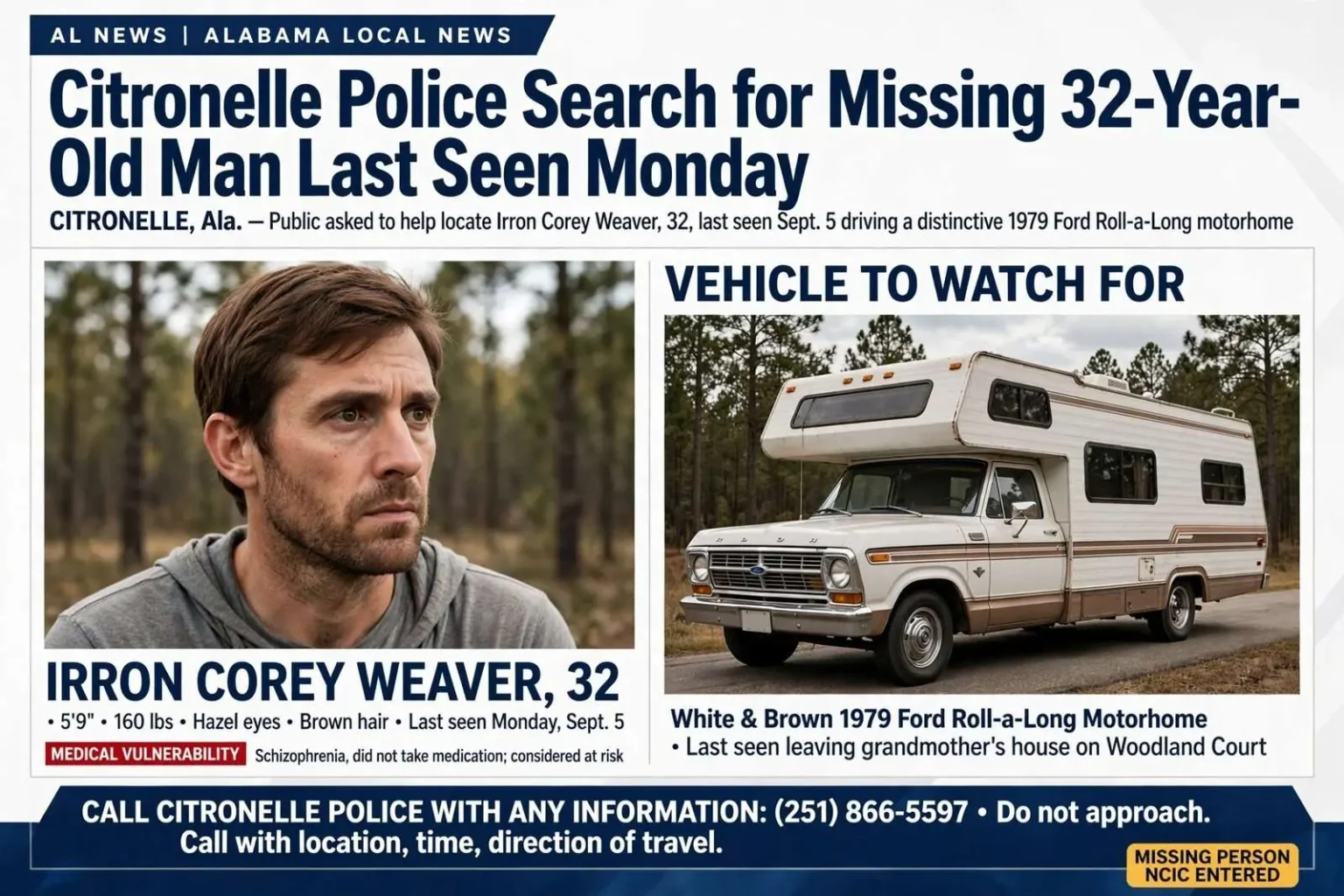
CITRONELLE, Ala. — Citronelle police are asking for the public’s help locating a 32-year-old man who was last seen Monday, Sept. 5, in Citronelle. The search for Irron Corey Weaver has drawn in family members, neighbors and law enforcement across the region, and investigators stress that his disappearance involves both a medical vulnerability and a distinctive vehicle that someone may have seen on the road.
Weaver is described as 5-foot-9, about 160 pounds, with hazel eyes and brown hair. The physical description — a thin man of average height with hazel eyes and brown hair — is the baseline police are asking the public to work from, and the department has paired it with the detail most likely to trigger recognition: the vehicle he was driving when he was last seen.
He was last seen at his grandmother’s house off Woodland Court, driving a white-and-brown 1979 Ford Roll-a-Long motor home. The vintage motor home is a rare sight anywhere on the road, and in a rural community like Citronelle — where residents know their neighbors’ vehicles — a 44-year-old RV in white and brown is exactly the kind of thing people notice. Its size and distinctiveness make it far harder to miss than an ordinary sedan, which is why police are leaning on that detail in their appeal.
According to the department, Weaver’s family told officers he suffers from schizophrenia and had failed to take his medication. That detail changes the nature of the search. A missing person with untreated schizophrenia is considered at risk — vulnerable to disorientation, exposure and dangerous encounters — and departments typically treat such cases with urgency, checking hospitals, shelters and known haunts while asking the public to call in sightings rather than approach the person themselves.
Why the family is worried
Family members said they fear for his safety and believe it’s possible he is unaware of what is happening. Their concern reflects what families of people with serious mental illness know well: a person in an untreated psychotic episode may not recognize danger, may travel far from familiar places, and may not seek help even when it’s available. The possibility that Weaver doesn’t fully understand his situation is, to his family, the scariest part.
Weaver has been entered into the National Crime Information Center as a missing person. The NCIC entry is the step that makes a local search regional and national: every law enforcement officer in the country who runs a check on Weaver or the motor home’s registration will see that he is missing, and sightings anywhere can be reported and routed back to Citronelle police. The entry also links the case to statewide missing-persons clearinghouses that publicize cases and coordinate searches across jurisdictions.
For a person driving a slow-moving vintage motor home, the geography matters. Citronelle sits along U.S. Highway 45 at the northern edge of Mobile County, with rural roads stretching toward the Mississippi line to the north and west and toward Mount Vernon and Mobile to the south. A motor home like Weaver’s travels at modest speeds, making its route potentially traceable if anyone along the way remembers seeing it.
Anyone with information on his whereabouts is urged to call Citronelle police at 251-866-5597. The department is asking specifically for sightings of Weaver himself or the white-and-brown 1979 Ford Roll-a-Long motor home — and for callers to share locations, times and directions of travel that could narrow the search.
How missing person searches work
When a department like Citronelle’s — a small force responsible for a city and its surrounding rural areas — takes on a missing person case, it moves through a standard sequence. Officers take the report, confirm the description and last-seen details, check the person’s known locations and contacts, and enter the case into NCIC. From there, detectives follow up on any sightings, medical records and phone activity, while the family mobilizes its own network of calls and social media appeals.
The vulnerability factor accelerates everything. Adults with medical or mental health vulnerabilities are treated differently under Alabama’s missing person framework than a typical adult disappearance, because an adult has the legal right to go missing — unless there’s evidence of danger, which a failure to take necessary medication supplies. That’s why police publicize the schizophrenia and medication detail: it’s not just context, it’s the legal and practical justification for treating Weaver’s case as an emergency.
Sightings of the motor home could come from anywhere. Vintage RVs attract attention at gas stations, campgrounds and roadside stops, and a 1979 Ford Roll-a-Long traveling through south Alabama or southeast Mississippi could have been seen by dozens of people. Law enforcement partners along likely routes — sheriff’s offices in surrounding counties and across the state line — are typically alerted in such cases, and a single verified sighting can redirect an entire search.
What the public can do
Police are asking anyone who believes they’ve seen Weaver or the motor home to call 251-866-5597 with specifics: where, when, which direction the vehicle was traveling, and who was seen. Callers are urged not to approach or attempt to detain the person — the goal is information, not intervention — and to let officers handle any contact, since a person in mental health crisis can be safest in the hands of trained responders.
Small departments like Citronelle’s rely heavily on the community in cases like this. The city’s residents know the comings and goings of unfamiliar vehicles, and a distinctive motor home parked somewhere it shouldn’t be is the kind of thing a neighbor notices and remembers. Police say no detail is too small — a partial license plate, a sighting on the highway, a recollection of the RV at a rural store — because any of it could break the case open.
The National Crime Information Center entry keeps Weaver’s case active indefinitely, meaning an officer anywhere in the United States who encounters him or the vehicle will make the connection. Missing person cases with vulnerable adults often resolve through exactly that mechanism: a routine traffic stop, a hospital admission, or a welfare check somewhere far from home that matches a name to an entry.
For the Weaver family, the days since Sept. 5 have been an agonizing wait punctuated by tips and dead ends. They’ve asked the public to keep sharing the description — a 32-year-old man, 5-foot-9, 160 pounds, hazel eyes, brown hair, driving a white-and-brown 1979 Ford Roll-a-Long motor home — and to call Citronelle police with anything at all. In cases like this one, police say, the community’s eyes are the search.
Woodland Court, the street where Weaver was last seen at his grandmother’s house, is part of the quiet residential fabric of Citronelle, a city that bills itself as the gateway to the northern reaches of Mobile County. Homes there sit among the pines that dominate the landscape of north Mobile County, and the area’s rural character means neighbors pay attention to vehicles that don’t belong — especially one as memorable as a 1970s motor home.
The mental health dimension of the search shapes how officers will respond to any sighting. Departments across Alabama have increasingly trained officers in crisis intervention — recognizing the signs of untreated mental illness and de-escalating contact — and a welfare check on a missing person with schizophrenia is handled as a medical situation as much as a police one. The preferred outcome in cases like Weaver’s is simple: a safe contact, an assessment, and a reunion with family who can help him resume treatment.
Vintage motor homes also carry practical risks that add to the family’s worry. A 1979 vehicle lacks modern safety features, and its mechanical reliability over a long journey is an open question. If the motor home breaks down, Weaver could be stranded at a rural roadside without fully understanding his predicament — another scenario that turns a sightings appeal into a race against time for the people looking for him.
The Sept. 5 date gives searchers a timeline to work from, and investigators will be reconstructing Weaver’s days since then: where the motor home’s registration has appeared, whether any cameras along U.S. 45 or the region’s highways captured it, and whether any of the businesses and campgrounds that cater to travelers recall the distinctive vehicle. In rural south Alabama, that trail can be thin, which is why police keep returning to the public as the best source of leads.
Missing person appeals like this one spread quickly through the region’s community networks — local social media groups, church prayer chains and word of mouth from Citronelle to Waynesboro and beyond. The department encourages that sharing, noting that the more eyes looking for the white-and-brown motor home, the better the odds that someone remembers where and when they saw it.
Until Weaver is found, the case remains open and active, with Citronelle police coordinating with partner agencies and the family holding onto the hope that someone, somewhere, has seen a 32-year-old man in a one-of-a-kind motor home — and will pick up the phone and call 251-866-5597.