Clarke County Commission Tables Tax Break Request From Jackson Paper Mill
The Clarke County Commission tabled a tax abatement request for the PCA paper mill in Jackson, delaying action on an equipment upgrade while also handling other county business.
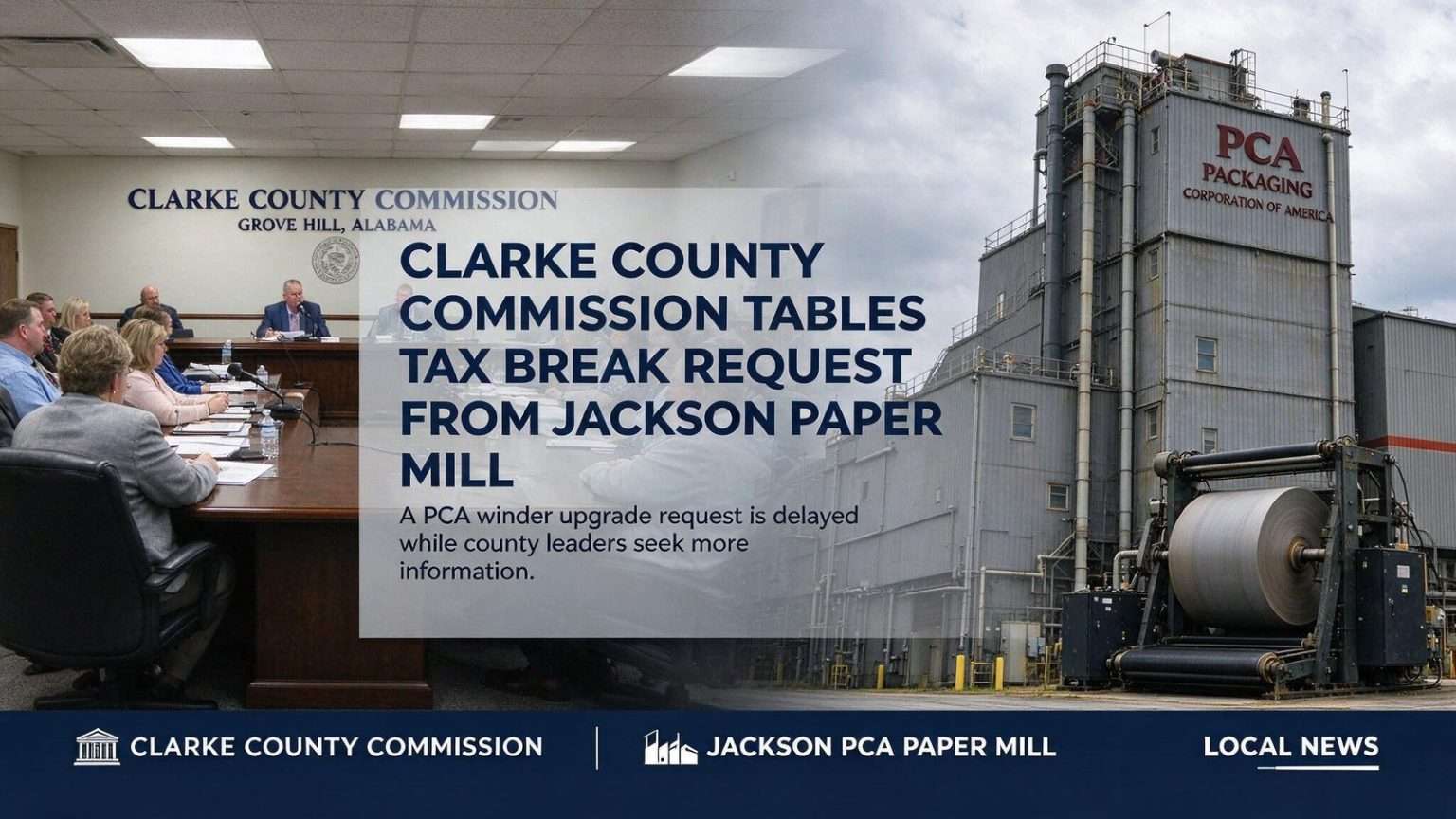
GROVE HILL — A requested tax abatement for the Packaging Corporation of America paper mill in Jackson was tabled Tuesday by the Clarke County Commission. County economic developer Jessica Ross asked commissioners for a delay so she could get a better understanding of the request before it moves forward.
The tabling leaves one of the county’s largest industrial employers in a holding pattern on an incentive request tied to new equipment, and it sets up a renewed debate when the commission next meets in regular session. Tax abatements for manufacturing equipment are a standard economic development tool in Alabama, but they reduce the property tax revenue counties collect, and commissioners here have historically weighed them carefully against the jobs and investment they help secure.
Commissioner Barry Chancey, who is employed by PCA, said the company is ready to proceed with an equipment purchase and that approval shouldn’t be delayed. Details on the specific equipment and its cost were not disclosed, but the mill is upgrading its winder operation to keep pace with increased production.
“Time is an issue,” Chancey said. “This was asked for at the last meeting in July.”
Commission Chairman Jackie Ray Rush pushed back on the idea that the delay was the board’s fault. “We didn’t have the stuff we needed. It isn’t on us,” he said.
What a Winder Upgrade Means
The winder is the machine at the end of a paper mill’s production line that takes the enormous reels of paper produced by the paper machines and cuts, rewinds and wraps them into the finished rolls customers order. Winder speed and precision directly determine how much saleable product a mill can ship, and upgrading a winder operation is typically a capacity and efficiency play: fewer breaks, less waste, faster changeovers between grades, and more tons out the door from the same raw material.
For the Jackson mill, which sits on the Tombigbee River in the northern part of Clarke County, the upgrade signals continued investment in a facility that has been part of the region’s industrial economy for decades. Paper mills are capital-intensive operations, and equipment decisions of this scale are made against long horizons — a company does not retool a winder at a mill it does not intend to keep running. The prospect of increased production carries implications for the mill’s workforce, its timber suppliers across Clarke, Washington and surrounding counties, and the trucking and rail operators who move finished paper out.
Packaging Corporation of America ranks among the largest producers of containerboard in the United States, and its southern mills supply the box plants that serve manufacturers and e-commerce shippers across the region. The Jackson facility is one of the anchor employers of Clarke County, and its payroll and tax contributions ripple through Grove Hill, Jackson and Thomasville, the county’s principal towns.
Why the Timing Dispute Matters
The exchange between Chancey and Rush reflects a familiar friction in county government: a company’s project schedule versus a commission’s duty to understand what it is approving. Abatement requests under Alabama’s incentive laws — which can shield manufacturing equipment from all or part of state and local property taxes for a period of years — commit the county to foregone revenue, and commissioners who approve one without full details answer to the taxpayers who make up the difference.
Ross’s request for time was framed in exactly those terms: the county’s economic developer wants a better understanding of the request before it moves forward, a process that typically includes the cost of the equipment, the abatement’s duration and structure, and the projected benefits in jobs and investment. Commissioners did not schedule a special-called meeting to act on the issue before their next regular session, meaning the earliest the matter can advance is at that meeting — a delay measured in weeks, not months, but long enough to draw protest from a company watching its procurement timeline.
Chancey’s dual role — a commissioner employed by PCA — was visible in the discussion but did not draw formal objection at the meeting. Alabama’s ethics framework requires officials to abstain from votes in which they have a financial interest, and any final vote on the abatement will require attention to that question.
Other Business Before the Commission
In other business at Tuesday’s meeting, the commission granted building superintendent Marlyn Partee and Adarian Daffin of the county road and bridge department permanent employee status after they completed their probationary periods. Permanent status carries the job protections and benefits that come with regular county employment, and the action capped standard probationary evaluations for both positions — the building superintendent who oversees the county’s facilities and a member of the road and bridge crew that maintains Clarke County’s extensive network of rural roads and bridges.
Road and bridge work is among the most visible services a rural Alabama county provides. Clarke County spans more than 1,200 square miles of pine forest, farmland and river bottom, and keeping county roads passable through the region’s frequent heavy rains is a year-round job for the department’s crews and equipment.
The commission also executed an annual contract for long-term juvenile detention services with the Alabama Department of Youth Services, using a facility in Dallas County. Clarke County does not operate its own juvenile detention facility, so housing youths who require secure detention means contracting with a DYS-partnered facility in Selma, the Dallas County seat. Such contracts are routine among Alabama’s smaller counties, which pool their needs through state facilities rather than bearing the cost of standalone detention operations, and the annual renewal updates the terms under which local juvenile cases are housed.
Board Appointments
Commissioners appointed Bridgette Powell to the Clarke County Parks and Recreation Board. The board guides the county’s parks system and recreational programming outside the municipalities, an area of growing importance as rural counties compete to offer the youth sports leagues, playgrounds and community facilities that help retain families. Board members typically serve staggered terms and advise both on maintenance of existing sites and on development of new ones.
The commission also appointed Terry Kiker Jr. as deputy coroner. Alabama’s coroner system relies on elected coroners supported by deputies who can respond when the coroner is unavailable, and in a county of Clarke’s size the deputy’s role covers death investigations requiring on-scene response — everything from natural deaths at home to traffic fatalities on the county’s highways. The appointment fills a role that must be staffed around the clock, since deaths do not keep business hours and the coroner’s office is often the first county authority to respond.
What Comes Next for the Abatement
The abatement request now awaits the commission’s next regular session, where Ross is expected to present a fuller picture of what PCA is requesting and what it would mean for the county’s finances. Between now and then, the company faces a decision of its own: whether its procurement timeline can absorb the delay or whether it will press for faster action through other channels.
The case illustrates the balancing act rural county commissions perform with industrial incentives. A mill the size of PCA’s Jackson operation represents hundreds of direct jobs, a massive timber procurement footprint across the region, and tax revenue — even abated — that anchors the county’s budget. An upgrade that increases production strengthens all of that. At the same time, abatements trim the tax base for schools and county services, and commissioners who grant them without scrutiny invite hard questions later. Rush’s response to Chancey — that the board lacked the information it needed — was an argument for process, not against the project itself.
For now, Clarke County’s largest industrial story sits in committee, waiting for the paperwork its chairman says was missing. The winder upgrade at the Jackson mill will move forward one way or another; the open question is how much of its cost Clarke County’s taxpayers will carry, and on what timeline the commission signs off.
Abatements and Alabama’s Economic Development Playbook
Alabama has built its industrial recruitment strategy for decades around tax abatement and incentive programs that let counties and cities compete for capital investment. Manufacturing equipment is the classic target: state law allows local governments to grant abatements on equipment and some related construction costs, sparing companies part of the ad valorem tax burden for a set period. The logic is that a facility paying payroll, buying timber and spending in the local economy contributes more with an abatement than an empty industrial site would contribute without one.
In practice, the requests move through a defined pipeline. An economic developer assembles the application — equipment descriptions, costs, projected employment effects — and presents it to the governing bodies whose revenue is affected, typically the county commission, the city council and the board of education, since abatements touch each of those tax streams. Public meetings are where the scrutiny happens, and where requests like PCA’s can slow down when board members feel under-informed.
Clarke County’s experience is a case study in how the process works in a rural setting. The county’s economy is anchored by timber and manufacturing, and its largest employers are exactly the kind of capital-intensive operations that use abatements routinely. A paper mill upgrading a winder is a modest project by the standards of, say, a new mill construction — but it is the bread-and-butter of local industrial work, and each such investment compounds the argument that a facility will keep running for decades.
The Mill’s Place in Jackson
The PCA mill’s history in Jackson reaches back generations, through a succession of owners and paper-grade changes, and it remains one of southwest Alabama’s signature industrial sites. Mills of this kind draw wood from a wide radius — loggers and timber dealers across Clarke, Choctaw, Washington and Monroe counties supply the fiber — and they operate continuously, around the clock, in a rhythm that ties shifts of millwrights, operators and maintenance workers to the town’s economy.
An upgrade to the winder operation touches the most customer-facing end of that process, where paper quality is judged by the plants that convert rolls into boxes. Keeping pace with increased production means the mill expects more volume moving through the facility, with implications for its wood procurement, its shipping schedule and, potentially, its staffing. Companies rarely detail those effects at the abatement stage, which is precisely the information gap Ross asked time to close.
For Jackson, the mill’s investment is also symbolic. Small south Alabama towns have watched paper industry consolidation for decades, with closures reshaping communities that depended on them. Every announced upgrade at a surviving mill is read locally as evidence of staying power — a reason to believe the paychecks and timber checks will keep arriving.
County Government’s Routine Work Continues
While the abatement dominated the meeting’s discussion, the rest of the agenda reflected the quiet, cumulative work of a rural county government. Permanent employee status for Partee and Daffin preserves institutional knowledge in departments where experienced hands are hard to replace. The juvenile detention contract with the Department of Youth Services through the Dallas County facility continues an arrangement that has long served Clarke County’s courts. And the appointments of Powell to the parks and recreation board and Kiker Jr. as deputy coroner fill citizen-service roles that keep county government functioning between commission sessions.
Together they form the backdrop against which the abatement debate plays out. Every dollar abated for industrial equipment is a dollar not available for the roads, parks, coroner services and detention contracts on the same county ledger. That arithmetic is what commissioners will weigh when the PCA request returns at the next regular session — and what Ross’s delayed presentation is intended to inform.