Clarke County Cuts Residential Trash Rates by a Third With a New Three-Year Hauling Contract
The Clarke County Commission approved a three-year contract with Waste Away Group Inc., operating as Waste Management, dropping the residential weekly pickup rate from $34.10 to $22.82 starting Nov. 1.
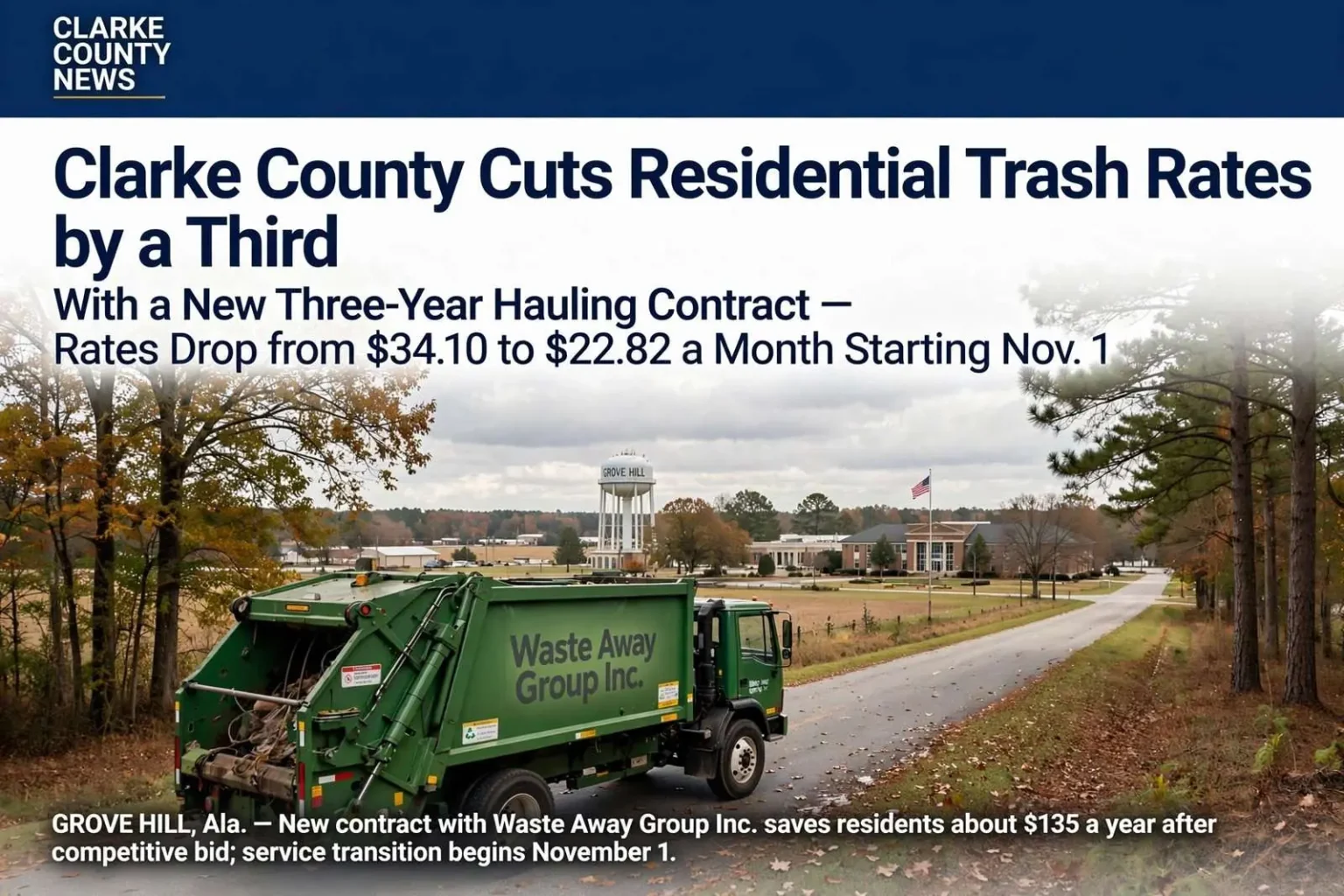
GROVE HILL, Ala. — Clarke County residents will pay about a third less for weekly garbage pickup starting Nov. 1, after the County Commission approved a new three-year contract Tuesday that cuts the residential rate from $34.10 to $22.82 a month.
The contract is with Waste Away Group Inc., operating as Waste Management, which will take over services now provided by Republic Services. Bids for commercial dumpster and handcart pickups also came in lower.
The savings amount to $11.28 a month per household — roughly $135 a year for a service most residents pay without giving it much thought.
How It Happened
The change did not arrive on its own. Commission Chairman Jackie Ray Rush initiated the search for a new contractor months ago, citing what he described as excessive rates county residents were paying.
When Rush asked for a motion to approve the contract Tuesday and whether there was any opposition, he answered his own question.
“There better not be. Praise Jesus!” he said.
“We are proud for our citizens that we could do this,” Rush said. “I hope citizens will appreciate it.”
County attorney Lamar Johnson noted that automatic rate increases are provided for in certain scenarios under the contract.
The Fine Print Worth Knowing
That last detail deserves attention, because it is the mechanism that determines whether a headline savings holds over three years.
Municipal solid waste contracts commonly include escalator provisions tied to specific triggers — changes in the consumer price index, fuel price movements above a threshold, or increases in tipping fees charged by the landfill receiving the waste. These clauses exist because a hauler committing to a fixed price for three years is otherwise absorbing every cost increase in that period, and would price the contract higher at the outset to protect against that risk.
For residents, the practical question is not whether escalators exist — they nearly always do — but what triggers them and how much they can move the rate. Those terms are in the contract the commission approved and are a matter of public record.
Why the Gap Was So Large
A drop from $34.10 to $22.82 is substantial for the same service, and the size of it invites the question of how the higher rate came to be in the first place.
Rural solid waste collection has an unforgiving cost structure. A truck covering a county like Clarke — roughly 1,200 square miles with a population under 22,000 — drives long distances between stops. The cost per household is driven principally by route density: the number of pickups per mile driven. In a dense subdivision, a truck may service dozens of homes in a few minutes. On a rural road, it may cover several miles between two.
That structural cost does not change with the contractor. What changes with a competitive bid is the margin, the assumptions the bidder makes about route efficiency, the equipment it can deploy from nearby operations, and how much the company wants the work.
A hauler with existing routes in adjacent counties can absorb a new contract at lower incremental cost than one starting from scratch, because trucks, transfer capacity and crews are already in the region. That dynamic frequently explains large swings between bids on the same rural service.
What Residents Should Expect During the Transition
Service transitions between waste haulers follow a predictable pattern, and a few points are worth anticipating ahead of Nov. 1.
Carts typically change hands. Rollcarts are usually the property of the contractor, not the county or the resident. In most transitions, the outgoing company collects its carts and the incoming company delivers new ones, sometimes within a window of several days. Residents are generally instructed not to move or dispose of the old cart themselves.
Pickup days may shift. A new contractor designs its own routes, which frequently means a different collection day than residents are accustomed to. Advance notice is standard, but the change catches people every time.
Billing arrangements may change. Depending on how the county structures collection, residents may see a different billing entity, a different cycle or a different payment method.
The final weeks of the old contract matter. Service interruptions occasionally occur at the end of a contract term. Residents who experience a missed pickup in late October should report it to the county rather than assume it is part of the transition.
The Commercial Side
The commission’s action also covered commercial dumpster and handcart pickups, where bids likewise came in lower.
For small businesses in Grove Hill, Jackson, Thomasville and the county’s smaller communities, commercial waste is a fixed monthly overhead line that rarely gets reviewed. A reduction there flows directly to operating margins for restaurants, retail shops and service businesses that generate enough volume to require dumpster service rather than residential carts.
Three Years, and Then What
The contract runs three years beginning Nov. 1. That term is typical for municipal and county solid waste agreements — long enough for a contractor to amortize equipment deployed for the route, short enough that the jurisdiction returns to the market with reasonable frequency.
The lesson Rush drew is one that applies broadly to county services: rates that have been in place for years are not necessarily the rates a competitive process would produce. Solid waste, in particular, is a service where jurisdictions frequently renew rather than rebid, because the process is administratively demanding and the service is not one that generates constituent complaints when it works.
Clarke County went back to the market and returned with a rate a third lower. That outcome is worth noting for any jurisdiction operating on a contract it has not tested in a while.
The Bigger Picture in Clarke County
The trash contract was one of several items the commission handled Tuesday, on a day that also saw approval of the county’s fiscal-year 2027 budget and new rate schedules for housing inmates at the Clarke County Jail.
For a county where the general fund runs to $8.6 million, a change that returns roughly $135 a year to each household is not a rounding error in a family budget. Grove Hill, the county seat, along with Jackson, Thomasville, Fulton and Coffeeville, make up a county where median household income sits below the state average and where fixed monthly costs carry real weight.
New service begins Nov. 1. Residents with questions about the transition should contact the Clarke County Commission office.