Clarke County K9 Vest: Sheriff’s Dog Joker Gets Bullet- and Stab-Protective Armor From Nonprofit
Clarke County Sheriff's Department K9 Joker received a custom-fitted, bullet- and stab-protective vest donated by the nonprofit Vested Interest in K9s Inc.
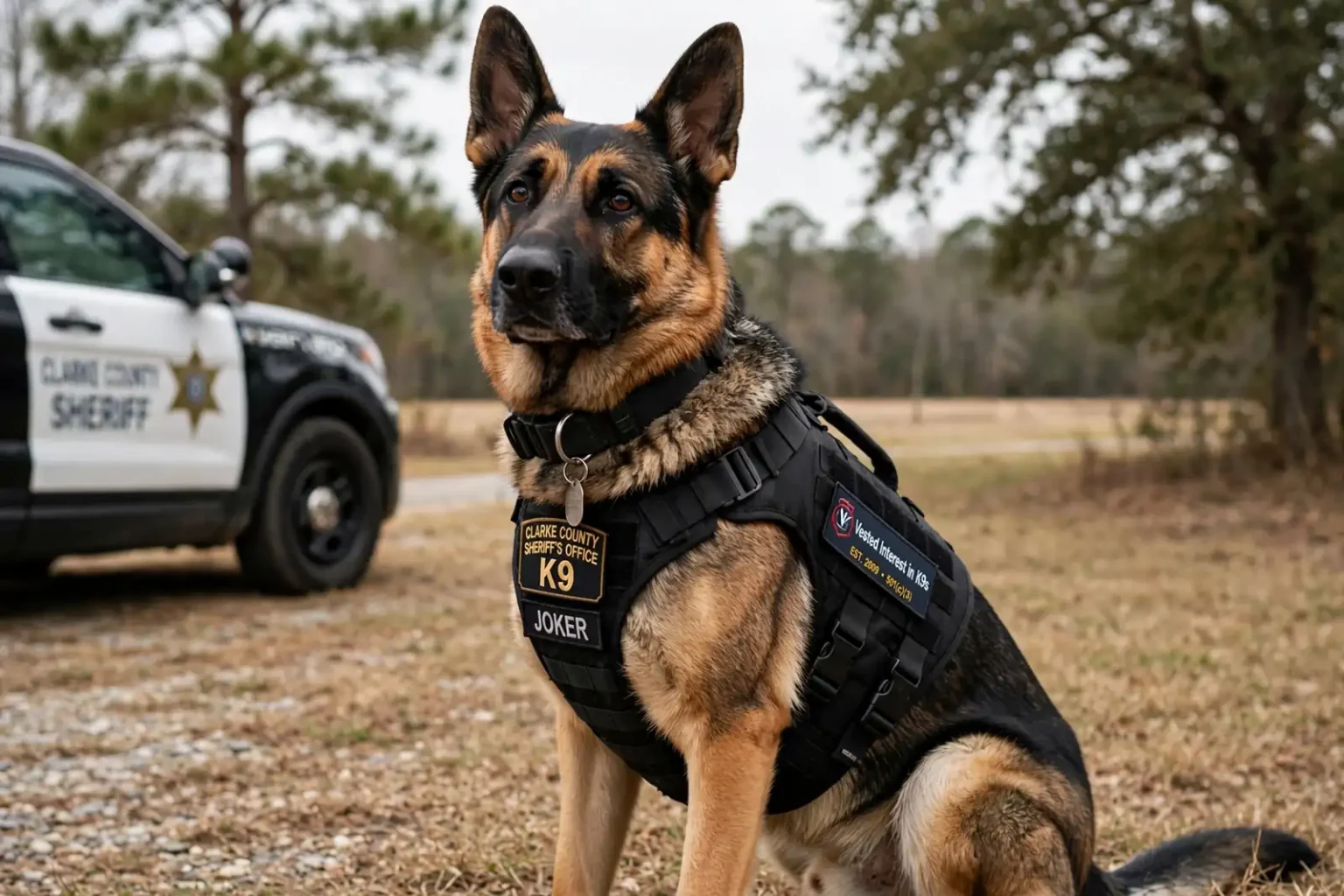
GROVE HILL, Ala. — Joker, a K9 with the Clarke County Sheriff’s Department, is now better protected on the job after receiving a bullet- and stab-protective vest donated by a national nonprofit. The Clarke County K9 vest came from Vested Interest in K9s Inc., a charity that has outfitted thousands of police dogs across the country.
The vest was provided through a charitable donation and is custom-fitted to Joker, according to the organization.
A Vest Built for a Working Dog
Police dogs face many of the same dangers as the officers they work beside. They are often sent first into buildings, wooded areas or vehicles to find a suspect, and they can be the first to encounter someone who is armed.
The vests provided by Vested Interest in K9s are designed to protect against both gunfire and knife attacks. Each vest is custom-fitted to the individual dog and certified by the National Institute of Justice, the research and standards arm of the U.S. Department of Justice that sets performance standards for body armor used by law enforcement.
A proper fit matters for a working dog. A vest that is too loose can shift or snag, and one that is too tight can restrict breathing and movement. Custom sizing allows the dog to run, climb and search while still covering vital areas of the body.
About Vested Interest in K9s
Vested Interest in K9s Inc. was established in 2009 and is a 501(c)(3) charity. Its mission is to provide protective vests and other assistance to dogs serving law enforcement and related agencies throughout the United States. The organization is based in East Taunton, Massachusetts.
Since it began, the nonprofit has provided more than 6,000 vests, valued at $6.9 million, to K9s in all 50 states. The program is paid for entirely through private and corporate donations.
- Founded: 2009
- Status: 501(c)(3) charity; donations are tax-deductible
- Vests provided: More than 6,000 in all 50 states
- Total value: $6.9 million
- Cost to sponsor one vest: $1,050
- Value of each vest: $1,800
There are an estimated 30,000 law enforcement K9s working across the nation, according to the organization.
How a Donated Vest Helps a Small Department
For a rural agency, the math behind a donated vest is significant. Each vest has a value of $1,800, a cost that can be hard to fit into the budget of a sheriff’s office serving a large, sparsely populated county. Equipment for K9 teams, including training, food, veterinary care and specially equipped vehicles, adds up quickly.
Clarke County covers a wide swath of southwest Alabama north of Mobile, with Grove Hill as its county seat and Jackson and Thomasville as its largest cities. The county is known for its timber industry and long stretches of rural roads, and deputies often cover long distances between calls.
The Clarke County Sheriff’s Department is led by Sheriff DeWayne Smith, who was honored by United Way of Southwest Alabama in September with its Heart of Gold Award for nearly three decades of law enforcement service and his work with young people.
What Police Dogs Do
Law enforcement K9s are trained for a range of jobs. Depending on their training, they may track missing people or fleeing suspects, detect narcotics, find explosives, search buildings and open areas, or help officers apprehend someone who is resisting arrest.
In rural counties such as Clarke, a dog that can follow a scent through woods and fields can be especially valuable in searching for a missing person or a suspect who has fled on foot. Many patrol dogs are trained in more than one of those skills. They live and work with a single handler, and the bond between the two is central to how the team performs. When a dog is hurt or killed in the line of duty, the loss is felt both by the handler and by the agency.
Protective vests are one way agencies try to reduce that risk. Like body armor for officers, a vest does not make a dog invulnerable, but it can turn a fatal wound into a survivable one.
The Standards Behind the Armor
The National Institute of Justice tests and certifies body armor so that agencies can be confident it will perform as rated. Ballistic armor is tested against specific types of handgun rounds fired at set velocities, and stab-resistant armor is tested separately against edged blades and spikes. Armor that meets those standards is listed by the institute’s compliance testing program.
Combining both kinds of protection in one vest matters for a police dog. A dog sent to stop a suspect can be close enough to be cut or stabbed, so protection against knives can be as important as protection against bullets.
Like the vests worn by deputies, a dog’s vest has to be maintained and eventually replaced. Body armor materials can degrade with age, heat and wear, which is why agencies track the condition and age of the armor their officers and K9s wear.
How to Support the Program
Vested Interest in K9s accepts tax-deductible contributions in any amount. A single donation of $1,050 sponsors one vest for a law enforcement dog. Individuals, businesses, civic clubs and community groups often raise money together to sponsor a vest for a dog in their own area.
- Organization: Vested Interest in K9s Inc.
- Donations: Tax-deductible, in any amount
- Sponsor a full vest: $1,050
- Who receives vests: Dogs serving law enforcement and related agencies across the U.S.
Residents who want to support Clarke County’s K9 program locally can contact the Clarke County Sheriff’s Department in Grove Hill to ask how community donations can help.