Clarke County Residents Could See Their Garbage Bill Drop by Nearly a Third After a New Low Bid From Waste Management
Clarke County commissioners reviewed competing solid-waste bids Tuesday, with Waste Management's low offer of $22.82 a month promising residents a roughly one-third cut to their current garbage bill starting Nov. 1.
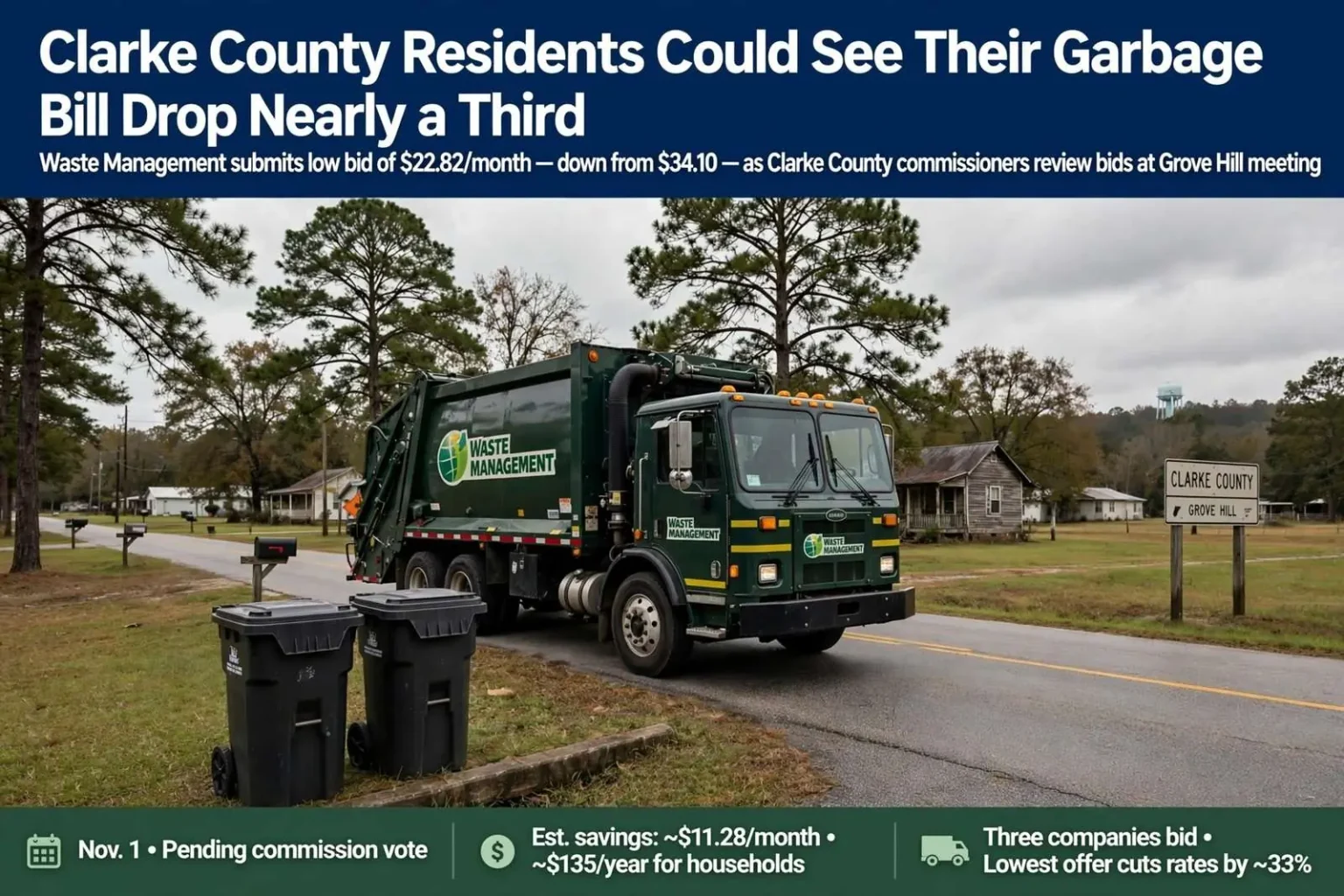
Clarke County residents could see a significant cut to their monthly garbage bill after commissioners opened competing bids for the county’s solid waste contract, with the lowest offer coming in well below what residents currently pay. Waste Management submitted the low bid at Tuesday’s Clarke County Commission meeting in Grove Hill, offering $22.82 a month for weekly residential pickup — down from the current residential rate of $34.10 a month, a cut of roughly a third. An additional $8.68-a-month add-on would cover bulky-item pickup.
The company’s commercial rates started at $130.84 a month for a two-cubic-yard dumpster collected weekly. Two other companies also submitted bids. Waste Pro offered $37.60 a month for weekly residential collection, with bulky waste pickup priced separately at 90 cents a month, plus $218.31 a month for a two-cubic-yard commercial dumpster. Republic Services, the county’s current provider, bid $32.84 a month for residential collection with no separate bulky-item charge, and $160.74 a month for commercial dumpster service.
How the Bids Stack Up
The gap between the low bid and the others is substantial. For a household paying the current $34.10 monthly rate, a switch to Waste Management’s offer would save about $11.28 a month before the bulky-item add-on, or roughly $135 a year — meaningful money in a rural county where fixed costs like trash service draw attention at budget time. Even the residential bids from the two other companies came in at or below the current rate, giving commissioners real leverage no matter which direction they go.
Households that need bulky-item service face a slightly different math. Republic’s bid builds that coverage into its base residential price, while Waste Management would charge $8.68 extra on top of $22.82, and Waste Pro only 90 cents extra on top of $37.60. Residents who rarely set out furniture or appliances might favor the lowest base rate, while those who use bulky pickup regularly would want to compare the all-in monthly cost before drawing conclusions. Commissioners will have to weigh those household-level differences, along with service quality and reliability, before finalizing the award.
Commissioners did not award the contract on the spot, agreeing instead to finalize the decision after a final review of the bids. If Waste Management’s bid is ultimately accepted, as appears likely given the price gap, the new contract would take effect Nov. 1. That timeline gives the county little slack between the award and the switch, meaning whichever company takes over will need to move quickly to line up carts, routes and schedules so residents see no interruption in weekly pickup.
A Competitive Bidding Process
Solid waste contracts are among the largest recurring expenses — or, when billed to residents, the most visible recurring charges — in rural county government. Bidding the service out periodically lets a county test the market, and the spread between these three bids suggests the exercise paid off. The presence of a national provider, a regional competitor and the incumbent all bidding on the same terms gave the commission a clean side-by-side comparison of price structures for both homes and businesses.
The current provider, Republic Services, is one of the largest waste companies in the United States, formed through a series of mergers with legacy haulers across the country. Waste Management is its chief national rival, and Waste Pro operates across the Southeast as a fast-growing regional player. Companies of this size can absorb lower per-household rates in counties like Clarke because route density and scale offset thin margins, which is part of why small-county contracts sometimes draw surprisingly aggressive bids.
The county’s leverage also reflects timing. Waste collection costs have been volatile in recent years, with fuel prices and equipment costs fluctuating, so locking in a multiyear rate at a steep discount protects residents from future increases. County commissions in neighboring southwest Alabama counties have run similar bid processes in recent years, and the results have varied widely depending on route distances and landfill access — factors that help explain why some counties pay far more per household than others for essentially the same weekly service.
For county residents, the outcome matters beyond the monthly bill. Missed pickups, blown litter and poor road treatment during collection are the complaints that most reliably reach county commissioners, so service quality under the new contract will be watched closely. The commission’s decision to review the bids before awarding signals that price alone will not decide the matter.
Other Business Before the Commission
The commission also handled a batch of other business at the same meeting: voting to apply for a $500,000 Community Development Block Grant to resurface 3.5 miles of Asbury Road, with the county providing a $50,000 match; approving a $739 half-page color ad in the county newspapers’ football preview edition; appointing Jake Bailey to the county merit board to fill a vacancy left by the death of longtime member Earl King; and signing off on a final payment of just over $100,000 to ABM Building Solutions for a multimillion-dollar energy-savings renovation to the courthouse and jail, a payment that had been withheld pending satisfactory completion of the work.
The Community Development Block Grant program, administered nationally through the U.S. Department of Housing and Urban Development and funneled to Alabama’s smaller communities through the state, is a fixture of rural infrastructure funding. Counties use it for road work, water and sewer projects and community facilities that would otherwise strain local budgets. The $50,000 match the county committed represents its skin in the game, and if the application succeeds, the 3.5-mile resurfacing of Asbury Road would come almost entirely from federal funds.
The withheld payment to ABM Building Solutions reflects a contracting practice counties increasingly use on major building projects. Energy-savings contracts let a company upgrade lighting, heating, cooling and other systems, then take payment from the utility and maintenance savings those upgrades generate. Withholding the final payment until the work proved satisfactory protected the county’s leverage during the project’s completion, and releasing it now closes out a multimillion-dollar courthouse and jail renovation.
The merit board appointment fills a seat that has been vacant since the death of Earl King, a longtime member whose service the commissioners acknowledged in naming his replacement. Merit boards handle personnel matters such as employee appeals and hiring standards, work that rarely makes headlines but shapes how county government treats its workforce. Jake Bailey takes the post as the county continues routine housekeeping that keeps its boards fully staffed.
Road Materials and Rural Infrastructure
County engineer Lance Jordan also told commissioners the county can no longer buy dirt from the Finch pit, a longtime source of fill dirt for county road projects, and said his office is searching for an alternate source. The loss of a trusted local source is a bigger deal than it might sound. Fill dirt is the raw material of rural road maintenance — used to build up shoulders, repair washouts and regrade low spots — and hauling it from farther away raises the cost of every load.
Clarke County’s road network, like that of its neighbors in south Alabama’s timber belt, depends on constant grading and resurfacing, and dirt work is a recurring line in the county engineer’s budget. When a pit closes or becomes unavailable, the ripple effects show up in project schedules as the county tests new sources for quality and negotiates new hauling arrangements. Jordan’s office will be scouting alternatives in the weeks ahead so routine maintenance does not fall behind.
Landline Woes in Coffeeville
Separately, Commissioner Barry Chancey raised ongoing landline outages from provider Bright Speed affecting the Coffeeville area — outages that have run as long as 10 days at a stretch — and said he intends to press the company directly on the issue. For rural residents, a dead landline is more than an inconvenience. It can cut off emergency 911 service, isolate elderly residents and disrupt businesses that still run on copper phone lines.
Extended outages have become a familiar frustration in rural Alabama, where aging telephone infrastructure spans long distances across sparsely populated terrain and repairs can take days. Commissioners have limited regulatory power over telephone providers, which is partly why Chancey’s plan to escalate directly with the company matters: sustained pressure from county leadership is often what moves repair priorities in small communities. Residents of the Coffeeville area who experience outages are encouraged to report each one, since call volume can influence how quickly a provider responds.
Altogether, the meeting captured the mixed portfolio of a rural county commission’s agenda: a competitive bid that could trim household bills, grant applications that stretch road dollars, personnel and contract housekeeping, and the everyday infrastructure headaches — from fill dirt to dead phone lines — that never make it into the glossy brochures but dominate life in small-town Alabama. The garbage contract decision is expected once commissioners finish their review, with a Nov. 1 start date awaiting the winner.