Oversized ‘Superloads’ Rolled Through Clarke County Overnight, Escorted Mile by Mile From a Jackson Barge Landing
Oversized industrial 'superloads' moved overnight through Clarke County on July 8 and 9, escorted from a Jackson barge landing to a site near Claiborne under ALDOT and emergency management supervision.
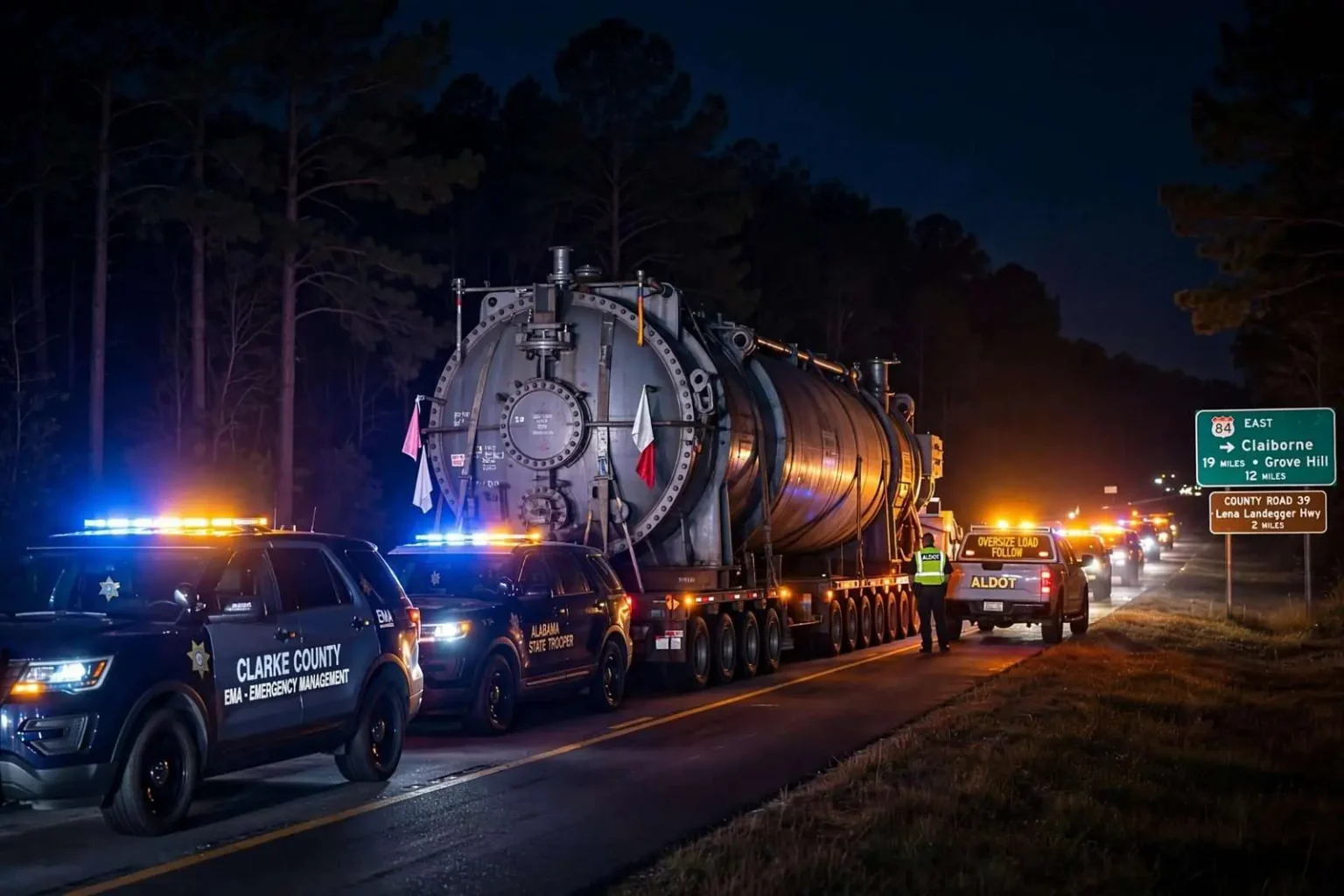
Drivers in Clarke County saw overnight traffic delays last week as oversized industrial equipment, known in trucking circles as “superloads,” moved through the county under close supervision from state and local emergency officials. The equipment traveled from a barge landing in Jackson to a site off County Road 39 near Claiborne, with the moves carried out overnight on July 8 and July 9 specifically to limit the impact on daytime traffic, according to the Alabama Department of Transportation.
The route covered roughly 31.5 miles end to end. Starting at the barge landing in Jackson, the loads traveled about 12 miles north on U.S. Highway 43 to Grove Hill, then turned east onto U.S. Highway 84 for another 19.5 miles before exiting onto County Road 39 — also known locally as the Lena Landegger Highway — near their final destination. Every mile of that route was surveyed in advance: bridge capacities, overhead clearances, turn radii and pavement strength are all checked before a superload ever rolls, because a load too heavy or too wide for the standard network can only move where the engineering allows.
Throughout the overnight moves, the Clarke County Emergency Management Agency tracked the convoy and provided real-time location updates, while traffic was managed through rolling roadblocks designed to let the oversized equipment pass safely without stopping normal traffic entirely. Rolling roadblocks work by leapfrogging ahead of the convoy: law enforcement vehicles slow oncoming traffic in stages, creating a moving pocket of empty road that the superload occupies, then releasing each pocket once the load clears. For drivers caught behind the move, the delay is measured in minutes rather than hours.
The overnight timing served the same logic. Moving a superload after dark means less traffic to manage, cooler temperatures for equipment and pavement, and wider margins for error on roads that carry school buses, log trucks and commuter traffic during the day. Superload moves like this one are typically tied to major industrial or energy projects that require equipment too large for standard trucking routes, and they require close coordination between ALDOT, county emergency management and law enforcement to safely route oversized loads through public roads without damaging infrastructure or endangering other drivers.
What a superload actually is
In the trucking world, a superload is a step beyond the ordinary oversize permit load. Loads that exceed standard legal dimensions — widths beyond roughly 12 feet, heights over 14 and a half feet, weights above the 80,000-pound general ceiling on interstate highways — require special permits from state DOTs, and the largest of them trigger engineering reviews of every bridge and structure on the route. Escorted convoys, utility crews lifting power lines and sometimes even temporary removal of signal arms or signage all become part of the operation.
The economics behind superloads explain why they move at all. A single piece of industrial equipment can weigh hundreds of tons — far beyond any truck’s capacity — which makes disassembly impractical and shipping in pieces impossible. Moving it by water and then road, slowly and with an escort fleet, is often the cheapest option by an enormous margin compared with rebuilding a facility around a piece of equipment or fabricating a replacement in place. The result is the occasional spectacle of a rural Alabama highway carrying, for one night, a load heavier than every vehicle that will use the road for the rest of the month combined.
Why bring such equipment by barge at all? Because rivers are the only practical road for some cargo. Jackson’s barge landing on the Tombigbee River connects the region to the inland waterway network that reaches the Port of Mobile and the industrial corridors of the Tennessee-Tombigbee Waterway, and manufacturers moving heavy industrial components — pressure vessels, reactor sections, transformer units and the like — often ship them by water as far as possible, then complete the last tens of miles by road. The barge-to-highway transfer is where the trucking challenge begins, and it is why landings like Jackson’s occasionally see convoys of escorts and state troopers instead of the usual log trucks and grain haulers.
The destination off County Road 39 near Claiborne points to the other half of the story: Clarke County’s role in Alabama’s industrial economy. The county and its neighbors in the state’s southwest have long hosted forest products plants, chemical facilities and other heavy industry that draws on the region’s rivers, rail lines and timber, and when one of those facilities expands or installs new equipment, the components arriving are frequently too large for any standard trailer. Rural counties across Alabama see these moves periodically, and each one is planned months ahead with input from every agency along the way.
ALDOT’s role in a move like this one runs from the permit application through the final mile. The department reviews the route, certifies that bridges can carry the weight, sets the conditions of travel — time of day, weather limits, escort requirements, speed caps — and coordinates with local law enforcement on traffic control. County emergency management agencies then fill the real-time role: tracking the convoy’s position, alerting local hospitals and fire departments in case anything goes wrong, and updating residents who might otherwise be surprised by a line of glow-marked trucks filling Highway 84 at midnight.
What drivers should know when superloads move
The overnight timing and rolling roadblock strategy used in Clarke County reflects standard practice for this kind of move, prioritizing minimal disruption over speed. For drivers who encountered the convoy, the experience typically meant a short hold at a roadblock, a slow-moving procession of oversized trailers with escort vehicles front and rear, and then a release back to normal travel. The worst response a driver can have is to try to slip past a superload — the trailers’ length and the escort configuration mean passing is unsafe even when it looks possible, and escorts are trained to enforce the space around the load.
Motorists traveling U.S. 43 between Jackson and Grove Hill, or U.S. 84 from Grove Hill east toward the County Road 39 turnoff, know those roads as the ordinary arteries of daily life in Clarke County — the routes to school, to work and to the county seat. For two nights, the same roads became an industrial corridor. The Highway 84 stretch in particular, running through some of the most rural country between Grove Hill and Claiborne, presents the kind of curves, narrow shoulders and tree lines that make oversized loads most demanding, which is why the escort plan for a move like this one is mapped segment by segment rather than treated as a single trip.
The Lena Landegger Highway name on the final leg is itself a piece of local history, honoring a family name long attached to the area’s industrial development. County roads that carry both a number and an honored name often trace back to the industries that built them, and County Road 39’s role in this move — from a state highway down a county road to the project site — shows how the last miles of a superload journey often fall to roads that were never designed for such cargo, which is precisely why they are checked and approved in advance.
For the agencies involved, a two-night operation represents a considerable outlay of attention for a rural county. Troopers and deputies staff the roadblocks, EMA staff run the tracking, and ALDOT’s permit and bridge engineers stand behind the whole plan — all to move a piece of equipment that might take 90 minutes to cover what a commuter covers in 40. The trade-off is deliberate: the alternative to overnight moving is daytime disruption on roads that the county cannot easily close, and the alternative to barge-and-truck is no practical way to deliver the equipment at all.
A routine operation with an unusual profile
Residents who saw the loads roll through and wondered whether such moves are common should know that, in Clarke County, they are rare enough to draw attention but routine enough that the agencies involved have the playbook down. The region’s industrial base means moves of this kind recur when major facilities expand, and each one follows the same template: a surveyed route, permits months in the making, escorts and rolling roadblocks, overnight timing, and real-time coordination from the county EMA.
The July 8 and 9 moves concluded with the equipment delivered to the site off County Road 39, leaving behind little evidence beyond a few memories of glowing trucks on Highway 84 and a longer-than-usual wait at a rolling roadblock. That invisibility is the mark of the operation’s success. ALDOT and its partner agencies measure a superload move by what does not happen — no bridge damage, no collisions, no stranded motorists — and by that standard, the two-night journey from the Jackson barge landing to Claiborne did exactly what it was planned to do: put a piece of Alabama’s industrial future in place while leaving the county’s daytime traffic barely the wiser.