Peruvian Fest Returns to Tillman’s Corner This Weekend With Belly Dancers, Traditional Cuisine and Free Admission
Peruvian Fest Mobile Alabama 2026 brings free Peruvian cuisine, music and a ZURAKA Belly Dancers performance to the Tillman's Corner Community Center on Sunday, July 19.
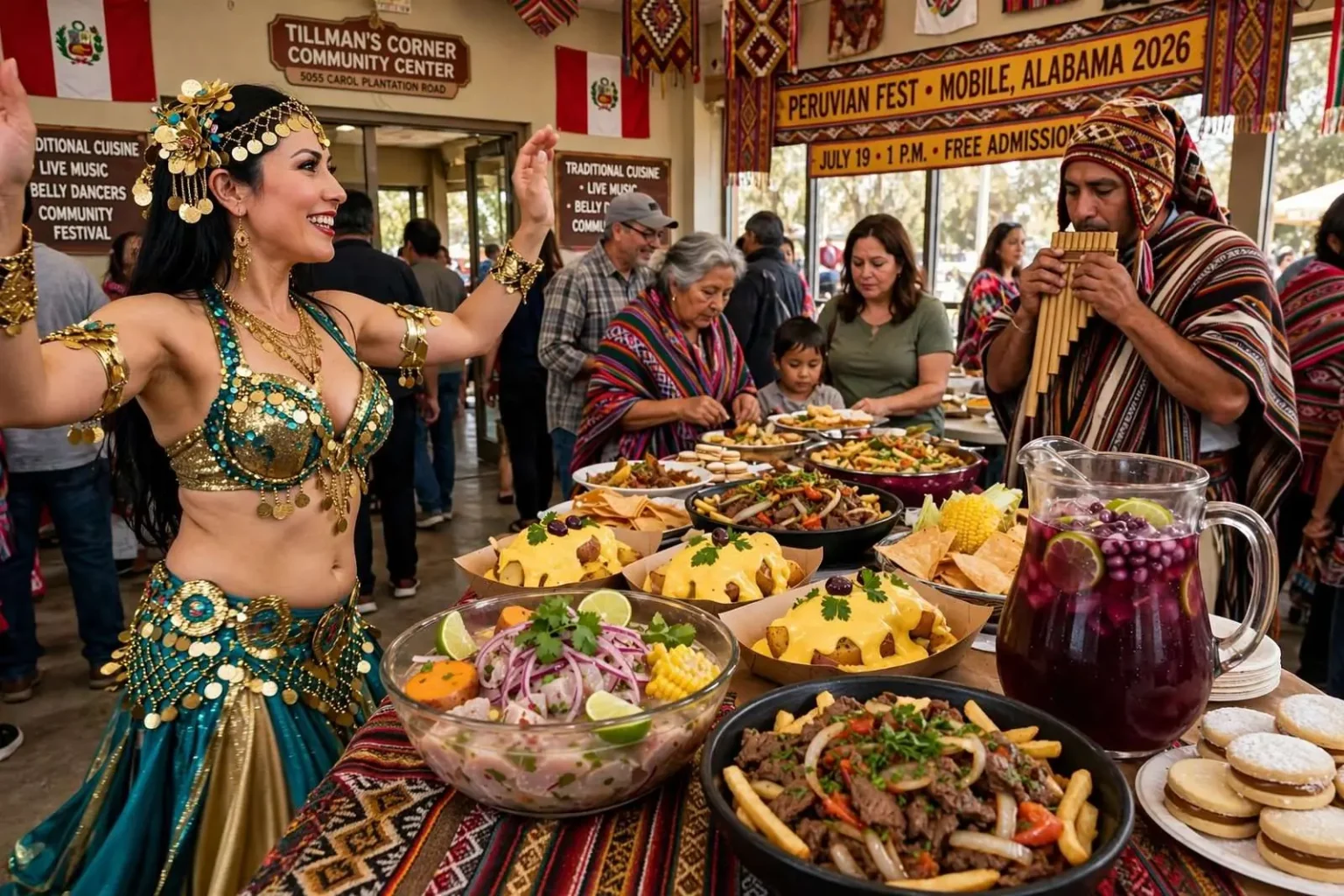
A celebration of Peruvian culture is coming to Tillman’s Corner this weekend, bringing traditional food, music and dance to a free community festival organized to introduce South Alabama to Peru’s culinary and artistic traditions.
Peruvian Fest Mobile Alabama 2026 is set for Sunday, July 19, at 1 p.m. at the Tillman’s Corner Community Center, located at 5055 Carol Plantation Road in Mobile. Admission is free.
The festival’s headline attraction is a performance from ZURAKA Belly Dancers of Mobile, a local dance troupe organizers say will bring “energy, elegance, and art” to the event as a special guest act. Alongside the dance performances, families can expect Peruvian cuisine, live music and traditional dances representative of Peru’s regional culture.
The pairing of a belly dance troupe with a Peruvian heritage festival reflects the crosscurrents common to Mobile’s cultural celebrations, where local performance groups of one tradition frequently appear on the stages of another community’s festival. ZURAKA, an established presence in Mobile’s dance scene, gives the afternoon a professional performance anchor, and the troupe’s Middle Eastern-influenced art form carries its own long history — dance traditions that traveled along the same global routes, in a sense, that carried Peru’s own blended culture into the world.
A Taste of Peru in South Alabama
Peruvian cuisine has become one of the world’s most celebrated culinary traditions, and for many attendees the food tables will be the festival’s main event. Peru’s cooking is a product of its remarkable geography — the Pacific coast, the Andes highlands and the Amazon basin each contribute distinct ingredients — and of waves of migration that blended Indigenous, Spanish, African, Chinese and Japanese influences into dishes that now draw food travelers from around the globe.
Festival-goers familiar with Peruvian cuisine will watch for the classics: ceviche, the citrus-cured fish dish that serves as the country’s national plate; lomo saltado, the stir-fried beef dish born of Chinese-Peruvian cooking; ají de gallina, the creamy chicken stew thickened with bread and yellow chili; and papas a la huancaína, potatoes under a bright yellow cheese sauce. Peruvian drinks and sweets — from chicha morada, the deep-purple corn drink, to the alfajores that show up at South American celebrations — round out the spread. Exactly which dishes appear will depend on the festival’s kitchens, but the tradition’s range gives organizers plenty to work with.
Music and dance carry equal weight in Peruvian tradition, from the highland sounds of the Andes built on panpipes and charango strings to the coastal marinera, the elegant partner dance Peruvians treat as a national emblem. The festival’s program of traditional dances gives audiences a cross-section of that variety in a single afternoon, and the live music sets the rhythm for the community atmosphere organizers are aiming for.
Tillman’s Corner as a Gathering Place
The Tillman’s Corner Community Center at 5055 Carol Plantation Road has long served as the gathering place for one of Mobile’s most active southern suburbs. Tillman’s Corner grew from a rural crossroads into a substantial commercial hub in the decades after World War II, and its community center has hosted everything from political forums to church homecomings to the wedding receptions and quinceañeras that mark family life in South Mobile County.
The venue’s location makes the festival accessible well beyond the neighborhood itself. Tillman’s Corner sits along U.S. Highway 90 and Airport Boulevard in the southern part of Mobile, a short drive from Theodore, Grand Bay, Irvington and the western shore of Mobile Bay, and an easy drive up I-10 for residents of the central city. Free admission and a single-afternoon schedule mean a family can drop in from any direction without planning an entire day around it.
Community cultural festivals built around a single country or region’s traditions have become a recurring fixture of Mobile’s event calendar in recent years, giving smaller immigrant and cultural communities in the area a platform to share food and performance traditions with the wider public.
Mobile’s festival calendar has grown markedly more international in recent decades, a reflection of the port city’s long history as a crossroads of migration. The Greek festival that draws lines around the block each fall, the rising schedule of Latin American celebrations, Asian cultural events and Caribbean heritage gatherings have joined the city’s older traditions — Mardi Gras chief among them, itself a festival built by successive waves of cultures layering celebrations on top of one another. Peruvian Fest takes its place in that lineage: a community putting its heritage on the table, literally, and inviting the whole city to pull up a chair.
Organizers are billing this year’s Peruvian Fest as a family-friendly event, with free admission removing one of the biggest barriers to turnout for a first-time or lesser-known cultural festival.
Why Free Admission Matters
For a first-time festival, free entry is both a philosophy and a strategy. Cultural celebrations succeed when curiosity can walk in the door without a ticket, and organizers of community heritage festivals consistently find that the no-cost model builds the broadest possible audience — families who might hesitate to buy tickets to an unfamiliar tradition will happily come for an afternoon of free entertainment, especially when children are part of the plan.
The economics work through community sponsorship, vendor sales and the volunteer labor that such festivals run on. Food sales sustain the event financially, and in the best case the festival builds an audience that returns the following year and grows into a fixture of the local calendar — the pattern that mobile-area cultural festivals from the Greek Orthodox community to the city’s Asian celebrations have followed over the years.
For Peru’s diaspora, meanwhile, the stakes are more personal. Festivals like this one serve as reunion points where expatriate families cook the dishes of home, play the music of their regions and raise children — often born in Alabama — inside the culture of their parents and grandparents. Peruvian communities have grown across the American South in recent decades, and heritage festivals are the most visible expression of that growth, drawing visitors from across a region who share the same background.
Planning an Afternoon at the Fest
No advance registration or tickets appear to be required for entry, and the event is scheduled for a single afternoon rather than a multi-day run, giving residents a relatively low-commitment way to sample Peruvian culture without planning around a longer festival schedule.
The 1 p.m. start puts the festival in the middle of a July Sunday, when Gulf Coast heat is at its peak — attendees should plan for an air-conditioned indoor venue, which the community center provides, and expect the usual rhythm of a cultural festival: performances on the stage, food service throughout the afternoon, and families drifting in and out as the afternoon goes on.
For anyone in South Alabama curious about Peru — whether through a travel documentary, a restaurant review or a child’s geography unit — Sunday’s festival offers the most direct route: food made by home cooks, dances performed in traditional dress, and a community center full of people happy to explain where it all comes from. The gates at 5055 Carol Plantation Road open at 1 p.m., the dancers take the stage through the afternoon, and admission costs nothing but the drive.
Peru’s Traditions on the World Stage
Peru’s cultural profile has never been higher on the world stage. The country’s cuisine has collected international awards and a constellation of celebrated restaurants in Lima, its music and dance traditions are studied and performed on world stages, and destinations from Machu Picchu to Lake Titicaca make the country a fixture on travel lists. That rising profile helps festivals like Mobile’s, because attendees arrive increasingly aware that Peruvian culture extends far beyond the stereotypes most people could name.
Within Peru itself, regional identity runs deep. The coastal capital of Lima holds one tradition of cooking and music; the Andean highlands around Cusco hold another, with festivals that blend Catholic feast days and Indigenous traditions; the Amazonian lowlands contribute yet another layer entirely. A diaspora festival can only sample that breadth in an afternoon, but the traditional dances on the program are chosen to give newcomers an honest cross-section rather than a single postcard image of the country.
The festival also gives Mobile’s established cultural organizations a chance to collaborate. Guest performances from local troupes like ZURAKA build relationships between communities that continue beyond a single event, and school-age children in the audience may encounter dance traditions and languages they have never encountered before — the kind of organic cultural exchange that community festivals exist to create, one afternoon and one plate of food at a time.
Organizers encourage attendees to come hungry and stay through the closing performances, when the day’s dancers and musicians traditionally gather the crowd for a final round of celebration — the fullest way to experience everything the festival has brought to Tillman’s Corner this year.