Clarke County Sheriff Releases New Details on Highway 43 Crash Involving Deputy
Clarke County Sheriff Ray Norris released new details on a Highway 43 crash in Grove Hill involving a deputy that left both drivers with minor bruises.
GROVE HILL — The Clarke County Sheriff’s Office has released additional details about a two-vehicle wreck on Highway 43 in Grove Hill that involved one of its own deputies, describing a collision that flipped a car onto its roof but left both drivers with only minor injuries.
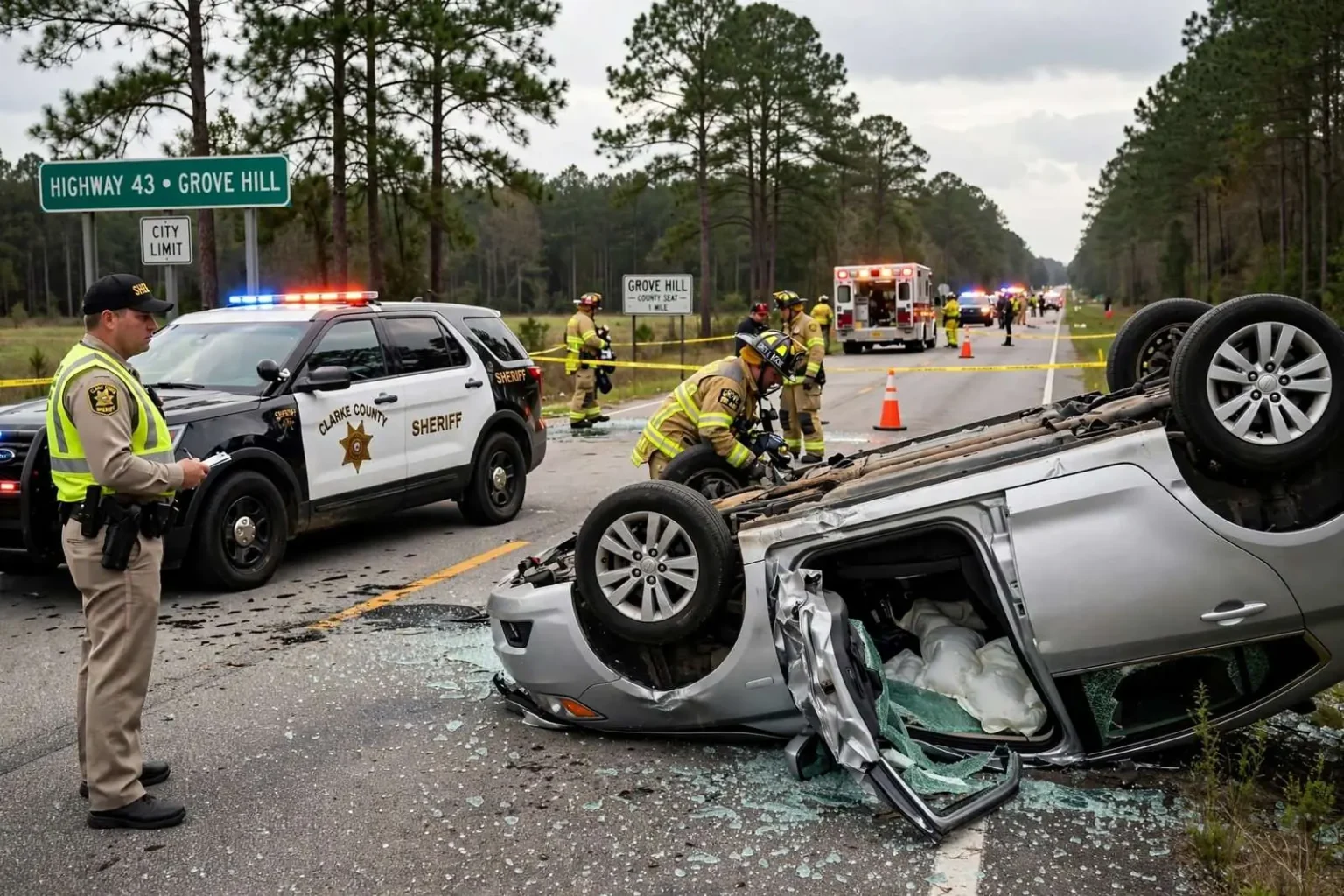
Sheriff Ray Norris said the deputy’s vehicle struck the other car on the front driver’s-side door. The force of the impact caused that vehicle to roll over and come to rest upside down, leaving the driver briefly trapped in the overturned car before rescue crews reached the scene.
The driver of the car that overturned was a resident of neighboring Choctaw County, according to the sheriff. The wreck occurred on Highway 43 within the Grove Hill city limits, the county seat and the busiest stretch of roadway in a rural county where serious collisions tend to draw attention across the community quickly.
Both Drivers Escape Serious Injury
Airbags deployed in both vehicles, Norris said. The deputy and the other driver each came away with bruises, and neither was reported to have suffered life-threatening injuries.
That outcome is more fortunate than the wreckage suggested. A vehicle that rolls onto its roof after a driver’s-side impact exposes its occupant to some of the most dangerous forces in a traffic collision — the roof crush and occupant ejection risks that modern roof-strength standards, side-impact airbags and seatbelt engineering are designed to blunt. Both vehicles deploying airbags indicates the impact registered at a severity well above routine fender-bender levels, making the bruise-level injuries to both drivers a genuine stroke of luck.
The sheriff’s office released photographs from the scene along with its updated account of the wreck. The images showed the overturned car and the damage to both vehicles, providing the public a direct look at an incident that involved a county law enforcement vehicle.
Questions That Remain Open
Investigators have not publicly stated what caused the collision or whether the deputy was responding to a call when it happened. Both questions matter for different audiences. The cause determines fault, potential citations and whether any charges follow; the deputy’s status at the time of the crash determines whether departmental policy on emergency responses — lights, sirens and speed — applies to the review.
The sheriff’s office has not indicated whether an outside agency will examine the crash. When a law enforcement vehicle is involved in an injury collision, departments handle the investigation with varying degrees of internal and external oversight, and rural agencies like Clarke County’s frequently rely on state troopers for independent reviews of their own crashes. Until investigators release their findings, the sequence of events that put a car on its roof on the main highway through Grove Hill remains an open file.
What has been established is the basic mechanics: two vehicles on Highway 43, an impact on the driver’s-side door of the civilian car, a rollover onto the roof, and two drivers walking away from a scene that could easily have produced worse.
Grove Hill and the Highway 43 Corridor
Highway 43 is a primary north-south corridor through Clarke County, carrying a steady mix of local traffic and longer trips between the Mobile area and points north. The road runs from Mobile’s northern suburbs up through Washington County and into Clarke County, passing straight through Grove Hill before continuing north toward the Black Belt and connections to westbound routes across the state.
For Clarke County residents, Highway 43 is the county’s commercial spine. The road through Grove Hill carries school traffic, commuters to the town’s shops and medical offices, logging trucks moving timber from the county’s vast pine forests, and through-travelers making the run between Mobile and Tuscaloosa-area destinations without touching the interstate system. That mix — local drivers making short turns alongside heavy trucks running long distances at highway speed — is a familiar formula for rural Alabama highway crashes.
Grove Hill, the county seat, sits near the center of Clarke County, one of Alabama’s larger counties by land area and one of its most rural. The town is the hub for county government, including the sheriff’s office, which operates from the courthouse complex. When a wreck involves a county deputy, it happens on turf the department covers daily — often with responding units drawn from the same small roster as the officer involved.
How Rural Crash Response Works
The wreckage described in the sheriff’s account called on the standard rural Alabama crash response: law enforcement to secure the scene, firefighters and first responders to reach the overturned driver, and an ambulance to evaluate both drivers. In Clarke County, those roles are filled by a combination of the sheriff’s office, the Grove Hill Police Department, volunteer fire departments and regional EMS services — agencies that routinely cover long distances on two-lane roads to reach scenes like the one on Highway 43.
An overturned vehicle is among the more demanding calls responders face on a two-lane highway. Flipping a car back onto its wheels requires equipment and coordination, and the possibility of fuel leakage or secondary collisions in active traffic lanes extends the time a scene remains closed. Photographs released by the sheriff’s office documented the aftermath, showing the kind of scene Grove Hill-area responders train for but rarely publicize.
The fact that both drivers escaped with bruises reflects the safety engineering now standard in passenger vehicles. Roof strength requirements introduced over the past two decades, combined with side-curtain airbags and modern restraint systems, have transformed rollover outcomes that were frequently fatal a generation ago into survivable events — a quiet statistical shift that this Highway 43 wreck illustrates in miniature.
Law Enforcement Crashes in Context
Crashes involving on-duty officers occupy a distinct category in traffic safety. Law enforcement vehicles spend far more hours on the road than typical passenger cars, often at higher speeds and with in-car distractions ranging from radios to mobile data terminals. Studies of police fleet safety have consistently found elevated crash rates per mile driven compared with civilian vehicles, which is why departments across the country have tightened pursuit and response policies and invested in driver training.
Whether any of that context applies to the Grove Hill wreck depends on the details investigators have not yet released — most importantly, whether the deputy was responding to a call, and at what speed. If the deputy was operating normally, the crash is a routine two-vehicle collision that happened to involve a county car. If an emergency response was underway, the sheriff’s office will review the response against its own written policy, as departments in Alabama routinely do.
The department’s decision to release photographs and a detailed account of the wreck itself — attributing the description to Sheriff Ray Norris by name — reflects the accountability that comes with public ownership of a county vehicle. Rural sheriffs’ offices across Alabama have increasingly adopted that transparency, releasing scene photos and preliminary accounts while investigations continue, precisely because community trust in a small county depends on hearing the department’s account of incidents involving its own personnel.
Choctaw County Connection
That the driver of the overturned car came from Choctaw County underscores how far people routinely drive on Highway 43. Choctaw County sits directly north of Clarke County along the Mississippi line, and its residents pass through Grove Hill regularly on trips to the Mobile area — the reverse of the Clarke County residents who drive north on the same road. A crash on Highway 43 at Grove Hill, in other words, involves drivers whose home counties may sit an hour apart, connected only by the highway that runs between them.
The two counties share more than a road. Both are rural, timber-dependent economies in southwest Alabama, with populations that shrink as residents drive to larger labor markets in Mobile, Jackson and beyond. Choctaw County’s hospital closed in recent years, sending residents toward larger facilities — a shift that puts more Choctaw County vehicles on highways like 43 for routine medical travel, shopping and work.
What Happens Next
The investigation into the crash remains open. When authorities complete their work, the findings will typically be summarized in a traffic collision report — the document that insurers for both drivers will use to assign responsibility and process claims for the vehicles involved. The overturned car, damaged on its driver’s-side door and roof, and the deputy’s vehicle will be evaluated against the account investigators construct from scene evidence, vehicle damage and any witnesses who come forward.
For the deputy, the crash will also pass through whatever internal review the sheriff’s office conducts when one of its vehicles is involved in an injury collision. That process is standard across Alabama law enforcement and runs parallel to the traffic investigation rather than replacing it.
A Reminder for the Corridor
Wrecks like this one are the recurring reality of Highway 43 through Clarke County. The road’s crash history reflects its role: two lanes, frequent access points, heavy trucks mixed with passenger cars and a steady flow of local drivers making the short hops between Grove Hill, Thomasville and the communities in between. State traffic data across rural Alabama consistently identifies exactly this kind of road — busy two-lane US highways — as among the state’s most dangerous per mile traveled, long before interstates and divided highways enter the picture.
For local drivers, the sheriff’s account of the Grove Hill wreck offers the practical lessons without the lecture. Driver’s-side impacts and rollovers do happen on the corridor, even at spots residents travel daily. Seatbelts and airbags turned a roof-down collision into a bruise report for both drivers — the outcome that modern vehicle engineering exists to deliver, and the reason a scare on Highway 43 ended with photographs released and an investigation, rather than a far worse phone call home.
The sheriff’s office has not said when its investigation will conclude. Until then, the images of an overturned car on the county’s main road stand as the latest entry in the long record of Highway 43 wrecks — and, for once, the mildest.