Clarke County Sheriff Resigns as Impeachment Case Nears Supreme Court Hearing
Clarke County Sheriff William Ray Norris resigned days before an Alabama Supreme Court impeachment hearing on corruption allegations.
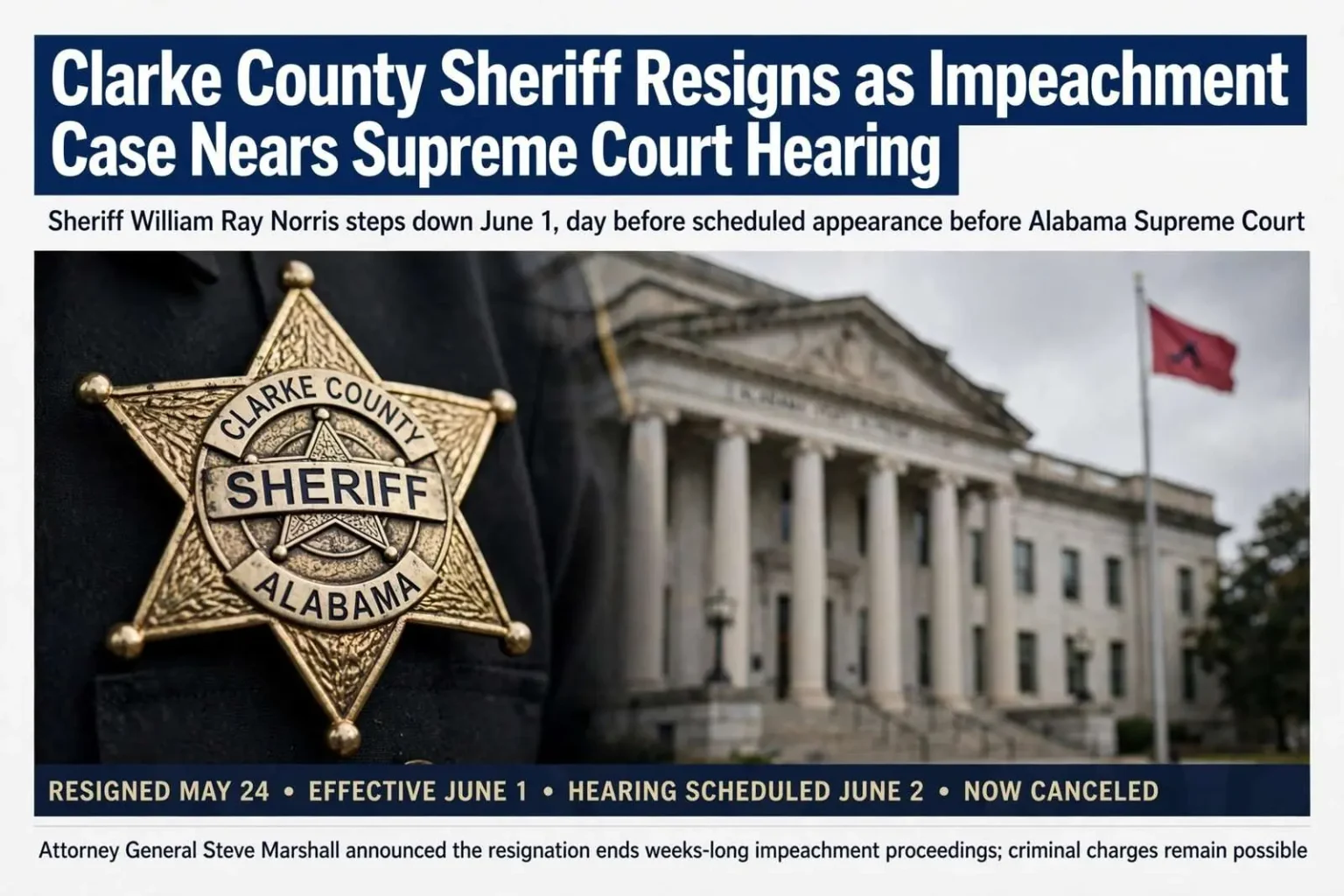
Clarke County Sheriff William Ray Norris has resigned, days before he was scheduled to answer impeachment charges before the Alabama Supreme Court. Attorney General Steve Marshall announced Wednesday that Norris submitted his resignation to Gov. Kay Ivey on May 24, with the departure taking effect June 1. The state’s high court had ordered Norris to appear on June 2 to answer a two-count information of impeachment. The resignation brings an abrupt end to a weeks-long legal standoff that had put the top law enforcement job in the southwest Alabama county in limbo.
The move marks an unusual conclusion to one of the rarest proceedings in Alabama government: the removal of a sitting sheriff through the state’s impeachment process. Sheriffs in Alabama are constitutional officers, and the path to ousting one runs not through local officials but through the Alabama Supreme Court, where impeachment matters are heard. Only a handful of such cases have been brought against Alabama sheriffs in modern memory, which made Norris’s case a closely watched test of how the state handles allegations of serious misconduct by elected law enforcement leaders.
How the Case Developed
Marshall filed an Information of Impeachment and Prayer for Ouster against Norris with the Alabama Supreme Court on April 27. According to the attorney general’s office, its investigation began in early 2020 and led to the decision to seek the sheriff’s removal from office. Norris was charged with four instances of corruption in office and eleven instances of committing crimes involving moral turpitude.
An information of impeachment is a formal charging document filed directly with the state’s highest court, and a prayer for ouster asks that the court remove the officeholder from the position entirely. Under Alabama law, the attorney general has authority to initiate such proceedings against state and county officers, including sheriffs. The two-count framing of the case reflected the two broad categories of alleged misconduct, with the individual instances of each alleged offense laid out beneath the counts.
Because impeachment proceedings exist to determine whether an officeholder is unfit to serve, Marshall concluded in a court filing that the resignation supersedes the pending case. If the Alabama Supreme Court agrees that the resignation nullifies the proceedings, the case is expected to be dismissed once the resignation takes effect. That interpretation rests on the idea that the court’s role in an impeachment matter is protective rather than punitive: the proceedings exist to shield the public from an unfit officeholder, and once the officeholder is gone, there is nothing left to remedy.
The timing is notable as well. Norris was under a court order to appear on June 2, and the resignation’s June 1 effective date means he steps down a single day before that appearance was set to take place. Had he shown up to answer the charges, the case would have moved toward a full hearing, with evidence presented and the allegations aired in public. Instead, the state’s highest court will now be asked to formally close the file.
Criminal Charges Still Possible
Marshall indicated the matter may not be closed. “It is more important than ever that the public be able to trust elected officials, especially when they occupy leadership positions within law enforcement,” he said. “It was my judgment that Sheriff Norris could no longer be trusted as a public servant or as a law enforcement official, and his resignation should be a welcome relief to the public.”
The attorney general added that the resignation “does not foreclose the possibility that criminal charges will be filed against him.” That distinction between the impeachment case and any future prosecution is significant. Impeachment is a civil process aimed at removing someone from office, and it does not constitute a criminal conviction. Any criminal case would have to be built separately, carried to a higher standard of proof, and would likely be handled by prosecutors independent of the removal proceedings. Marshall’s warning made clear that stepping down does not immunize a former officeholder from accountability through the criminal courts.
Marshall credited his office’s Special Prosecutions Division and thanked several agencies for assisting, including the Alabama Securities Commission, the Investigations Division of the Alabama Department of Revenue, the FBI’s Mobile Field Division and the U.S. Attorney’s Office for the Southern District of Alabama. The breadth of the agencies involved, spanning securities regulation, state revenue enforcement and federal investigators, suggested the underlying inquiry reached well beyond a single incident and touched on financial matters as well as the sheriff’s official conduct.
A Rare Exercise of the State’s Impeachment Power
Impeachment occupies a peculiar place in Alabama’s framework of county government. Sheriffs are elected in each of the state’s 67 counties and hold sweeping authority over county law enforcement and, in many counties, the operation of the county jail. Because they answer to voters only at election time, the attorney general’s power to file impeachment charges in the Supreme Court has long stood as one of the few formal checks available between elections. It is a check that is rarely used, and one that almost never progresses to the point of a scheduled hearing before the state’s highest court.
The procedural posture of the Norris case also illustrates how the process works in practice. An information of impeachment is not an indictment, and the Supreme Court does not conduct the kind of jury trial familiar from criminal dockets. The court hears the charges, weighs the evidence and decides whether the officeholder’s conduct makes him unfit to continue serving. The remedy, where misconduct is established, is removal from office, and in some circumstances the court can also bar the official from holding public trust in the future.
For Clarke County, the case has been an uncomfortable chapter. The sheriff’s office sits in Grove Hill, the county seat, and its deputies patrol a largely rural stretch of southwest Alabama that includes the communities of Jackson and Thomasville. Residents have watched an elected constable of the law become the subject of a two-year investigation that ended with formal impeachment charges and, now, a resignation filed with the governor’s office.
Marshall’s office has framed the outcome as vindication of the process even as it presses the possibility of criminal charges. The resignation, in the attorney general’s telling, accomplishes the central aim of the impeachment filing: Norris will not continue to hold a law enforcement office that the state’s chief legal officer concluded he could no longer be trusted to occupy.
What Comes Next for Clarke County
With the resignation effective June 1, attention in Clarke County shifts to the transition. The sheriff’s office handles patrol duties, criminal investigations and jail operations for the county, and its day-to-day work does not pause while the paperwork is sorted out. State law provides a mechanism for filling a vacancy in the office of sheriff, and whoever takes over will inherit a department that has spent months operating under the shadow of the attorney general’s investigation.
Residents can expect continuity in basic services. Deputies will continue answering calls across the county’s rural roads and small communities, and the jail will continue operating under existing staff. But the transition also raises longer-term questions: whether an interim leader will serve until the next election cycle, how the department’s command structure will be reshaped, and whether the incoming sheriff will face pressure to rebuild public confidence in an office that has been the subject of statewide headlines.
The broader significance of the case extends beyond one county. Impeachment filings against Alabama sheriffs have become somewhat more visible in recent years, as attorneys general have used the tool against officers accused of misconduct ranging from financial impropriety to failures in jail oversight. Each case helps define the boundaries of the process, and the Norris matter adds a new wrinkle: a resignation filed on the eve of a court hearing, and a legal argument that the departure itself renders the impeachment case moot.
How the Supreme Court resolves that question will matter for future cases. If the justices agree that a resignation supersedes pending impeachment proceedings, officeholders facing removal will have a clear incentive to resign before a hearing, preserving the possibility that the allegations are never publicly adjudicated. If the court instead presses forward, it could signal that impeachment remains a vehicle for a full public accounting even after an official leaves office.
Whether criminal charges follow will be the next question for Marshall’s office. Prosecutors typically do not comment on the status of potential cases until formal charges are filed, and no timeline for a charging decision has been offered. Until then, the former sheriff is a private citizen, having left office under a cloud of unresolved allegations one day before he was scheduled to answer them in open court.
For the people of Clarke County, the immediate takeaway is simpler. The office they funded, and the officer they elected, will be led by someone new. The attorney general who pursued the case says the public should be relieved. Whether that relief proves lasting will depend on what the courts, and possibly a jury, do with the allegations that prompted the resignation in the first place.