Coast Guard Crews Tow Disabled Vessel to Dauphin Island After Offshore Breakdown
Coast Guard crews located a disabled vessel 35 miles south of Dauphin Island and towed it to Little Billygoat Hole Ramp after an offshore breakdown.
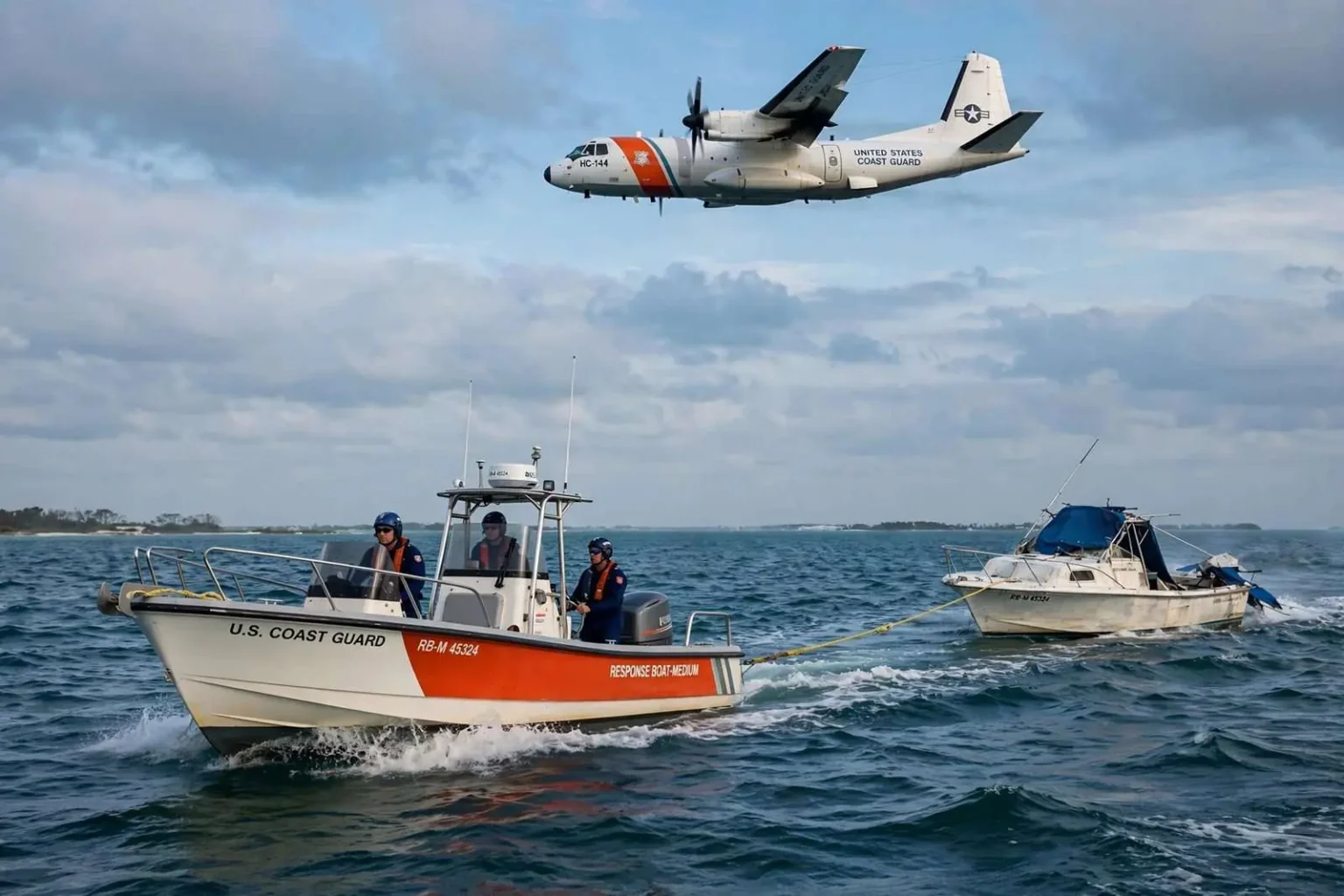
A boater whose vessel became disabled far offshore got a hand from the Coast Guard over the weekend, with crews towing the boat safely back to Dauphin Island. The rescue unfolded across a Saturday morning and afternoon in the open Gulf, combining an aircraft overhead and a rescue boat on the water to bring a stranded vessel and its occupants home without injury. It was a textbook case of the search-and-rescue network that stands watch over the waters off the Alabama coast.
Coast Guard Sector Mobile received word of the troubled vessel around 10:04 a.m. Saturday. The boat was roughly 35 miles south of Dauphin Island when it lost the ability to make way on its own, leaving its occupants adrift in open Gulf waters. Thirty-five miles offshore is well beyond the horizon — a position where a dead engine is a serious emergency in the making, and where the distance alone makes any rescue a coordinated operation involving both air and surface assets.
Watchstanders worked up an approximate position for the vessel and launched a Response Boat-Medium crew from Coast Guard Station Dauphin Island. An HC-144 Ocean Sentry aircrew out of Mobile was also directed to the scene to assist in locating the disabled craft and standing by until surface help arrived. The two-unit response — aircraft to find and watch, boat to tow — reflects standard Coast Guard practice for cases far offshore, where speed of location and continuous observation can decide how a case ends.
How the Rescue Unfolded
The HC-144 Ocean Sentry is a medium-range surveillance aircraft flown by Coast Guard crews out of Mobile, built for exactly this kind of mission: long hours on station, sensors capable of picking out a small vessel against the water, and the ability to relay a precise position to surface units. The aircrew reached the vessel shortly before 1 p.m., providing situational awareness while the response boat made its way offshore — confirming the boat’s location, monitoring its condition and keeping the crew of the disabled vessel in contact with rescuers.
The boatcrew from Station Dauphin Island arrived around 2:25 p.m. and took the vessel under tow. A Response Boat-Medium is designed for offshore work — self-righting, seaworthy in rough conditions and equipped to tow disabled craft through open water — and the run of more than 30 miles to the scene and back is well within its envelope. Once the tow was rigged, the hardest part of the case was over: the vessel was attached, stable and moving.
The tow concluded without further trouble, with the disabled boat secured at Little Billygoat Hole Ramp on Dauphin Island. The ramp, a public launch facility on the island’s protected side, is a familiar destination for the station’s tows, giving recovered vessels a place to be tied off while owners arrange retrieval. Neither the name of the vessel nor a count of those aboard was released in the initial report. No injuries were noted in connection with the incident — the outcome every search-and-rescue case is measured against.
The Network Behind the Tow
The case drew on the full range of Coast Guard assets stationed around Mobile Bay. Sector Mobile, headquartered in the area, coordinates search and rescue across the approaches to the Port of Mobile and the waters of the central Gulf Coast, standing watch around the clock and turning maydays, radio calls and distress reports into coordinated responses. Station Dauphin Island provides the surface rescue boats positioned closest to the Gulf’s open waters, and the aviation side out of Mobile adds the range and speed that only aircraft provide.
The HC-144 fleet out of Mobile serves a dual role that makes it valuable in cases like Saturday’s: the same aircraft that fly search and rescue also patrol for fisheries enforcement, drug interdiction and homeland security, keeping crews sharp at finding and tracking vessels far from shore. When a case breaks, an aircrew can be over a search area in a fraction of the time a boat needs to make the same distance, cutting the time a disabled crew spends alone on open water.
Dauphin Island itself sits at the front line of this system. The barier island guards the entrance to Mobile Bay, and its Coast Guard station faces directly onto the Gulf, putting rescue boats minutes from open water. For boaters launching from Bayou La Batre, Coden, the island’s ramps or anywhere along the Alabama coast, that geography is the margin between a long tow and a long night adrift.
Sector Mobile’s watchstanders are the first link in that chain, and their work rarely gets seen. The 10:04 a.m. phone call that started Saturday’s case set off a sequence they have run countless times: gather what the caller knows about position and condition, cross-reference it against weather and drift, decide which assets to launch and in what order, and keep every responding unit talking to each other until the case closes. On a busy weekend, watchstanders may be juggling several such cases at once, along with routine traffic on the radio channels every boater shares.
Why Breakdowns Far Offshore Turn Dangerous
Breakdowns dozens of miles from land can turn dangerous quickly, particularly when weather or seas deteriorate before help arrives. A disabled boat in calm conditions is an inconvenience; the same boat when the wind rises takes seas over the transom, drifts steadily away from its last known position and puts an increasing strain on everyone aboard. Distance compounds every problem — fuel, communications, exposure and the simple difficulty of finding one small hull in a vast search area.
Time of day matters too. Saturday’s case began midmorning, giving rescuers hours of daylight to locate and tow the vessel. A breakdown that starts at dusk turns the same problem into a night search, with helicopter flares, radar and night-vision equipment doing work that eyes in sunlight did for this crew. The occupants of the disabled boat did the right things by having working communications to get the word out early, which is what allowed watchstanders to build a position estimate and launch assets while conditions were still manageable.
Drift is the variable rescuers fight in every offshore case. A boat without power does not stay where it breaks down; wind and current push it along, sometimes at more than a knot. The longer a vessel is adrift, the further it moves from the position reported in the initial call, which is why the Coast Guard places such emphasis on accurate position reports, GPS coordinates and prompt notification. Saturday’s aircrew bridged that gap, updating the vessel’s position while the response boat transited offshore.
The Preparation the Coast Guard Asks For
Coast Guard officials regularly urge boaters planning trips well off the Alabama coast to file a float plan, carry reliable communications equipment such as a VHF marine radio, and make sure flares and other signaling gear are aboard and within reach of the operator. Each of those three recommendations maps directly onto how cases like Saturday’s resolve.
A float plan — a simple document left with a marina, friend or family member describing the vessel, who is aboard and where the boat is going — turns a missing-boat case into a directed search. When a vessel fails to return, the person holding the float plan knows where to start, and rescuers begin with a search area instead of a guess. It costs nothing and takes minutes, and it is the single piece of paperwork that most often shortens a search.
The VHF marine radio remains the backbone of offshore distress communications. Cell phones fail at 35 miles offshore and cannot be heard by other boaters nearby; a VHF radio broadcasts to every vessel and every Coast Guard watchstation in range, with GPS-equipped models transmitting position automatically with a mayday. Flares and signaling gear complete the picture, giving a disabled crew a way to be seen once rescuers are close — the final step in turning a good report into a successful pickup.
A Good Ending, and the Standard It Sets
Saturday’s case ended the way the system is built to produce: a disabled vessel located, monitored, towed and secured, with no injuries and its occupants back on Dauphin Island by afternoon. From the 10:04 a.m. call to Sector Mobile to the tow secured at Little Billygoat Hole Ramp, the response moved through location, observation, transit and recovery in a matter of hours — a routine outcome only because the crews, the aircraft and the station made it routine.
For the boating public along the Alabama Gulf Coast, the case carries the season’s recurring lesson. The Gulf off Dauphin Island is a popular and productive body of water, but 35 miles offshore is nowhere to be unprepared, and the boaters who come home under their own power are generally the ones who carried the radio, filed the plan and checked the gear before leaving the dock. The Coast Guard’s part of the bargain held on Saturday, as it does on hundreds of cases a year across the central Gulf — and the disabled crew that rode a tow into Little Billygoat Hole Ramp got to see the system work exactly as advertised.