Coast Guard Medevacs Sick Crewmember From Vessel South of Fort Morgan
A Coast Guard crew from Station Dauphin Island medevaced a 27-year-old vessel worker five miles south of Fort Morgan.
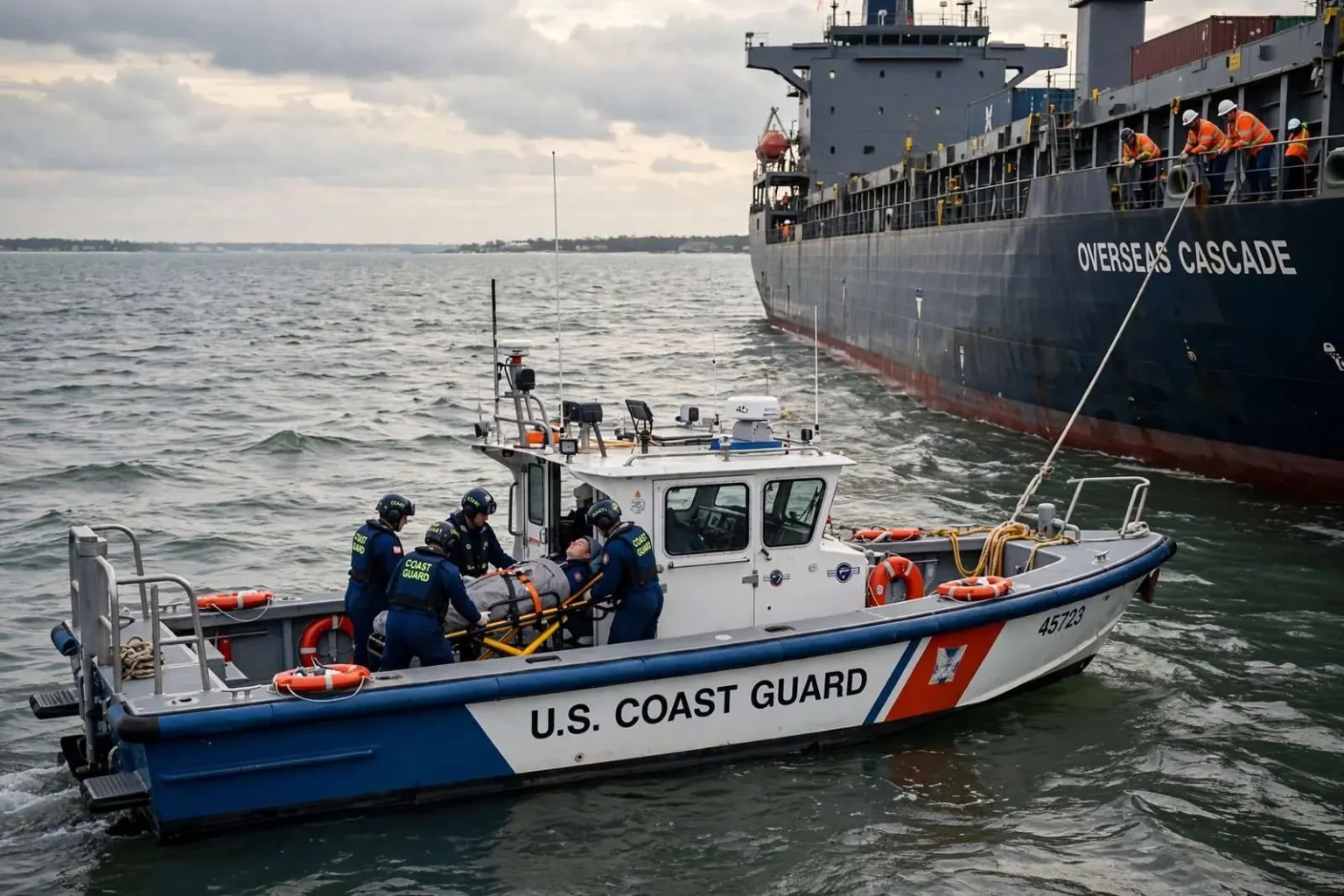
The U.S. Coast Guard rushed a sick crewmember off a cargo vessel south of Fort Morgan over the weekend. Watchstanders received a call around 4 p.m. Sunday from the motor vessel Overseas Cascade reporting a medical emergency involving one of its crew. The Coast Guard launched a 45-foot response boat crew from Station Dauphin Island to meet the ship about five miles south of Fort Morgan. Once on scene, the boat crew transferred the 27-year-old crewmember to waiting emergency medical personnel at Coast Guard Station Dauphin Island. The crewmember was last reported in stable condition.
The call set in motion one of the Coast Guard’s most practiced missions: the at-sea medical evacuation. When a crewmember falls ill or is injured aboard a ship far from shore, the vessel’s master has few options, and the most reliable one is the Coast Guard. Mobile Bay’s entrance sits between Fort Morgan on the east and Dauphin Island on the west, and the waters south of the fort are a regular corridor for commercial traffic, which makes the response stations on either side of the bay mouth the natural first responders for emergencies in the area.
In this case, watchstanders took the report from the Overseas Cascade around 4 p.m. Sunday and quickly determined that the 27-year-old crewmember needed care beyond what the ship could provide. The motor vessel was a cargo ship working the waters off southwest Alabama, and rather than waiting for the ship to make port, the Coast Guard launched a response boat from Station Dauphin Island to intercept it about five miles south of Fort Morgan — a short run from the station, but one that must be executed carefully against the weather, the sea state and the movement of a large commercial vessel.
The transfer itself is a delicate piece of seamanship. A 45-foot response boat must hold position alongside a ship that towers over it, matching the motion of both vessels in a swell while crewmembers move the patient across. Crews train for exactly this evolution, using proper transfers at designated boarding points and coordinating closely with the ship’s crew over radio. Once the patient was aboard the response boat, the crew ran back across the bay entrance to Station Dauphin Island, where emergency medical personnel were waiting to take over.
Station Dauphin Island’s role on the bay
Coast Guard Station Dauphin Island sits on the western side of the Mobile Bay entrance, one of the search and rescue stations guarding the central Gulf Coast. Its crews stand watch around the clock, ready to launch for mariners in distress, medevacs like this one, and the routine patrol work that covers one of the busiest harbor approaches on the Gulf. The station’s 45-foot response boats are built for exactly this kind of mission, capable of running in rough conditions and carrying personnel and patients safely back to shore.
The station’s position gives it a critical advantage: proximity to the shipping lanes. Every vessel entering or leaving the Port of Mobile passes between Dauphin Island and Fort Morgan, and cargo ships anchored or waiting in the waters offshore fall within the station’s quick response radius. When a ship reports a medical emergency within that radius, a response boat can be on scene in minutes rather than the hours a helicopter or a distant cutter would need.
Fort Morgan, the old masonry fort at the eastern point of the peninsula, gives the geography its name and its history, but for the Coast Guard the point marks the eastern edge of the rescue corridor. A medevac five miles south of the fort puts the scene well clear of the ship channel, giving the response boat room to maneuver alongside the vessel without conflicting with harbor traffic. That separation matters, because Mobile Bay’s entrance carries a steady flow of tugs, barges and deep-draft ships.
The Overseas Cascade’s crew made the report that started the rescue, and their handling of the emergency reflects the safety culture required aboard commercial vessels. Ships operating in U.S. waters are required to have medical officers or trained personnel aboard, emergency communication procedures and the ability to coordinate with shore-based rescue forces. When a crewmember’s condition exceeded the ship’s capabilities, the master made the call to the Coast Guard rather than risking the delay of a port call.
How a medevac comes together
In the case of the Overseas Cascade, the calculation favored a response boat launch from Station Dauphin Island. The vessel was close to shore, the patient was stable enough for a surface transfer, and the station’s 45-foot boat could make the run quickly. Not every medevac is that simple; patients in critical condition farther offshore are often hoisted by helicopter crews, and vessels beyond helicopter range may require a cutter response or a long escort to port. The layered system exists so that the right resource meets each emergency.
The coordination continued through the transfer. The ship slowed or adjusted its course to reduce the relative motion, the response boat came alongside, and crewmembers moved the patient safely across. Radio traffic between the boat, the ship and the sector command center kept everyone informed, and the waiting emergency medical personnel at Station Dauphin Island meant that no time was lost once the patient reached shore. The crewmember was last reported in stable condition, the outcome every link in that chain is working toward.
Medevacs from commercial vessels are among the most common missions Coast Guard units on the Gulf Coast perform. Merchant mariners live and work aboard ships for weeks at a time, far from hospitals, and illness or injury aboard can range from appendicitis to injuries from the ship’s own machinery and cargo operations. The crews of cargo vessels like the Overseas Cascade carry the region’s commerce, and the safety net beneath them is the network of search and rescue stations, sector commands and air stations that stand ready along the coast.
The waters where it happened
The scene of the medevac, about five miles south of Fort Morgan, lies in the open Gulf just beyond the mouth of Mobile Bay. That stretch of water is a working frontier: cargo ships waiting for berth assignments, tugs moving barges along the coast, fishing boats working inshore and recreational vessels crossing between the bay and the barrier islands. Weather on the Gulf can change quickly, and the sandbars and shoals around the bay entrance demand respect from mariners in any conditions.
Dauphin Island and Fort Morgan frame the bay’s entrance on either side, and the communities on both have long histories with the water. Dauphin Island’s Coast Guard station traces its presence on the barrier island back through decades of search and rescue work, and the station’s crews have answered everything from fishing boat sinkers to hurricane rescues. The weekend medevac was, by comparison, a routine mission — but routine in the Coast Guard’s vocabulary means practiced, rehearsed and executed without drama.
For the family and shipmates of the 27-year-old crewmember, the difference between a Coast Guard response boat and a ship continuing its voyage was the difference between a hospital bed and an untreated emergency. The transfer to emergency medical personnel at Station Dauphin Island placed the patient in the care of local medical services, and the stable condition reported afterward reflected both the ship crew’s initial response and the speed of the evacuation.
The Coast Guard did not release details about the crewmember’s illness, which is standard practice in medical cases. Patient privacy governs what responders share publicly, and the service’s account of the mission sticks to the operational facts: the 4 p.m. Sunday call, the vessel’s location five miles south of Fort Morgan, the launch from Station Dauphin Island, the transfer and the stable condition.
What it means for the port community
Episodes like this one are invisible to most residents of the Mobile area, yet they underpin the maritime economy the region depends on. The Port of Mobile ranks among the major deepwater ports on the Gulf, and every ship that calls there brings a crew whose health and safety rest partly on the Coast Guard’s readiness. Shippers, vessel operators and mariners alike take assurance from the fact that a response boat can reach a vessel within sight of the bay entrance in a matter of minutes on a Sunday afternoon.
Behind every at-sea medevac is a chain of decisions made quickly by watchstanders. The first call from a vessel triggers an information-gathering process: the patient’s condition, the vessel’s position and course, the weather and sea state, and the medical resources already aboard. Coast Guard watchstanders consult with medical personnel to determine the urgency, then weigh response options — a response boat, a helicopter, or directing the vessel toward port.
The mission also highlighted the partnership between the Coast Guard and shore-based emergency medical services. The response boat did not deliver the patient to a hospital; it delivered the patient to the waiting hands of emergency medical personnel at the station, who then carried the care forward. That handoff — from ship to response boat to EMS — is rehearsed so that when a real call comes, the seams between organizations do not show.
For the crew of the Overseas Cascade, Sunday’s mission ended with a shipmate safe ashore and stable, and a ship able to continue its work. For the Coast Guard crews involved, it was another entry in a mission log that stretches back generations on Mobile Bay. And for residents of the Gulf Coast, it was a reminder that behind the region’s working waterfront stands a rescue network that answers when called — at 4 p.m. on a Sunday, or any other hour.