Coastal Alabama Community College Nursing Program Earns National Center of Excellence Honor
Coastal Alabama Community College's nursing program is now a National League for Nursing Center of Excellence, one of only 20 programs honored nationally in 2026.
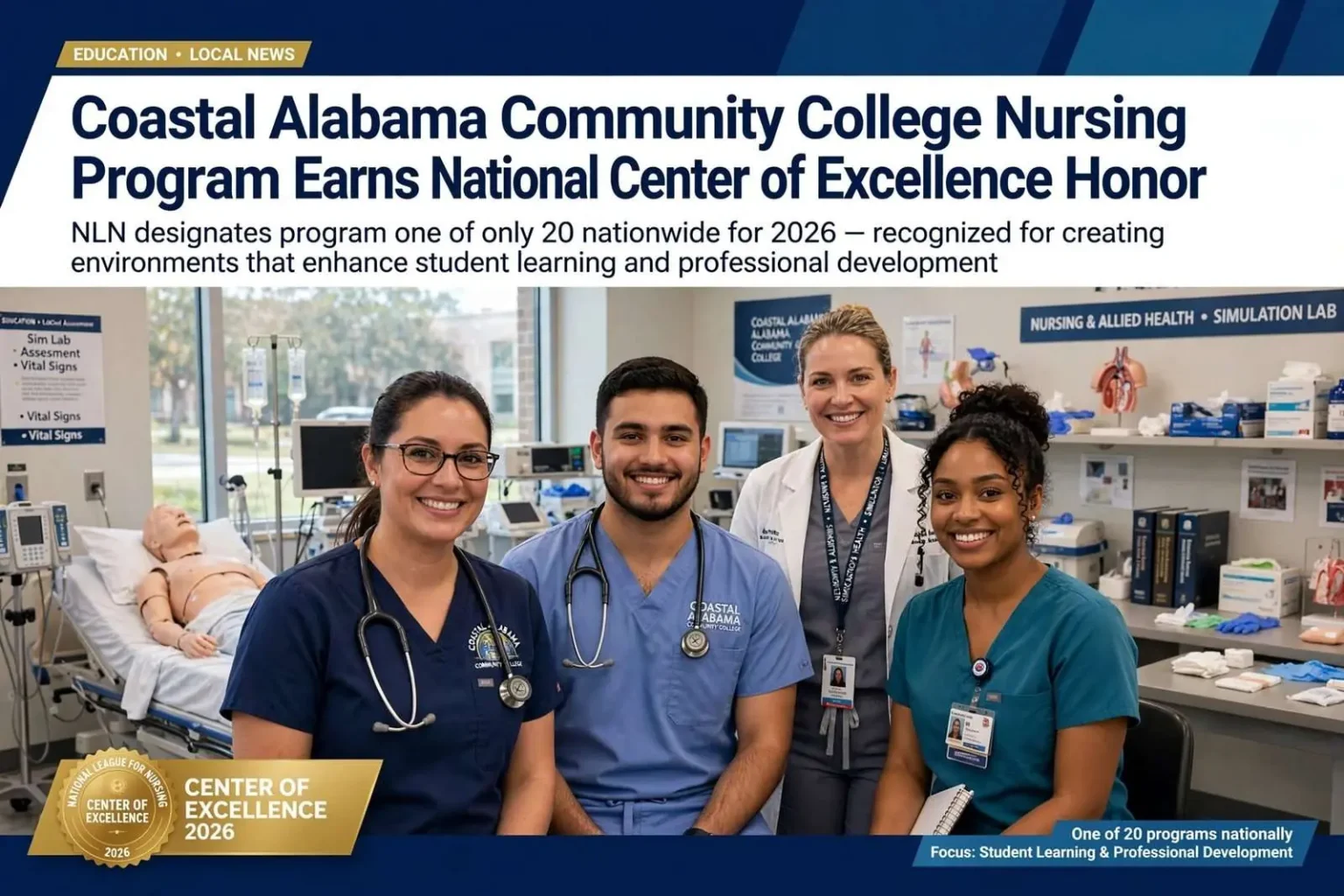
Coastal Alabama Community College’s nursing program has been designated a National League for Nursing (NLN) Center of Excellence in the category of Creating Environments that Enhance Student Learning and Professional Development, one of only 20 programs nationwide to receive the honor for 2026.
The designation, awarded by the National League for Nursing — the country’s leading organization for nurse faculty and nursing education leaders — recognizes programs that show sustained excellence and innovation in preparing future nurses. It highlights institutions that cultivate learning environments built on innovation, collaboration, evidence-based teaching and continuous professional growth for both students and faculty. Fewer than two dozen programs earned a Center of Excellence designation this cycle, making the 2026 class one of the most selective in the program’s history.
Standing among 20 programs in a nation with thousands of nursing programs places the college’s department in rare company, and the honor reflects years of work across classrooms, simulation labs and clinical partnerships that extend across the communities the college serves.
What the Designation Means
The NLN Centers of Excellence program exists to identify and celebrate nursing schools that demonstrate sustained, evidence-based excellence in faculty development, nursing education research and student learning. The category Coastal Alabama earned — Creating Environments that Enhance Student Learning and Professional Development — focuses on the conditions that surround a nursing student’s education: how faculty teach, how students are supported, and how a program builds professional growth into its culture rather than leaving it to chance.
Designees are selected through a rigorous application and review process in which programs document their practices and outcomes against the League’s standards. The honor is competitive precisely because it examines not a single metric but the sustained culture of a program — the things that determine whether graduates arrive in the workforce prepared, confident and committed to the profession.
“This recognition is a testament to the dedication, passion, and collaborative spirit of our nursing faculty, staff, students, and clinical partners,” said Dr. Tiffany Scarborough, dean of nursing and allied health at Coastal Alabama Community College. “Our mission has always been to prepare compassionate, highly skilled nurses who are ready to meet the evolving healthcare needs of our communities.”
The People Behind the Program
Dr. Tyler Sturdivant, associate dean of nursing and nursing program administrator, said the honor reflects the college’s focus on students from admission through graduation. “We have intentionally built a culture that promotes academic excellence, resilience, mentorship, and professional development while preparing graduates to provide safe, high-quality patient care,” Sturdivant said. “We are honored to receive this national distinction.”
The language both leaders use — culture, mentorship, resilience — tracks what nursing educators nationally identify as the difference between programs that merely train nurses and those that form them. Nursing school demands rigor that tests students’ endurance as much as their knowledge, and programs that pair that rigor with structured support tend to graduate classes that pass licensure exams at high rates and stay in the profession.
Mentorship, in particular, works in both directions in a program like Coastal Alabama’s. Faculty members mentor students through the hardest semesters, and students on the way up often return as clinical preceptors and, eventually, educators themselves — a cycle that builds the faculty pipeline the profession so badly needs. The clinical partners named in the college’s credit for the honor are part of that same cycle, hosting students in real care settings where classroom lessons become practiced skill.
About Coastal Alabama Community College
Coastal Alabama Community College serves a broad stretch of the state through a network of campuses and instructional sites stretching across south and central Alabama. Its nursing and allied health programs are among the college’s most consequential offerings, feeding qualified graduates into the hospitals, clinics and long-term care facilities that anchor healthcare delivery in the region’s smaller cities and rural communities.
Community colleges occupy a distinctive place in American nursing education. Associate-degree nursing programs produce a large share of the nation’s registered nurses, and for many students — particularly those balancing work and family — the community college pathway is the practical route into the profession. Programs that earn national recognition raise the profile of that pathway and of the region their graduates serve.
The college’s multi-campus structure shapes how its nursing program operates. Students may begin their coursework at different campuses and sites across the service area, but they work toward the same standards, sit for the same licensure examination, and enter the same workforce. A designation earned by the program is shared by every campus and site that contributes to it — and by the communities that recruit from it.
Addressing Alabama’s Nursing Workforce
College officials said the recognition reinforces Coastal Alabama’s role as a leader in nursing education, as it works to help address ongoing workforce needs by preparing qualified nurses to serve Alabama and beyond. The need they describe is not abstract: Alabama, like the nation, faces persistent shortages of nursing professionals, with rural counties and long-term care settings feeling the strain most acutely.
The shortage has multiple dimensions — an aging nursing workforce approaching retirement, growing demand for care as the population ages, and limited capacity in nursing education itself, where faculty vacancies constrain how many students programs can admit. Programs that both expand access and demonstrate excellence in preparing graduates sit at the center of any credible response to that shortage. The bottleneck is often educational capacity rather than applicant interest; qualified students are turned away nationally each year because there are not enough faculty seats to teach them, which makes the programs that do expand — and do it well — especially significant.
For the communities along the Gulf Coast and through the Black Belt that the college serves, a nationally recognized nursing program close to home means two things: a pipeline of well-prepared nurses entering local facilities, and a route into a stable professional career for students who might otherwise leave the region to find one.
The National League for Nursing
The National League for Nursing has a long history in American nursing education, tracing its roots to the nineteenth century and its modern form to the twentieth. It advances excellence through faculty development programs, testing and certification services, research support and public recognition of outstanding schools. Its Centers of Excellence program, under which Coastal Alabama now sits, functions as both an honor and a network — designees are expected to serve as models and resources for programs seeking to improve.
That model-and-resource role gives the designation practical value beyond the certificate on the wall. Students weighing nursing programs can look to the NLN’s list as a signal of quality; faculty recruitment benefits from the program’s visibility; and the college’s clinical partners — the hospitals and agencies that host students — gain assurance that the pipeline they depend on meets a national benchmark.
What Comes Next for the Program
Center of Excellence status carries expectations of continued leadership. Designees typically host visits from other programs, contribute to the League’s conferences and publications, and document ongoing outcomes during their designation period. For Coastal Alabama’s nursing faculty, the honor formalizes work they have been doing and adds a platform for extending it.
The designation period also gives the program a national peer group. The other Centers of Excellence — spread across universities, colleges and health systems nationwide — become colleagues rather than competitors, sharing what works in curriculum, simulation and student support. For a community college program, access to that network is itself a resource that compounds the value of the honor.
The recognition also lands at a moment of change in nursing education nationally, as programs integrate simulation technology, expand flexible pathways for working students, and respond to the lessons of a healthcare system tested in recent years. Programs honored for their learning environments are, by definition, the ones positioned to adapt while keeping their standards intact.
A Regional Distinction with Statewide Reach
For Coastal Alabama Community College, the honor is institutional — but its effects reach into every community where a graduate takes a position. Every cohort the program graduates enters a healthcare system that needs them, and the NLN designation is a public statement that those graduates come from one of the nation’s strongest learning environments.
The college’s nursing leaders framed the distinction as a shared one — earned by faculty, staff, students and clinical partners together. That framing matches how the honor itself is structured: the NLN evaluates environments, not individuals, and the environment that earned Coastal Alabama its place among 20 programs nationwide is the product of years of sustained, collective effort.
As the 2026 designation takes effect, the program’s task becomes what it has always been: preparing compassionate, highly skilled nurses for the communities that count on them — now with a national standard affirming that it does so among the very best.