
Coheed and Cambria Bring ‘The Afterman’ Tour to Mobile’s Soul Kitchen
Coheed and Cambria brought The Afterman tour to the Soul Kitchen in Mobile, Alabama in November 2013. Guitarist Travis Stever on The Amory Wars and more.
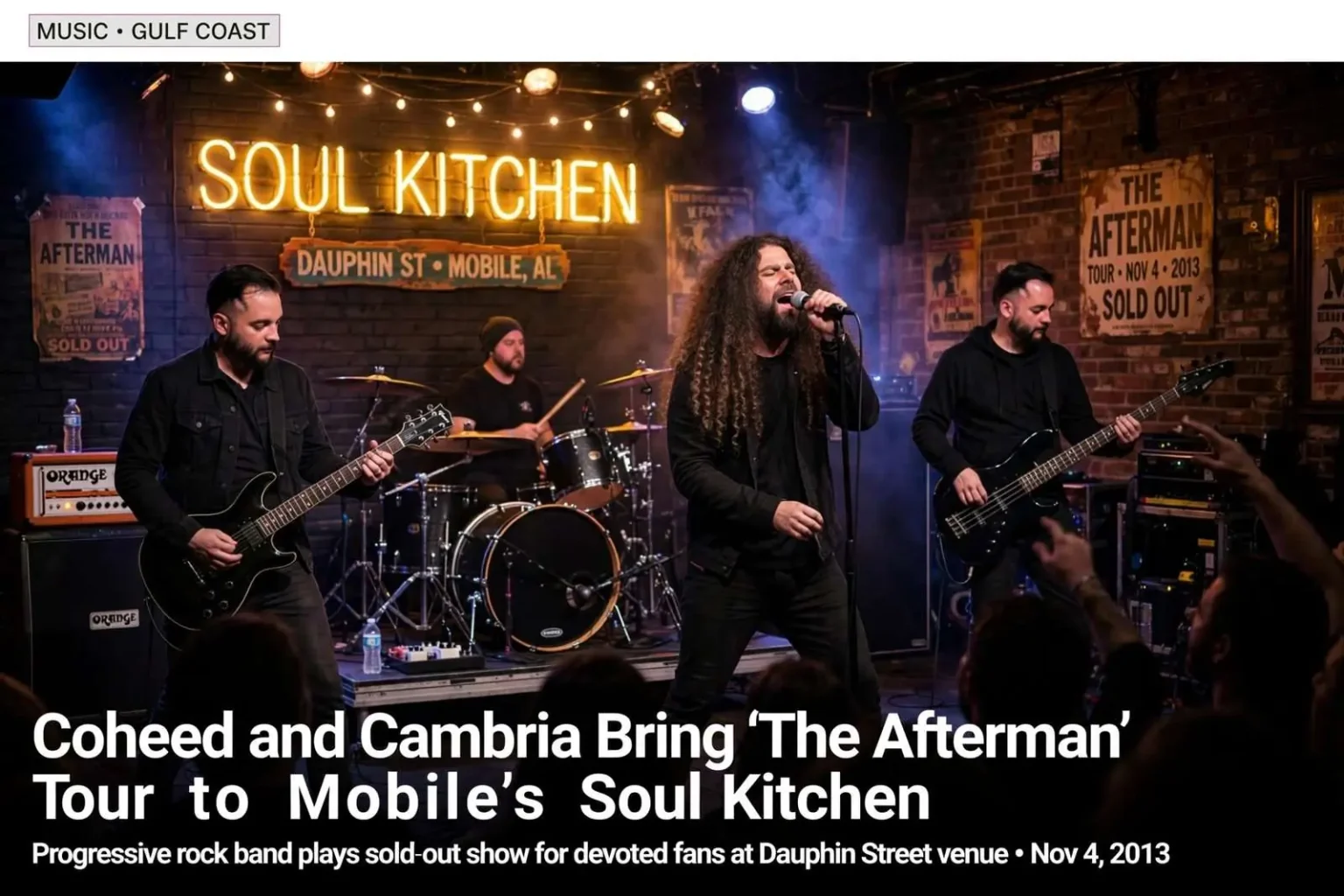
Progressive rock heavyweights Coheed and Cambria rolled into Mobile’s Soul Kitchen in early November 2013, capping a fall run that gave local fans their second chance in a few years to catch the New York band after their earlier Hangout Festival appearance on the Gulf Coast. The Monday night show opened its doors at 7 p.m., with advance tickets priced at $25 and day-of-show admission at $28.
Given the band’s devoted following, early purchase was the smart play for anyone hoping to get inside one of Soul Kitchen’s biggest bookings of the fall. The venue, a mainstay of Dauphin Street’s entertainment district, has built its reputation on landing national touring acts that would have bypassed Mobile a generation ago, and a band of Coheed’s stature on a Monday night underscored how the Gulf Coast touring circuit has expanded — bands that once skipped the region between New Orleans and Atlanta now route through the city’s clubs.
The Hangout Festival connection ran deeper than a single booking. The Gulf Shores beach festival, held each May along Alabama’s coastline, has become a national destination that introduces major acts to Gulf Coast audiences, and Coheed’s appearance there gave the band a regional following that a stand-alone club date in Mobile could then capture. For local fans, the fall show offered something the festival setting never could: a full headline set, close quarters, and a room full of the band’s most committed listeners rather than a casual beach crowd.
A Band Built on a Universe
Rhythm guitarist Travis Stever talked with local media ahead of the stop, describing what keeps the road rewarding. “It’s a good thing for us to be out playing for people,” Stever said. After more than a decade together, the band had settled into a working rhythm built on relentless touring — the kind of road-tested cohesion that shows up in the details, transitions tightening, sets breathing with the crowd, and songs from different eras stitching together seamlessly each night.
What sets Coheed apart from nearly every other act on the rock circuit is its sprawling concept mythology, “The Amory Wars” — an elaborate sci-fi saga told across the band’s albums, complete with its own comic book series and cast of characters. Nearly every Coheed record advances a chapter of the story, written by frontman Claudio Sanchez, following the Armory Wars saga across planets, tyrants, and family tragedy in a serialized universe that unfolded album by album the way a novel series does across volumes. The comics extended the narrative beyond the music, giving fans a second medium through which to follow the story and drawing comic-shop readers into the band’s audience in turn.
That interconnectivity has earned the group one of music’s most loyal cult audiences. Coheed fans do not merely listen to albums; they study them, decode them, and attend shows in costume and in groups, treating each tour as a reunion of a shared fandom. “I don’t think the story will ever go away, because there are so many avenues to take the story,” Stever said. “I hope it never does. I think the sky’s the limit.” The band’s willingness to let the mythology expand — into comics, novels, and beyond — has kept two decades of material in continuous conversation with itself.
From Acoustic Demos to Arena Sound
Sonically, the band blends progressive rock with post-hardcore urgency — intricate, metal-flavored riff trading between Stever and frontman Claudio Sanchez beneath Sanchez’s unmistakable falsetto. The combination is the band’s signature: rhythm sections that swing from punk propulsion to prog epics, guitar lines that trade leads the way classic metal dual-guitar teams did, and a voice that leaps into registers most rock frontmen never attempt. Listeners have drawn comparisons to everyone from Rush to At The Drive-In, a pairing that captures both the band’s compositional ambition and its hardcore-rooted energy.
The songwriting process, Stever explained, usually starts small: an acoustic demo worked up at Sanchez’s house before the rest of the arrangements layer in. “For the most part… he’ll have an acoustic demo, we’ll work on something at his house, I’ll come up with some guitars around it, and everything else just kinda happens,” he said. The organic build from one writer’s sketches to a full-band arrangement has kept the group’s records coherent even as their sound expanded — songs that begin as a voice and a guitar can grow into the multi-movement suites that fill out the band’s longer albums without losing their melodic core.
Breakthrough came with 2003’s “In Keeping Secrets of Silent Earth: 3” and the hit “A Favor House Atlantic,” followed by “Good Apollo, I’m Burning Star IV” and singles like “Welcome Home” and “The Suffering.” Those records carried the band from the Long Island club circuit to arenas and festival main stages — “Welcome Home” in particular became the band’s calling card, a seven-minute epic that introduced millions of listeners to the Amory Wars mythology whether they knew it or not. By the time of the Mobile show, the catalog spanned a decade of releases and a setlist dilemma most bands would envy: too many fan favorites for one night.
The Tour and the Album Behind It
The 2013 tour supported that year’s release “The Afterman: Descension.” The record completed “The Afterman” double album, the project that took the band’s storytelling inward — trading cosmic warfare for the personal story of an astronomer whose discoveries ripple through his life and marriage. Released in two halves across 2012 and 2013, “The Afterman” earned some of the strongest reviews of the band’s career, with critics noting that the tighter narrative focus had sharpened the songwriting itself. For the fall tour, the double-album structure gave the band a fresh framework for building sets, mixing the new chapters with the older Amory Wars material fans had followed for a decade.
For Soul Kitchen, the booking fit the venue’s trajectory in 2013. The club had spent the year stacking its calendar with national touring acts, and a progressive rock band with a two-decade catalog and a devoted national following fit the room’s sweet spot: large enough to sell out, intimate enough that every ticket felt close to the stage. Monday night dates are often the compromise of routing realities, but for a band with Coheed’s following, the night of the week mattered less than the rarity of the visit — Gulf Coast fans had learned not to assume a next time.
Doors at 7 p.m. set up a full evening, with the band’s progressive rock delivery — falsetto leads, dual-guitar interplay, and sci-fi narrative threading through the set — arriving as the centerpiece of a Dauphin Street night out. For Mobile’s rock fans, the show was a marker of how far the local scene had come: a band with a comic-book universe, an arena-sized sound, and a cult audience measured in the millions, playing a room of a few hundred on the Gulf Coast, and selling it out on the strength of fans who had been following the story one album — and now one tour stop — at a time.
The Amory Wars Beyond the Music
The mythology that sets Coheed apart has grown into one of the most elaborate transmedia projects any rock band has attempted. The Amory Wars saga has been published as a full comic book series with professional artists and publishers, its plot arcs mapped across the band’s albums so that a listener can follow the story from record to record the way readers follow a serialized novel. That structure changes how the audience relates to the music: songs are chapters, albums are volumes, and a new release is an event that fans approach with the anticipation comic readers bring to a milestone issue. The band has encouraged the expansion — Sanchez, the saga’s author, has treated side projects and media extensions as part of the work rather than merchandise around it.
For the audience, the result is a fandom with unusual depth. Longtime listeners can trace character arcs across two decades of tracklists, debate interpretations online, and introduce new fans to the catalog with a reading order as well as a listening order. That depth is what fills venues night after night on a tour like this one — the Mobile crowd did not arrive for a hit single, but for the next installment of a story they have been following, played live by the only four people who can play it.
Progressive Rock’s Second Life
Coheed’s rise has paralleled a broader revival of ambitious, long-form rock in the 2000s and 2010s. The band came up through the same Long Island and New Jersey scene that produced much of the era’s post-hardcore generation, but where most of their peers sharpened songs toward radio formats, Coheed doubled down on suites, recurring musical themes, and narrative continuity — ideas borrowed as much from 1970s progressive rock as from hardcore’s intensity. The gamble aged well: as mainstream rock radio contracted, the bands that survived touring were the ones with audiences attached to something a playlist could not replace, and few audiences are more attached than one following a twenty-year story.
The comparison to Rush — mentioned by nearly every writer who has grappled with the band’s sound — captures the technical side: three musicians with instrumental virtuosity and a taste for odd meters and extended compositions. The comparison to At The Drive-In captures the energy: hardcore urgency, tremolo-picked lines, and a frontman capable of sounding desperate at full voice. Coheed’s fusion of the two schools, with Sanchez’s falsetto floating above riffs built for a mosh pit, is the band’s own contribution to the lineage.
What the Mobile Date Meant
For Gulf Coast fans, the November date completed a year that had already included the band at the Hangout Festival grounds in Gulf Shores, and the contrast between the two experiences illustrated why club shows endure. A festival set is a sample — however strong, it competes with dozens of other stages, sound bleed, and a crowd of generalists. A headlining club date is the full argument: two hours inside the band’s universe, with the deep cuts, the extended passages, and the running order built for people who know every word. The $25 advance ticket bought the kind of night that festival passes costing ten times as much cannot guarantee.
Soul Kitchen’s stage of the fall touring calendar also carried the practical romance of the road. Monday night in mid-November, the band rolled off a stretch of Texas and Southeast dates into downtown Mobile, where Dauphin Street’s bars and restaurants absorb a tour bus crowd the way they have absorbed traveling musicians for generations. The morning after, the tour would push on toward the next city, but the night belonged to the room — a progressive rock epic performed in a few hundred seats on the Gulf Coast, by a band whose story, as Stever said, has so many avenues left that the sky’s the limit.


