
Cold Case Arrest: Pensacola Man Accused in Decade-Old Drugging and Sexual Assault
Aaron Bates is charged with sexual assault in a 2009 Pensacola cold case after FDLE DNA evidence matched him while he served time in Mississippi.
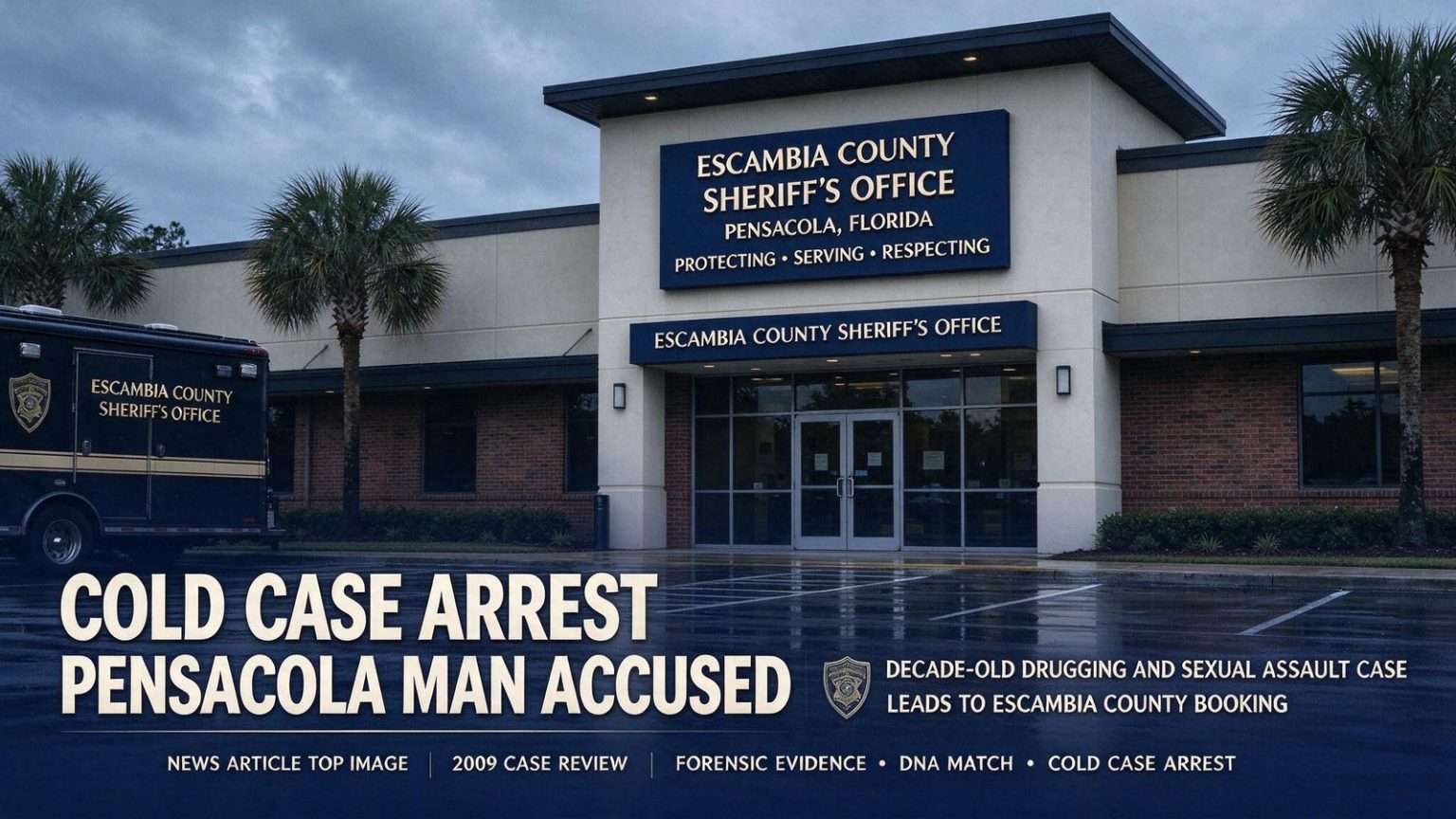
More than a decade after the attack, Escambia County investigators have made an arrest in a 2009 sexual battery case. Aaron Bates, 37, has been booked into the Escambia County Jail on a sexual assault charge stemming from an incident reported Sept. 27, 2009, according to the Escambia County Sheriff’s Office. The arrest closed a gap that had persisted for years between a victim’s account, a DNA match and a suspect investigators could not reach — and it illustrates how cold-case work in Florida unfolds when the evidence outlasts the suspect’s freedom.
Deputies who responded early that morning found the victim upset and physically ill. She told them a friend had brought her to a house where strangers were gathered, then left her there. She said she believed someone drugged her drink, and that her memory ended as she sat waiting on a couch for her friend to return. The account deputies documented that morning became the foundation of the case — the detail that would matter again, years later, when forensic science caught up with it.
The woman told deputies she next recalled waking on a bed, where she was being raped by two men and drifting in and out of consciousness. She remembered one of the men saying they had put her in the shower because she had pained herself. The description of the assault, recorded in the first hours after it happened, gave investigators a narrative framework that later evidence would corroborate — and it preserved, in the victim’s own words, the sequence of a night she could only partially remember.
Sexual assault investigations of this kind depend heavily on the first response. Deputies secured the scene, arranged for the victim’s medical examination, and collected the forensic evidence that would sit in storage for years before technology and opportunity aligned. The Escambia County Sheriff’s Office, one of the largest sheriff’s offices in the Florida Panhandle, maintains an investigations division that carries unsolved cases forward even as deputies rotate, retire and take new assignments — the quiet infrastructure that makes an arrest years later possible.
An early identification, a missing suspect
The victim identified Bates in a photo lineup that October, less than a month after the attack. But deputies were unable to find him. Bates was already wanted on other warrants, and his ability to stay ahead of authorities — moving between jurisdictions, avoiding his known haunts — kept the case from advancing past the identification stage. A photo lineup is evidence, not an arrest, and without a suspect in custody the case stalled at the same wall that stops many sexual assault investigations: a named suspect who cannot be located.
Bates later entered a Mississippi prison to serve time on other matters, where he still had six years left to serve when a 2014 Florida Department of Law Enforcement report matched crime scene DNA to him. The match turned the stalled investigation into a viable case — but it also raised the legal question that had been ticking since 2009. Florida’s statute of limitations for prosecuting the offense ran four years, and by 2014 that window had long since closed on its face.
Though a four-year statute of limitations would normally have lapsed, Florida law tolls the clock while a suspect is continuously absent from the state, allowing prosecutors to move forward. The tolling doctrine exists precisely for cases like this one: a suspect cannot benefit from the expiration of the limitations period if his own absence from Florida is what prevented prosecution. With Bates documented in another state’s prison system for a stretch that bridged the limitation period, the legal pathway to charges remained open even years after the attack.
The DNA match itself reflected the standard machinery of modern case review. The Florida Department of Law Enforcement operates the state’s crime laboratories, and evidence from unsolved cases is routinely compared against profiles in the national DNA database as new samples are entered — from arrests, from convictions, from other evidence submissions. A hit does not end a case; it restarts it, sending investigators back to the original file to re-interview witnesses, confirm chain of custody and build a charging decision for prosecutors.
The victim told investigators in 2014 that she still wanted to pursue charges. That answer, given five years after the attack and around the time the DNA match surfaced, kept the case alive through the legal and procedural steps that followed. Victims’ willingness to continue is often the deciding factor in whether cold sexual assault cases move forward at all — re-opening an investigation means re-living the attack in interviews and, eventually, in court — and her stated resolve gave the Sheriff’s Office and prosecutors a clear mandate.
How the case reached an arrest
The path from DNA match to booking involved coordination across state lines. Bates’s incarceration in Mississippi meant investigators had to work through that state’s correctional system to reach him, and the eventual arrest added its own layer of process: extradition or transport back to Escambia County, an initial court appearance, and the appointment of counsel before any trial date could be set. His booking into the Escambia County Jail marked the first time the suspect named in the 2009 report had been held in the jurisdiction where the attack occurred.
Interstate cases like this one are familiar ground for Florida Panhandle law enforcement. Escambia County sits at the junction of Alabama, Florida and the Gulf, and its agencies routinely work with counterparts in Mississippi, Alabama and across the region when suspects and evidence cross borders. The paperwork that moves a prisoner between state systems — detainers, governor’s warrants, transport orders — can take months, and the years Bates spent in the Mississippi system meant investigators had to balance the urgency of the DNA match against the slow mechanics of reaching a man already in custody elsewhere.
The case now moves into the court system, where the charges announced at booking are only the beginning. Prosecutors will review the evidence — the victim’s 2009 statement, the forensic material, the DNA match and the tolling analysis that keeps the case legally alive — and the defense will have every opportunity to challenge each link. A more-than-decade-old case presents particular challenges: memories have faded, witnesses have scattered, and the physical evidence must survive scrutiny of how it was collected and stored. The tolling question itself is likely to be litigated before any jury hears the facts of the attack.
The second man the victim described has not been announced as arrested, and the case file may remain open as to him. Cold-case units routinely treat a DNA hit as one thread in a larger tapestry, and investigators with new momentum on a 2009 file often revisit every lead associated with it — including the identity of others present at the house. Whether additional charges follow will depend on what the renewed investigation turns up.
What the case says about cold-case work
The arrest is a case study in why sexual assault evidence is preserved even when a case goes dormant. The forensic material collected in the hours after the 2009 attack sat in evidence storage for years before the database comparison produced a match — a delay that had nothing to do with the quality of the original investigation and everything to do with when the suspect’s DNA entered the system. Every year, database hits like this one convert dormant files into arrests, which is why victim advocates press relentlessly for the timely testing of stored sexual assault kits.
The tolling provision that kept prosecution possible is also worth understanding. Statutes of limitations exist to protect defendants from stale evidence, but Florida’s Legislature carved out the absence exception to prevent suspects from gaming the clock by leaving the state. Courts apply the provision strictly — the absence must be continuous and documented — which is why investigators took care to establish Bates’s whereabouts through his Mississippi prison record before prosecutors relied on it. The doctrine has rescued any number of Florida cold cases from the limitations bar.
For the victim, the arrest arrives more than a decade after the morning she sat with deputies and gave them what they needed. Cases of this kind test the patience of everyone involved: the investigators who carry the file between assignments, the prosecutors who must make the tolling argument stick, and the victim who was asked in 2014 whether she still wanted to pursue charges and answered yes. The Escambia County Sheriff’s Office has not announced what happens next beyond the booking, but the case that stalled in 2009 is moving again — and the man identified in that October photo lineup is finally in a jail in the county where the attack occurred.


