
Cold Nights Ahead: Mobile’s Salvation Army Collects Coats and Blankets Before Opening as Cold-Weather Shelter
Mobile's Salvation Army is collecting coats and blankets before opening its emergency cold-weather shelter when temperatures drop below 40 degrees.
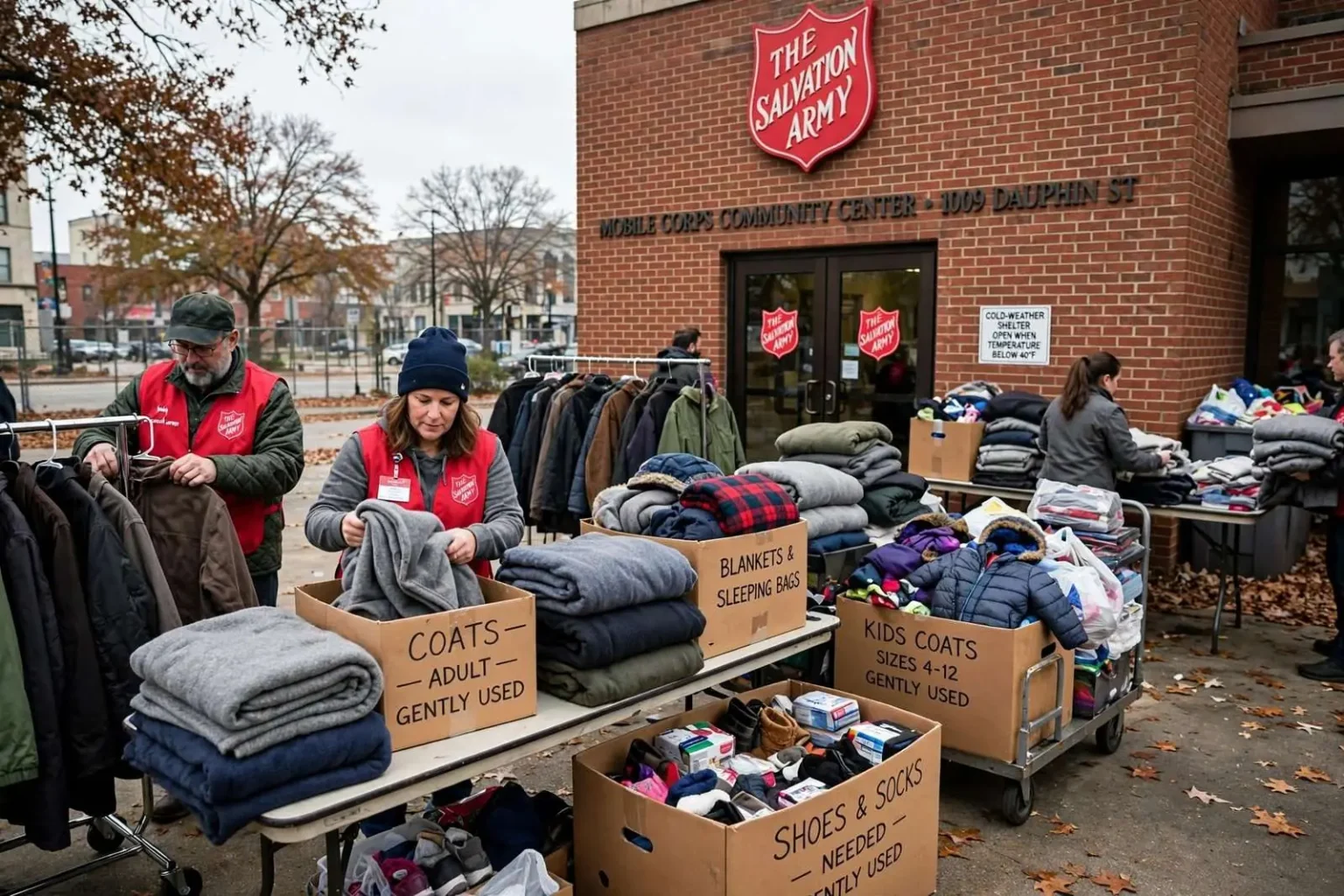
MOBILE, Ala. — With chilly nights in the forecast in November 2018, The Salvation Army put out a call for warm clothing — and prepared to open its doors. Whenever the temperature dips below 40 degrees, the organization operates as an emergency cold-weather shelter, giving people without a warm place to stay a way to escape the cold. Forecasters were expecting several nights that cold the following week, so volunteers were gathering winter items to hand out to everyone who came in from the low temperatures.
The trigger system is a familiar rhythm on the Gulf Coast, where winters rarely justify a season-long shelter operation but can still turn dangerous overnight. South Alabama’s housing stock is built for heat and humidity rather than hard freezes, and the region’s unhoused residents have limited access to the heavy bedding and layered clothing that colder climates consider routine. A night in the upper 30s that would barely register in Chicago can be a genuine medical threat in Mobile, especially for older adults, people with chronic illness and anyone sleeping outdoors near the water, where wind off the bay cuts the effective temperature even lower.
That is why the Salvation Army’s Mobile corps treats the 40-degree threshold as a standing order. When the forecast crosses it, the shelter opens its doors, cots go out, and staff and volunteers shift into emergency mode — often on short notice, and usually for a string of nights at a time as cold fronts move through in succession.
What the shelter needs
“Jackets, blankets, coats, shoes, anything that will help someone stay warm,” said volunteer manager Genie Baker. The list reflects what guests actually need when they come in from a cold night: not just a cot, but dry clothing to change into, warm layers for the morning, and blankets substantial enough for temperatures that, while mild by national standards, are cold by Gulf Coast ones. Donations of gently used items were welcome, Baker said, and families cleaning out closets should remember the kids.
The Salvation Army also runs a family shelter and accepts children’s winter gear. “Kids grow so fast,” she said. “Just like anyone else’s child, children need new coats every year.” The point lands with any parent who has packed away a coat in the spring only to find it too small by the next cold snap — a cycle of outgrowing that falls hardest on families with tight budgets. For the organization’s family shelter, which houses parents and children together, a supply of youth coats in every size is as essential as the adult inventory.
Shoes belong on the list for reasons that may not be obvious at first. Guests arriving at an emergency shelter frequently arrive wet — rain, dew, or sweat after a long walk — and dry socks and footwear prevent the foot problems that cold, damp conditions cause. Blankets and coats carry guests through the night; shoes and socks carry them through the following day.
How cold snaps work on the Gulf Coast
November cold fronts in south Alabama follow a pattern locals know well: a strong front sweeps through, temperatures tumble 30 degrees in a day, and the coldest air settles in for two or three nights behind it before moderating. The Gulf moderates the extremes — single digits are nearly unheard of in Mobile — but freezing temperatures do occur every winter, and the wind chill near the waterfront can make a 35-degree night feel far colder. The National Weather Service office serving south Mobile County issues freeze warnings and wind chill advisories for exactly the nights the shelter plan anticipates.
Because the cold arrives in bursts rather than a continuous season, emergency sheltering in Mobile is inherently episodic. The Salvation Army’s system of opening below 40 degrees means the facility may operate a full shelter for a week in January and be closed to cold-weather guests in December — which is precisely why donations matter before the forecast turns rather than after. An organization that must scale up on 48 hours’ notice cannot wait for the first cold night to gather coats.
The November 2018 cold snap fit the pattern. Forecasters expected several nights below the threshold in the following week, meaning the shelter would likely cycle through the routine repeatedly: open in the evening, intake guests as temperatures dropped, hand out warm items, provide a safe night’s sleep and a morning meal, then reset for the next night. Each cycle consumes supplies — blankets wear out, socks are taken and worn, coats leave with the guests who need them — so the inventory must be constantly replenished.
A century of service on Dauphin Street
The Mobile Salvation Army’s presence downtown long predates the shelter program. The organization has served the city since the late 19th century, and its corps community center on Dauphin Street places it within walking distance of the downtown neighborhoods where the need is most concentrated. Alongside the emergency shelter work, the local command runs the family shelter, food service, youth programs and the year-round social services the organization is known for across the Gulf Coast — plus the kettle bells and toy drives that mark its public face each holiday season.
Donations could be dropped off at The Salvation Army at 1009 Dauphin Street in Mobile, or at the Pensacola location at 1501 North Q Street for donors across the state line. The two-city arrangement acknowledges how the region actually works: the Mobile-Pensacola corridor shares media markets, highways and family connections, and donors in Escambia County, Florida, who heard the call had a drop-off point of their own rather than a 60-mile drive west.
For donors deciding what to give, Baker’s guidance effectively doubled as a shopping list: jackets, blankets, coats and shoes, in adult and children’s sizes, gently used or new. The organization accepts the items year-round, but cold snaps are when the shelves empty fastest, and November — with the whole winter still ahead — is when a donation does the most good over the longest season.
Who the shelter serves
The guests who arrive on cold nights are a diverse group. Some are chronically homeless residents of downtown Mobile who know the shelter’s routine well. Others are people experiencing homelessness for the first time — workers priced out of housing, people fleeing a family crisis, individuals recently released from hospitals or institutions — who arrive unfamiliar with the system. Families may be staying in the family shelter year-round, while single adults cycle through the emergency beds. What they share on a 38-degree night is the same basic need: somewhere warm, safe and dry until morning.
The cold-weather shelter also serves a broader safety function for the city. Exposure is a documented killer of unhoused people even in southern climates, and hypothermia does not require sub-freezing air — prolonged wet chill in the 40s can bring body temperature down, especially among people with poor nutrition or untreated illness. Opening the shelter on trigger nights is, in the most literal sense, a life-safety measure, and one that depends on the community’s donations and volunteer hours as much as on the organization’s staff.
Volunteers are the flexible labor that makes the model work. Staffing an emergency shelter with employees alone would be prohibitively expensive for the nights it operates; volunteers handle intake, distribute blankets and clothing, serve meals and help guests settle in. The organization’s volunteer corps in Mobile, coordinated through its Dauphin Street facility, includes church groups, civic clubs and individual residents who show up when the forecast drops — and Baker’s role as volunteer manager is to keep that corps organized and supplied.
How the community can help
Beyond coats and blankets, the organization’s needs during cold weather extend to the practical items that make an emergency stay survivable: toiletries, socks, undergarments and tarps or rain gear for guests returning outdoors in the morning. Monetary donations, which the Salvation Army accepts at its facilities and online, let staff purchase exactly what is missing from the shelves in the sizes and quantities needed — often the most efficient option when a cold front is two days out.
Residents who want to do more than donate can plan ahead for the season. Knowing that the shelter opens below 40 degrees, neighbors, landlords, police officers, hospital staff and outreach workers across downtown can refer anyone they encounter without warm lodging to 1009 Dauphin Street on trigger nights. The system works only if the people who need it know it exists, and every cold front brings first-time guests who learned about the shelter from a passerby rather than a sign.
As the November 2018 cold front approached, the Salvation Army’s message to Mobile was characteristically direct: the doors would open when the temperature fell, the cots were ready, and the shelves needed filling first. A coat dropped off on a mild November afternoon would be on someone’s shoulders within the week. On the Gulf Coast, where winter arrives in short, sharp bursts, that advance preparation is what turns a forecast into a plan — and a cold night into a safe one for every person who comes in from it.


