
Cold Shelters Open Across Mobile and Northwest Florida as Temperatures Plummet
Cold shelters and warming centers open in Mobile, Ensley, Crestview and Milton as Gulf Coast temperatures drop below 40 degrees Friday night.
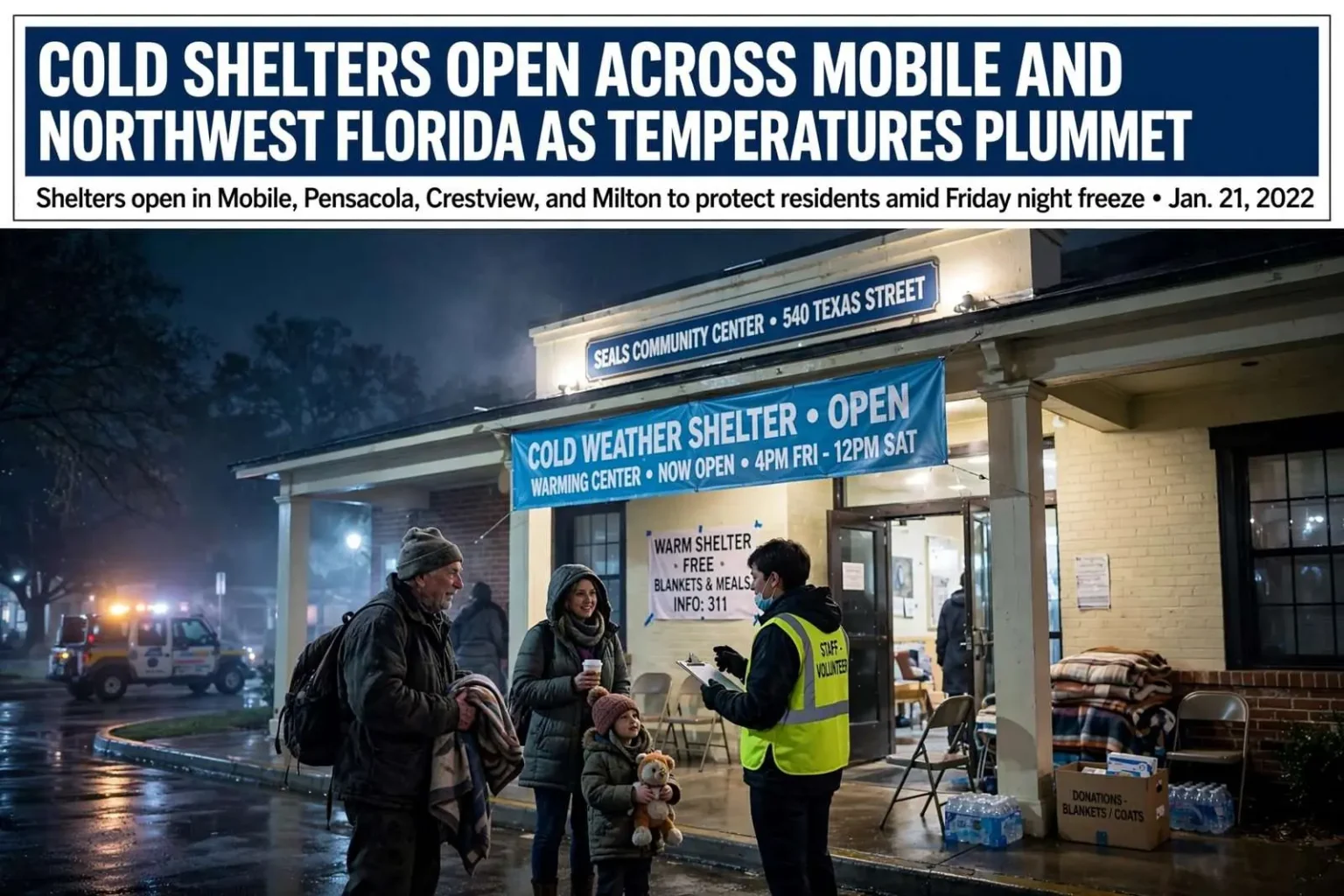
With temperatures expected to fall below 40 degrees across several Gulf Coast counties Friday night, Jan. 21, 2022, communities from Mobile to the Florida Panhandle opened cold weather shelters and warming centers for residents without reliable heat. The activation was a routine exercise in Gulf Coast emergency management — routine, that is, until one remembers that the region’s infrastructure and its people are built for hurricanes and heat, not for cold, and that even a modest chill can be deadly for those with nowhere warm to sleep.
In Mobile, the city opened a cold weather shelter at the Seals Community Center, 540 Texas Street. Doors opened Friday at 4 p.m., with the center remaining open until noon Saturday, Jan. 22, giving anyone who needed a warm place overnight a predictable window and a known address. The city’s community centers double as warming sites because they sit in established neighborhoods, carry the staffing to open quickly and offer the open floor space a shelter requires — the same qualities that make them useful during hurricane evacuations and summer heat activations.
Shelters across the Panhandle
Across the state line, the Pensacola area’s response leaned on the faith communities that anchor cold-weather sheltering in Northwest Florida. Ensley First Baptist Church accepted women and children at its cold shelter from 6 p.m. to 8:30 p.m., with guests returning for checkout at 7 a.m. The evening intake window and morning checkout structure is the standard rhythm of church-based cold shelters, which rely on volunteers and operate overnight in fellowship halls and classrooms that serve other purposes the rest of the week.
In Crestview, the Crestview Area Shelter for the homeless opened at 6 p.m. at 120 Duggan Avenue, providing beds in a community whose overnight temperatures regularly run a few degrees cooler than the coast. And in Milton, Ferris Hill Baptist Church, 6848 Chaffin Street, opened its doors Friday night and planned to remain available through Monday morning, Jan. 24, at 7 a.m. — the longest commitment of the night, spanning the entire cold snap rather than the single worst evening. That distinction mattered: a shelter that stays open through the weekend gives overnight guests continuity instead of forcing them back out onto the street each morning with nowhere to go until the next nightfall.
Together the sites formed a patchwork safety net across two states, each run by local partners but activated by the same forecast — the coordination, informal as it is, that Gulf Coast communities have refined through years of shared weather.
Why near-freezing is dangerous here
Officials reminded residents that even brief Gulf Coast cold snaps can be dangerous — overnight lows near freezing pose a genuine hypothermia risk, particularly for people experiencing homelessness. The warning surprises newcomers from colder climates, but it rests on physiology and exposure rather than the thermometer alone. Hypothermia can develop when the body loses heat faster than it produces it, and wet coastal air accelerates that loss; a person sleeping outdoors in 35-degree damp weather loses heat faster than the same temperature would suggest. Without proper bedding, layers and wind protection, an overnight low near freezing is not merely uncomfortable — it is a medical emergency in the making.
The region’s housing stock compounds the risk. Many Gulf Coast homes lack serious insulation or central heat, built instead around shade, cross-ventilation and hurricane resilience. Elderly residents on fixed incomes face the choice between heating bills and other necessities, and space heaters — the region’s usual answer — bring their own fire and carbon monoxide hazards each winter.
Anyone needing transportation to a shelter, or looking for a site not on the list, was encouraged to contact their city’s non-emergency line, the clearinghouse that connects residents with whatever warmth their community has arranged.
How cold weather activation works
Cold weather sheltering on the Gulf Coast runs on forecast triggers. When overnight lows are projected to approach a threshold — typically near or below 40 degrees — cities, counties and nonprofit partners activate shelters that otherwise sit dark. In Mobile, that means the city parks and recreation network opens one of its community centers; in the Florida Panhandle, it means churches and established homeless services open their doors on a schedule announced through local media and social channels. The triggers exist because the need is episodic: a week of cold can pack a shelter, and weeks of mild weather can leave one empty, so the system flexes rather than runs year-round at every site.
Seals Community Center, on Texas Street in Mobile, is one of the city’s established public facilities, and its use as a cold shelter follows the playbook the city uses for other emergencies. Staff prepare the floor space, check guests in, and provide what warmth and safety a building can offer; the city communicates the address and hours through every available channel, because the population most at risk — people sleeping outside, in cars or in unheated rooms — is also the least likely to see a morning news report.
That is where the broader network comes in. Outreach workers, law enforcement officers on overnight patrol, hospitals and even neighbors pass along the shelter information person to person, and the non-emergency lines give families a way to arrange shelter for a relative or neighbor they are worried about.
The people the shelters serve
Cold shelters serve a wider population than many residents imagine. The visibly homeless are the core, but the doors are also open to people in homes that lost power, residents of unheated rooms and rentals, families in the middle of a housing crisis, and individuals who simply cannot afford the utility bill that a cold snap would require. On the Gulf Coast, where many homes are older and insulation is thin, a below-40 night can push a marginal household into crisis as easily as it endangers someone on the street.
The shelters’ rules reflect that breadth. Intake windows like Ensley First Baptist’s 6 p.m. to 8:30 p.m. allow volunteers to plan; separate accommodations for women and children recognize the vulnerability of families; and morning checkout — 7 a.m. in the Ensley model — lets guests reach jobs, bus stops and day services. The churches and community organizations that run these sites are, in practice, the region’s flexible emergency housing stock, activated a few nights a year when the forecast makes them necessary.
Ferris Hill Baptist’s weekend-long commitment in Milton addressed one of the system’s recurring gaps: the daytime and evening hours between a morning checkout and the next night’s intake, when guests have nowhere to be. A shelter that stays available through Monday morning blunts that cycle for the duration of the cold event.
Staying safe through a Gulf Coast cold snap
Public officials paired the shelter announcements with the standard advice that cold-weather veterans of the region repeat every winter: check on elderly neighbors, bring pets indoors, protect exposed pipes, and use space heaters with clearance and care. Carbon monoxide from generators and charcoal grills brought indoors is a recurring killer in Southern cold snaps, and space heaters placed too close to bedding drive a predictable spike in house fires. The advice matters because the Gulf Coast’s emergency rooms see the consequences of improvisation every time the temperature drops.
For residents without reliable heat, the message was simpler: come inside. The shelters at Seals Community Center in Mobile, Ensley First Baptist Church in Pensacola, the Crestview Area Shelter and Ferris Hill Baptist Church in Milton existed for exactly the nights the forecast promised, and no eligibility test stood between a cold resident and a warm floor.
The cold snap passed, as Gulf Coast cold snaps do — but only after the region’s shelters had done, once again, the quiet work of keeping its most vulnerable neighbors alive through the night.
The geography of the cold
The Friday night forecast that triggered the openings covered several Gulf Coast counties at once, from Mobile County across the Alabama coastal plain and into the Florida Panhandle. That stretch of the Gulf Coast shares a climate that rarely sees hard freezes — which is precisely why a night below 40 disrupts so much. Agriculture, outdoor work, fishing and construction all continue through winters that farther north would shut them down, and few residents keep the clothing, bedding or heating equipment that a true cold climate demands. When the forecast dips, the region adapts in real time: shelters open, pipes get wrapped, and schools and businesses make their own calls about the morning.
The January 2022 cold snap arrived in the middle of the Omicron winter, adding a public-health layer to an already strained season. Shelter operators were balancing warmth against crowding, and the usual shared-floor arrangements required more care than in pre-pandemic years. That context made the quick activation of sites — the city center in Mobile, the churches in Ensley and Milton, the established shelter in Crestview — all the more important, since every unfilled bed risked putting someone back into the cold.
What a night in a cold shelter looks like
The mechanics are simple but deliberate. Guests check in during the posted intake window, receive a floor cot or chair space, and settle in for a night of warmth that most of them would otherwise spend outdoors. Volunteers and staff provide blankets, a meal or snacks where donations allow, and a measure of security that a sidewalk, a parked car or an abandoned building cannot. In the morning, guests leave with referrals — to case management, meal programs, health clinics — that the shelter’s partner organizations provide during the day.
For the operators, the hardest part is not the night but the season. Cold weather activations come with little notice, rely on volunteers recruited on short timelines, and depend on donated blankets, food and supplies that arrive only when the public is reminded the need exists. Each activation is, in effect, a small mobilization mounted against a forecast — and the communities along the Gulf Coast have gotten good at it, even if the system runs on goodwill more than funding.
Residents who want to help during the next activation have well-worn options: donate blankets and coats through the organizations that run the shelters, volunteer for intake or overnight shifts, and spread the shelter information to anyone who might need it — especially the neighbors and relatives who are unlikely to see the announcement themselves.
Remembering the risk after the snap passes
The Friday night, Jan. 21, 2022 activation ended the way these episodes usually do — with temperatures recovering, shelters closing at their posted hours, and the region’s attention moving on. Seals Community Center emptied by noon Saturday, Ensley First Baptist’s guests checked out at 7 a.m., and Ferris Hill Baptist held on through the weekend as promised until Monday morning, Jan. 24.
But the underlying vulnerability does not close with the shelters. Every Gulf Coast winter carries a handful of these nights, and the population at risk — people experiencing homelessness, elderly residents in underheated homes, families one power bill away from crisis — grows with the region’s rising housing costs. The cold snap of January 2022 was, in that sense, both a successful emergency response and a recurring reminder: the infrastructure of warmth along the Gulf Coast is real, it works, and it depends on residents remembering, each time the forecast turns, exactly where the doors are open.
For that night at least, the answer ran from Texas Street in Mobile to Duggan Avenue in Crestview — and no one who reached a shelter had to face the cold alone.


