Colombia’s Bomba Estéreo Brings Electro-Tropical Sound to Mobile’s Alabama Music Box
Bogota electro-tropical band Bomba Estereo, an SXSW and Bonnaroo alum, played a rare Gulf Coast show at Mobile's Alabama Music Box.
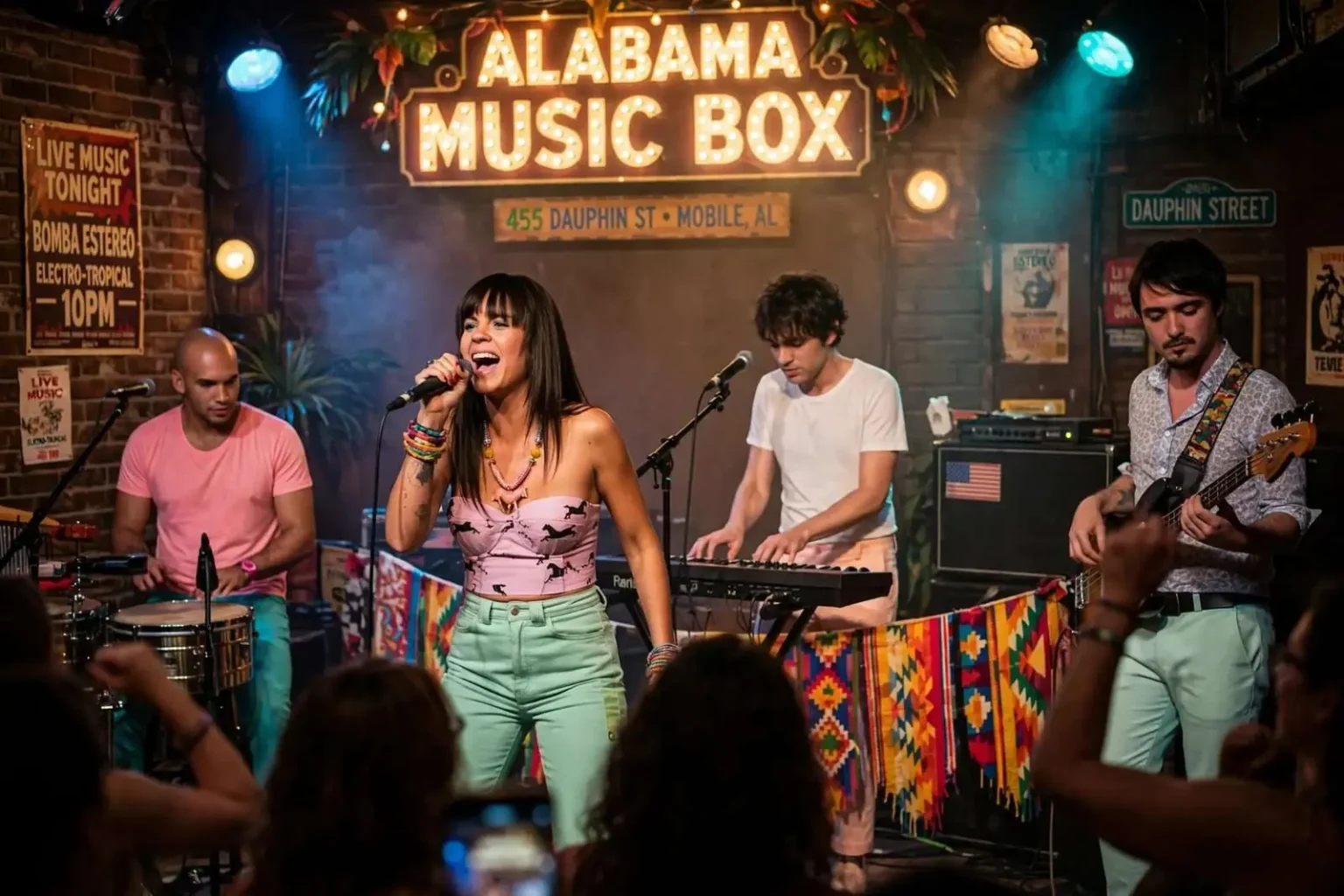
International touring acts don’t often route through Mobile — which made Bomba Estéreo’s stop at the Alabama Music Box a genuinely rare booking. The Bogotá band, one of South America’s most talked-about live acts, played the downtown Dauphin Street club on its North American run, giving local music fans the kind of show that usually required a trip to New Orleans, Atlanta or Nashville.
The Alabama Music Box, a fixture of the Dauphin Street entertainment district, has long been the venue most willing to book outside the standard circuit of touring cover bands and regional rock acts. Its room — a few hundred people at capacity — puts audiences close to the stage in a way that larger theaters cannot, and for a band whose live show is built on rhythm and movement, the setting suited the material.
Bomba Estéreo’s arrival in Mobile was the product of routing and reputation rather than chance. As the band’s North American tour mapped dates across the Southeast, the Dauphin Street club found itself on an itinerary that otherwise touched major markets — a reflection, venue watchers said, of the Alabama Music Box’s willingness to chase international talent that bigger Mobile rooms pass over.
Cumbia Meets Electronics
Bomba Estéreo’s sound fuses traditional Colombian cumbia with electronic music — an electro-tropical style that has carried the group far beyond its home country. Cumbia, the rhythm that grew from Colombia’s Caribbean coast and spread across Latin America as the continent’s shared dance music, provides the pulse; synthesizers, programmed percussion and bass-heavy production push it into club territory. The result is music rooted in tradition and engineered for a dance floor, and it translates as well in an American club as it does in Bogotá.
The band built its reputation on performances rather than radio play. Live, the group’s shows are physical affairs — driving percussion, hypnotic grooves and a front line that turns the stage into a celebration. That live intensity is what earned the band its standing as one of South America’s most in-demand touring acts, and what made the Mobile stop an event rather than just another weeknight booking.
By the time the band reached Dauphin Street, it had already been adopted by the international festival circuit — an unusual trajectory for any act, and rarer still for one singing primarily in Spanish. The Mobile show offered a chance to see that act in a room of a few hundred people, an intimacy the festival stages it had graduated to could never match.
A Band on the World’s Festival Stages
In 2010 alone, the band performed at some of the world’s biggest festivals: South by Southwest in Austin, the massive music-and-media conference that serves as an annual proving ground for acts on the way up; Bonnaroo in Tennessee, one of the largest and most prestigious festivals in the United States; Lovebox in London, a staple of the British festival summer; and Bumbershoot in Seattle, the long-running Labor Day weekend festival that closes out the American festival season.
That itinerary says something about the band’s reach. A Colombian group appearing at festivals in Texas, Tennessee, England and Washington in a single year is evidence of a sound traveling well beyond any single language market. Electro-tropical acts of this era found audiences across the Americas and Europe on the strength of rhythm alone, and Bomba Estéreo was among the movement’s most prominent ambassadors.
The industry recognition followed the touring. MTV Iggy, the music channel’s global-pop arm, named Bomba Estéreo one of the 25 best new bands in the world — a list that introduced international audiences to acts crossing borders and genres, and one that placed the Bogotá group alongside the most talked-about emerging acts anywhere in music.
For a band from Bogotá, the path through those venues traced the growing mainstream acceptance of Latin alternative music in the United States. College radio, festival bookers and music supervisors had spent the previous decade opening doors for acts that mixed traditional Latin American rhythms with contemporary production, and by the time Bomba Estéreo reached Mobile, the audience for that sound had spread well beyond the Latin music charts.
The Alabama Music Box and Dauphin Street
The Alabama Music Box has spent years as one of downtown Mobile’s essential live music rooms, sitting in the middle of the Dauphin Street corridor where the city’s nightlife concentrates. Dauphin Street runs through the heart of the historic downtown, lined with bars, restaurants and clubs that come alive on weekend nights, and the venue has been a consistent home for original music in a market where cover bands often dominate the club calendar.
Booking international acts is a calculated risk in a market Mobile’s size. The economics of touring favor rooms in larger metros, and bands routing between New Orleans and the Florida panhandle historically blew past the Alabama Gulf Coast. A venue that lands a Bogotá band mid-tour is one that works the phones, builds relationships with booking agents, and takes chances on acts before they price themselves out of small rooms — which is exactly the reputation the Music Box’s decision to chase this show reflected.
For the local scene, nights like this serve a function beyond the show itself. They expose Mobile audiences to music they would otherwise stream without ever hearing live, they prove to touring agents that the market can support a date, and they make the next international booking easier to sell. Venue watchers credited the club’s persistence with making Mobile a stop that agents could route through rather than around.
What the Audience Got
The crowd that filled the Dauphin Street club got a show scaled to the room: an internationally recognized act, close enough to watch the mechanics of the performance, in a space where the bass does the same work it does in a festival tent but the crowd is only a few hundred people. For fans who had tracked the band through its festival appearances and the MTV Iggy list, the difference between hearing electro-tropical music through headphones and standing inside its groove is the difference that makes club shows worth attending.
The stop also marked a moment for Mobile’s music community. A city that has historically watched international tours pass between New Orleans and Pensacola got one of South America’s most talked-about live acts on its own downtown street, on its own terms, in its own room.
However the routing luck broke, the lesson of the night was the one local venue watchers had been making for years: with the right room and the right persistence, Mobile doesn’t have to be a drive-through on the way to somewhere else. On this night, it was the destination — and the band on stage was one the rest of the festival world had already discovered.
The Bigger Picture for Gulf Coast Music
Bomba Estéreo’s Mobile appearance sits in a longer story about the Gulf Coast’s music map. The corridor from New Orleans across the panhandle hosts hundreds of venues, and the competition for touring acts is constant. Mobile’s advantages — a historic downtown, a walkable entertainment district, and a location squarely between two major markets — only matter when a venue converts them into bookings.
The electro-tropical movement the band represented has only grown since, with Latin alternative music moving from festival side stages to main stages and from niche radio to mainstream charts. Acts from across Latin America now tour the United States regularly, and rooms like the Alabama Music Box are where those audiences first form — a few hundred people on a weeknight, discovering a sound live before the rest of the country catches up.
For the fans in the room, the arithmetic was simple: the same band that played Austin, Manchester and Seattle that year played Dauphin Street, and the tickets cost club prices instead of festival prices. That is what a rare booking looks like — and why Mobile audiences learned to pay attention when the Music Box chased one.
Why Small Rooms Matter to Touring Bands
For a band climbing the international circuit, small rooms are where audiences are won. A festival slot puts an act in front of thousands of passersby, but a club date builds the kind of dedicated following that sells tickets on the next tour — and promoters across the country build their calendars on venues that reliably deliver those rooms. Mobile’s place in that economy depends entirely on its few remaining original-music stages doing the work of courting agents.
Club shows also pay off for the act in ways festivals cannot. A headlining club date means the band controls the room, plays a full set, and connects with an audience that bought a ticket specifically to see them. For an electro-tropical act whose music depends on sustained rhythm, an hour-plus set in a packed room is the ideal format — which is why the Alabama Music Box show was worth the detour for the band as much as for the crowd.
A Lasting Marker for the Local Scene
Nights like this one become reference points in a local music community. Fans remember the night a globally recognized act played a room they walk past every week, and the memory changes expectations: it becomes harder to convince Mobile audiences that world-class touring music only happens elsewhere. Venue owners, meanwhile, gain a proven data point to show booking agents that the market shows up.
The booking also connected Mobile to a wider story about Latin music’s international ascent. As electro-tropical and Latin alternative acts moved steadily into the global mainstream over the following years, the fans who caught them in small rooms along the way — including a few hundred on Dauphin Street — got to say they saw it early.
For a Tuesday-scale crowd in a mid-sized Gulf Coast city, that is the enduring value of a rare booking: the night a band from Bogotá turned a downtown Mobile club into a stop on the world tour.