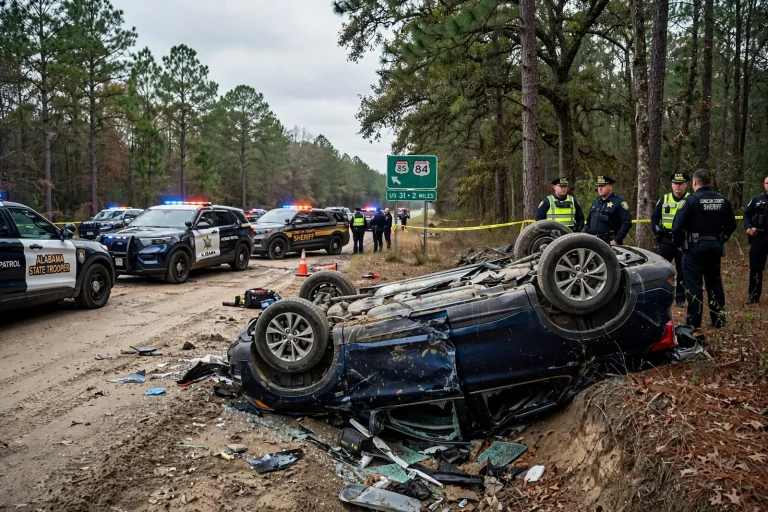
Commercial Vehicle Crash Closes I-65 Southbound Lane in Conecuh County
A single-vehicle crash involving a commercial truck shut down a southbound lane of I-65 in Conecuh County early Friday before all lanes reopened by midmorning, according to ALEA.
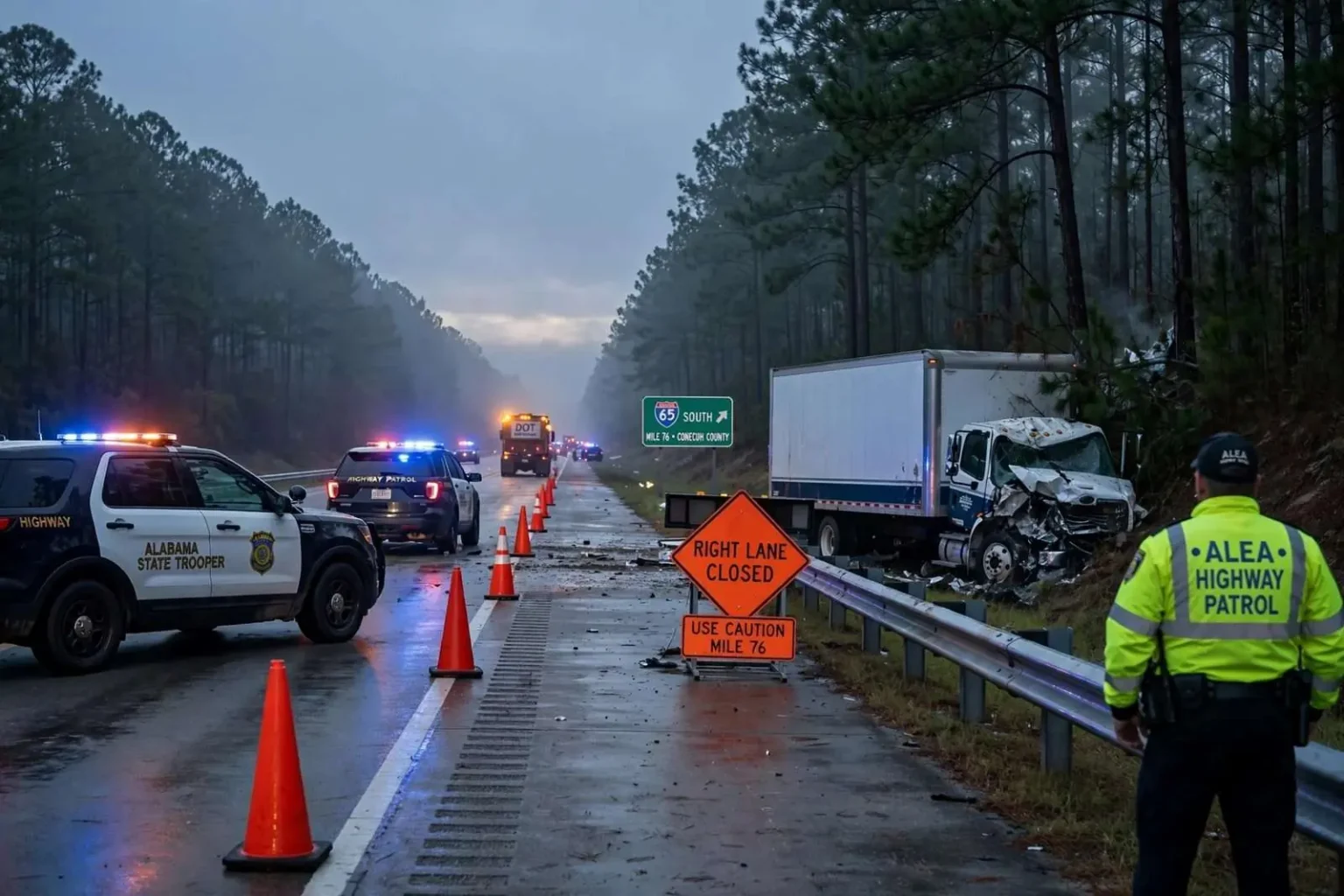
CONECUH COUNTY, Ala. — A commercial vehicle crash forced the closure of a southbound lane on Interstate 65 in Conecuh County early Friday morning, according to the Alabama Law Enforcement Agency, snarling traffic on the state’s principal north-south corridor before all lanes had reopened by midmorning.
ALEA said the single-vehicle crash occurred just before 5:30 a.m. near the 76 mile marker, prompting officials to shut down the right lane while crews worked the scene. The closure remained in place for several hours as authorities monitored the situation and worked to clear the roadway, with the restriction finally lifted by 9:42 a.m., when ALEA confirmed that all lanes of I-65 in the area had reopened.
Officials did not release information about the driver’s condition, and no further details about the crash have been made public. The absence of details in the hours after such a crash is typical: ALEA’s highway patrol division investigates commercial vehicle collisions with an eye toward both traffic reconstruction and any regulatory violations, and findings often are not announced until that work is complete.
For travelers and freight operators, the four-hour lane closure on a Friday morning translated into delays on one of the busiest stretches of highway between Mobile and Montgomery. I-65 serves as the spine of Alabama’s Gulf Coast commerce, and a blocked southbound lane near Conecuh County — the midpoint of the drive for much of that traffic — backs vehicles up for miles and reroutes others onto U.S. 31 and U.S. 84 through communities like Evergreen.
The corridor and the crash site
The 76 mile marker on I-65 sits in rural Conecuh County, a stretch of the interstate that crosses pine forest and rolling terrain between the Exit 83 interchange at Evergreen and the exchanges to the south toward Brewton and Atmore. It is the kind of segment where the highway carries a steady mix of commuter traffic, beach-bound travelers, and heavy trucks moving freight between the Port of Mobile and the Montgomery and Atlanta markets to the north.
Commercial vehicles account for a substantial share of I-65’s traffic in south Alabama, and the highway’s engineering — high speed limits, gradual curves, and long sight lines — generally produces fewer crashes per mile than rural two-lane roads. When a truck or other commercial vehicle does crash on the interstate, however, the consequences compound quickly: the vehicle’s size complicates recovery, any spilled cargo or fuel extends the cleanup, and each blocked lane of a highway this heavily used imposes costs on hundreds of drivers per hour.
A single-vehicle crash near 5:30 a.m. Friday also falls in the window that safety researchers flag for commercial transport: the pre-dawn hours, when alertness dips and visibility is reduced, and when drivers pushing to reach destinations by morning are on the road. ALEA’s account did not speculate on the cause, and this report preserves that restraint.
How ALEA works a commercial vehicle crash
The Alabama Law Enforcement Agency, formed in 2015 by consolidating the former Department of Public Safety and other state functions, handles interstate crash response through its Highway Patrol Division, with its Truck Safety Section providing commercial vehicle enforcement and inspection expertise. A crash involving a commercial vehicle typically draws both: patrol troopers manage the scene, document the roadway, and reconstruct the collision, while truck enforcement specialists examine the vehicle, its cargo, and the driver’s logs and licensing.
That examination is why commercial vehicle crashes keep lanes closed longer than comparable car crashes. A wrecked passenger car can be pushed clear or towed once injured parties are cared for; a commercial vehicle may require heavy wreckers, cargo transfer, and a hazardous-materials response if fuel tanks or cargo are compromised. Each step must be completed before the lane can safely reopen, and each is documented for the investigation.
The closure protocol itself follows a now-standard playbook. The right southbound lane is closed first, with traffic funneled past the scene; if conditions worsen, full closure and a detour follow. ALEA posts lane closures through its traffic advisories, which feed navigation apps and highway message boards, and troopers remain at the scene through the clearance to manage speed and keep approaching traffic away from workers.
What drivers faced Friday morning
From roughly 5:30 a.m. to 9:42 a.m., southbound traffic through Conecuh County moved at reduced volume past the crash scene. Friday mornings on I-65 between Montgomery and Mobile carry both the week’s last business freight and the leading edge of weekend travel toward the Gulf beaches — a mix that makes a lane closure there more disruptive than the same closure on a Tuesday.
Drivers who stayed on the interstate faced slowdowns approaching the 76 mile marker, while those who exited onto the parallel U.S. 31 or onto U.S. 84 through Evergreen found two-lane alternatives that slow quickly under heavy diversion. Local law enforcement in Conecuh County routinely assists during such events by managing intersections at the interchange ramps, keeping the flow moving between the interstate and the town’s surface streets.
The several-hour closure also illustrates the arithmetic of highway incident management. Federal highway safety guidance treats every minute of an unplanned lane closure as producing minutes of subsequent delay, because the queue of backed-up traffic takes far longer to dissipate than it took to form. Clearing a commercial vehicle crash in about four hours — with all lanes reopened by midmorning — is, by those standards, an efficient recovery for an incident of its type.
What the record shows
The verified facts of the incident are narrow, and this account holds to them: a single-vehicle commercial crash just before 5:30 a.m. Friday near the 76 mile marker on I-65 southbound in Conecuh County; a right-lane closure by the Alabama Law Enforcement Agency; a scene worked for several hours; all lanes reopened by 9:42 a.m.; no information released on the driver’s condition; and no further details made public.
Within that narrow frame, the incident still documents the routine machinery of interstate safety in south Alabama — troopers and truck enforcement specialists on the scene before dawn, heavy equipment summoned to a rural mile marker, a corridor’s traffic held to one lane, and a highway restored to full use before the morning was out.
It also documents the quiet role Conecuh County plays in the state’s transportation system: a rural stretch of pine-covered interstate between Evergreen and Atmore that most Alabamians know only as the middle hour of the drive to the beach — until something goes wrong near mile marker 76 and the whole corridor feels it.
Conecuh County and its highways
Conecuh County sits in south-central Alabama along the I-65 corridor, with Evergreen — the county seat — positioned directly on the interstate at Exits 91 and 93. The county’s economy has long been tied to the highways that cross it: the railroad that gave the town its name, U.S. 31 that predated the interstate, and I-65 itself, completed through this stretch in the 1970s and now the dominant route between the state’s two largest population centers of Mobile and Montgomery.
Rural counties along the interstate corridor absorb the consequences of its traffic in ways that rarely make headlines: crash responses handled by small volunteer fire departments, ambulance services stretched across wide territories, and coroner and emergency management duties that arrive without warning at all hours. A commercial vehicle crash near mile marker 76 summons resources from Evergreen and surrounding communities before any state response arrives.
ALEA’s post structure places troopers across the state’s highway districts, with the Montgomery-area and Mobile-area posts sharing coverage of the corridor through Conecuh County. The pre-dawn timing of the Friday crash meant the responding troopers worked the scene in darkness, with emergency lighting and traffic approaching at highway speed — the most dangerous working environment the Highway Patrol occupies, and one that has made “move over” law compliance a persistent officer-safety issue on Alabama interstates.
Commercial vehicle rules behind the response
Commercial vehicles operating on Alabama highways fall under federal and state safety regulations covering driver hours of service, vehicle maintenance, cargo securement, and licensing. When one of them crashes, investigators document those elements alongside the ordinary collision factors, because the findings determine not only what happened on the roadway but whether any regulatory violations contributed — information that can shape enforcement actions against the driver or carrier afterward.
That is part of why officials in commercial vehicle crashes customarily release little information in the first hours. The driver’s condition, any injuries, the cargo involved, and the crash’s cause all await investigation, and premature detail can misstate facts that the reconstruction later corrects. The archived account of the Conecuh County crash — no condition released, no further details public — reflects that standard practice rather than any unusual secrecy.
For the drivers who passed the scene that Friday morning, the incident was an hour’s delay and a line of brake lights through the Pine Barrens. For the agencies that worked it, it was a routine interplay of state and local resources: ALEA troopers reconstructing the collision, truck inspectors examining the vehicle, county and municipal crews managing the diversion, and a roadway returned to full service — all lanes reopened, the queue dissolved, and the corridor’s Friday flow restored by midmorning.