
Construction on new Mobile Bay I-10 toll bridge could begin in 2023
A new I-10 toll bridge across Mobile Bay could begin construction in 2023 under a plan from Mobile and Baldwin County MPOs, with tolls ending when debt is.
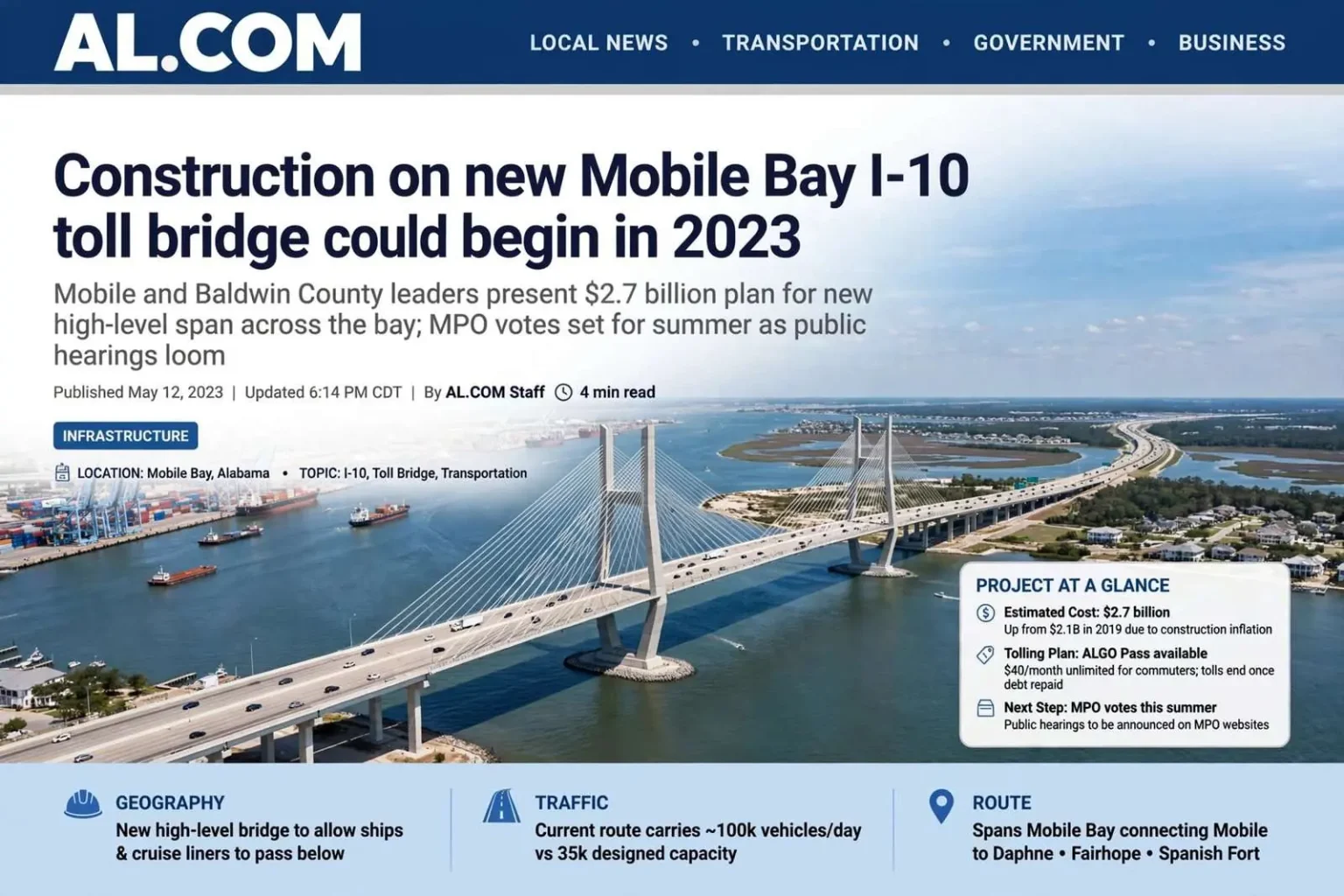
Construction on a new Interstate 10 toll bridge spanning Mobile Bay could begin as early as 2023, according to a news release from Mobile and Baldwin County leaders. The chairs of the Eastern Shore and Mobile Metropolitan Planning Organizations outlined a plan for a new Mobile River Bridge and a new Bayway, including how much it would cost drivers to use the bridge. The announcement marked the most detailed public picture yet of a project that has been discussed, debated and deferred for decades — a crossing that would, for the first time, carry Interstate 10 traffic over the bay on a high-level span rather than through tunnels beneath the river.
Before the project moves forward, the MPOs will vote on the plan at their summer meetings, with public comment opportunities and hearings to be announced on the MPO websites. Those votes represent the formal gatekeeping step for federal transportation funding in the region: the Mobile and Eastern Shore metropolitan planning organizations decide which projects enter the area’s long-range transportation plan, and no billion-dollar crossing moves ahead without their endorsement. Officials urged residents who commute across the bay to follow the hearings and weigh in before the votes are cast.
A Response to Congestion
Both MPOs agreed in December that a new toll bridge across Mobile Bay was the only solution to congestion. The Alabama Department of Transportation, which backed the toll bridge concept in January, prepared the plan for the south Alabama MPOs. The agreement between the two bodies — which cover the Alabama side and the Eastern Shore cities of Daphne, Fairhope and Spanish Fort, respectively — matters because the bridge is a bi-county project by definition, drawing traffic and criticism from both sides of the bay in equal measure.
The numbers behind that agreement are stark. The current system of bridges and tunnels crossing Mobile Bay and the Mobile River was designed to carry about 35,000 vehicles a day. On peak days, nearly 100,000 cars and trucks now use that route, the planning organizations said. The result is a daily squeeze through the George Wallace and Bankhead tunnels and the Jubilee Parkway, where fender benders alone can back traffic up for miles in both directions and where an incident at the wrong hour can trap commuters for an entire evening.
Interstate 10 is the region’s economic artery as much as its commuter route. The highway links the Port of Mobile’s freight traffic to the beaches of Baldwin County and the panhandle, and trucks making port runs share the same two-lane tunnel bores as school buses and beach traffic. Any disruption — a stalled vehicle, a wreck, a tropical weather evacuation — ripples through both counties at once, which is why transportation planners have spent years studying alternatives and why the two MPO chairs ultimately converged on a single recommendation.
How It Would Be Paid For
All toll revenue would go toward paying for the project, and tolls would end once the debt is paid off, according to the MPOs. The State of Alabama would contribute at least $250 million, with another $125 million from a federal Nationally Significant Multimodal Freight & Highway Projects (INFRA) grant. The remainder of the cost would be financed against future toll collections, a model that has become standard for major crossings nationwide. Planners emphasized that the toll would retire with the debt — once the bonds are satisfied, the gantries come down and the bridge becomes an ordinary stretch of interstate.
The State of Alabama — not a private concessionaire — would own, operate and maintain the infrastructure. That provision was a direct answer to earlier proposals that drew criticism for handing a long-term toll monopoly to a private company, and it keeps decisions about rates and operations in public hands. To keep the Wallace Tunnel toll-free, toll gantries would be placed at the Mid-Bay interchange so that only vehicles using the new bridge are charged. Under that configuration, drivers who prefer the existing tunnel route could continue using it at no charge, while those wanting the faster new span would pay.
New construction costs are estimated at $2.7 billion, up from a $2.1 billion estimate in 2019, a change the MPOs attributed to inflation affecting highway projects statewide. The escalation illustrates the budgetary risk of delay: every year a project of this scale waits, materials and labor grow more expensive, and the financing gap grows with them. Planners also noted that the estimate covers not just the bridge itself but the associated Bayway improvements that would carry the interstate across the open water east of the Mobile River.
An “ALGO Pass” transponder would be available for a nominal fee, with the lowest toll rates for users. A $40 monthly unlimited rate would cover most two-axle vehicles under 7.5 feet tall, bringing the average one-way toll for a typical Mobile-to-Baldwin County commuter to under $1, planners said. The structure was designed with daily commuters in mind: someone crossing the bay for work five days a week would pay a fraction of the per-trip rate by subscribing, while occasional travelers — beachgoers, shoppers, port traffic from out of state — would pay more per crossing. The height limit in the unlimited plan reflects the bridge’s role as a route where commercial trucks and tall vehicles would pay a different schedule.
What Comes Next
The summer votes by the two MPOs will determine whether the plan advances to final design and financing stages. Public hearings ahead of the votes are expected to draw strong opinions from both sides of the bay, where the toll question has divided commuters who want relief from tunnel traffic and residents who object to paying for a route they consider already funded by their taxes. Officials with the planning organizations have argued that the alternative — doing nothing — means congestion that worsens every year as the region grows.
The stakes extend beyond commuting time. Baldwin County has been among the fastest-growing counties in Alabama and the nation, and much of its workforce crosses the bay daily from Mobile. The Eastern Shore’s own growth has pushed its road network toward capacity, and the city of Mobile has staked development plans on improved connections between the port, downtown and the beaches. A new crossing would reshape all of those patterns, concentrating growth around new interchanges and potentially relieving the surface streets that now absorb overflow from the tunnels.
A 2023 construction start, if the votes align, would put the region on a path followed by other coastal cities that replaced aging tunnel systems with modern spans. The existing tunnels, opened decades ago, require increasingly costly maintenance, and their low clearances and narrow lanes cannot be expanded. Planners describe the new bridge as the eventual replacement for that system — a crossing built for the traffic volumes of the next half-century rather than the last one. For now, the decision rests with the two MPO boards, the public comment process and the summer meetings that will decide whether Mobile Bay’s next bridge finally moves from study to steel.
The geography of the crossing explains both its cost and its complexity. A new Mobile River Bridge would rise high enough to allow port vessels and the cruise ships that call on Mobile to pass beneath, which means long approach ramps and elevated highway sections on both banks. East of the river, the Bayway — the elevated causeway stretch that already carries Interstate 10 across the open waters of the bay toward the Eastern Shore — would be rebuilt and widened as part of the project, replacing a structure that has served beach traffic since the middle of the last century.
Residents on both sides of the bay have followed the toll debate with intensity because it touches household budgets directly. For a family with two commuters crossing daily, even a dollar a trip adds up over a year, which is why the unlimited monthly plan and its sub-dollar average rate became the centerpiece of the financing pitch. Opponents have countered that a free alternative route through the tunnels will remain, but planners note that the tunnels’ limited capacity is precisely the problem — a new bridge without tolls would simply shift the bottleneck rather than fund its solution.
The INFRA grant cited in the plan is a federal program reserved for projects of national significance to freight movement, and Mobile’s application leaned on the port’s growing role in Gulf shipping. Winning $125 million in federal freight money signaled that Washington sees the bay crossing as more than a local convenience; it is part of the national freight network that moves containers, vehicles and cargo between the port and the interstate system. Combined with the state’s $250 million commitment, the grant reduces the amount that must be financed through toll-backed borrowing.
Commuters and businesses with a stake in the outcome have several chances to shape it before the votes. The MPO websites will carry hearing announcements and plan documents, and public comments submitted during the review period become part of the record the boards consider. For the hundreds of thousands of residents whose daily lives are measured by the tunnel backup on the Mobile Bay crossing, the summer meetings represent the closest the region has come in years to an actual decision — and the last chance to weigh in before the biggest public works project in south Alabama history either advances or stalls again.


