Could Movie Making Return to Coastal Alabama?
From Spielberg's Close Encounters to tax-credit pushes, Coastal Alabama has film roots — but can it build the talent base to bring movie making back?
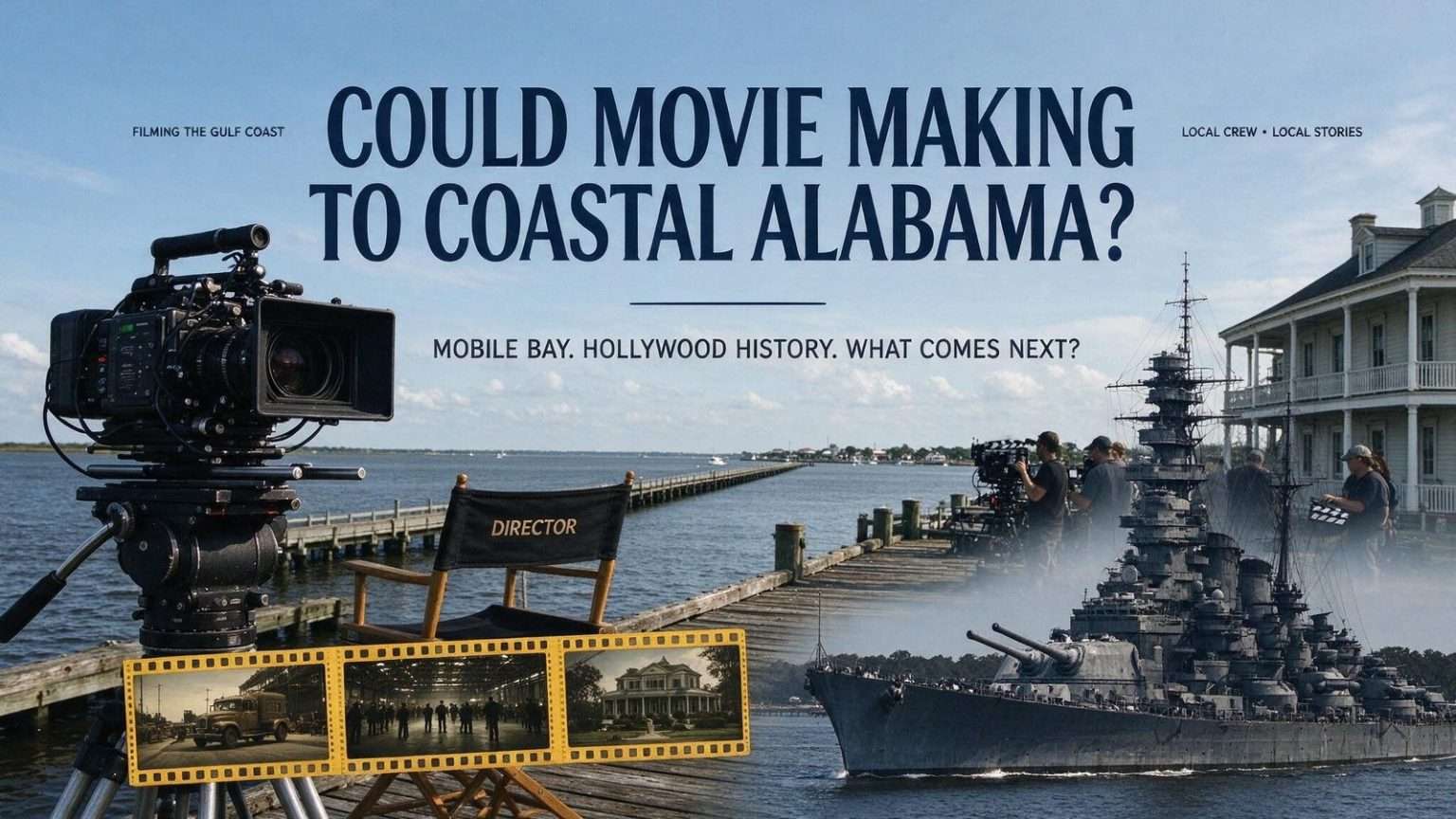
MOBILE, Ala. — Long before streaming changed the business, Coastal Alabama had a surprising Hollywood pedigree. The first movie about truckers was shot on the Causeway, Steven Spielberg filmed “Close Encounters of the Third Kind” in the Brookley hangars, and Martin Jurow brought Kate Chopin’s “The Awakening” to Victorian Point Clear. The region’s film résumé is longer and stranger than most residents realize, and the question hanging over it now is whether movie making could once again become part of the local economy.
The pieces that once made the area attractive to filmmakers have not disappeared: the water, the historic architecture, the military hardware, the unmistakable Gulf Coast light. What has been missing, industry watchers say, is the critical mass of consistent production talent that turns occasional location shoots into a standing industry. Whether that gap can be closed may determine if the next chapter of Gulf Coast storytelling is told on screen.
A Location History Hiding in Plain Sight
The links between Hollywood and Coastal Alabama go back decades. The Causeway, the low causeway spanning the upper reaches of Mobile Bay that connects Mobile to the Eastern Shore, hosted what is counted as the first movie about truckers — a piece of road-movie history shot long before the interstate highway system reshaped American travel.
Steven Spielberg brought “Close Encounters of the Third Kind” to the Brookley hangars in Mobile, using the cavernous aircraft facilities as a backdrop for one of the most celebrated science fiction films ever made. The hangars, built for aircraft manufacturing and maintenance, offered the kind of immense interior space that few locations outside dedicated studios can match.
Martin Jurow, the producer whose credits include some of mid-century Hollywood’s most recognizable comedies, brought Kate Chopin’s “The Awakening” to Victorian Point Clear, putting the Eastern Shore resort community’s historic architecture on screen. Point Clear’s waterfront homes and quiet grandeur gave the adaptation a period authenticity that sets struggle to reproduce.
The USS Alabama and USS Drum, the battleship and submarine that anchor the memorial park on Mobile Bay, stood in for wartime mayhem in various productions. Their authenticity is impossible to fake: the battleship earned nine battle stars in World War II, and filming aboard a genuine fighting ship gives war productions a texture that miniature and digital work still chase.
Downtown Mobile on the Big Screen
Downtown Mobile hosted Sally Field and Al Pacino, giving the city’s historic core starring roles alongside two of the most decorated actors of their generation. The downtown streetscape, with its mix of antebellum-era buildings and mid-century commercial blocks, has long offered filmmakers a stand-in for Southern city life that reads as genuine rather than dressed up.
Ted Prior churned out a string of B-movies locally, an example of low-budget production that sustained steady work in the region even when no studio epic was in town. Fairhope’s Scott Lumpkin helped place major Hollywood productions across the region, working behind the scenes to match scripts with locations and to smooth the practical path for out-of-town crews.
Those efforts show a recurring pattern: individual projects found their way to Coastal Alabama, but the region never developed the steady pipeline of crews, sound stages and post-production work that keeps an industry in place between productions. When a shoot wrapped, the expertise and equipment largely left with it.
The Push for Tax Credits and New Voices
More recently, locals such as actor Richard Tyson pushed for production tax credits, arguing that the financial incentives other states use to attract crews could help Alabama compete. Tax incentive programs have reshaped the geography of American filmmaking over the past two decades, drawing production to states that offer rebates on qualifying spending and, in the process, building year-round crew bases in places that once had none.
Documentarian Margaret Brown earned Sundance recognition for work rooted in the region, proving that stories from Coastal Alabama can find national audiences and critical attention. Her documentaries have drawn on the area’s music, environment and working-class culture — subject matter that exists nowhere else and cannot be manufactured elsewhere.
The decentralization of filmmaking toward smaller regions and right-to-work states such as Alabama and North Carolina has fueled location shooting elsewhere, but Alabama has lacked the critical mass of consistent production talent. North Carolina built that base over years of continuous production; Alabama’s efforts have been more episodic, rising and falling with individual projects and incentive cycles.
Technology Is Reshaping the Math
Technology is changing the economics that once kept production concentrated in a few industry capitals. Spielberg himself now shoots digitally rather than on Kodak film, and modest budgets rule. Digital cameras and lightweight post-production workflows have lowered the cost of entry, meaning a disciplined production team can now accomplish with a small crew and regional locations what once required a studio apparatus.
With web distribution emerging as the next frontier, film voices are breaking out through low-cost opportunities that don’t require a studio’s blessing. Streaming platforms and online distribution have created demand for more content than the traditional studio system can supply, and that demand reaches into regions that the old gatekeepers overlooked. A filmmaker in Coastal Alabama no longer needs permission from Los Angeles to reach an audience.
The math matters for a region like this one. Production spending flows into local economies through location fees, catering, lodging, equipment rentals and hired local crew. A single mid-budget production can put hundreds of temporary workers on payrolls across a metro area, and a steady run of smaller projects can sustain a permanent professional base between them.
A Creative Wellspring Without a Screen Voice
Coastal Alabama remains a distinctive creative wellspring. The region has produced writers such as Truman Capote, music from Jimmy Buffett and painters like Mose T. Oliver — a range of artistic output that spans literature, song and folk art. The stories, landscapes and characters of the Gulf Coast have already proven their power in other media.
Yet a nationally recognized film or television voice has yet to emerge from the region. The gap is not one of material but of infrastructure and momentum: writers, actors and directors from the area have historically had to leave to build careers, and few productions have been anchored here long enough to seed a local industry that could keep them home.
What Would It Take?
The ingredients that transformed other Southern cities into production centers are identifiable: sustained incentive programs, training pipelines through schools and colleges, usable sound-stage space, and a crew base deep enough that productions do not have to import every skilled position. Each element reinforces the others — crews attract productions, productions train crews.
The region’s location assets remain genuine advantages. Within a short drive, a production can find beaches, bayous, historic districts, industrial waterfront, military sites and small-town main streets. Few regions of comparable size offer that range, and the mild winters extend the practical shooting season well beyond what northern locations allow.
Lessons From the Region’s Past Productions
The productions that did come here left lessons that still apply. “Close Encounters” showed that the Brookley hangars could support effects-driven filmmaking at the highest level, and the space remains one of the largest undeveloped production assets on the Gulf Coast. The battleship shoots demonstrated that authentic military locations can draw productions that would otherwise build expensive sets, and the memorial park remains an active draw for film and television work that needs the real thing.
The B-movie run of the Ted Prior era showed a different kind of viability: production that is small, fast and continuous, keeping local hands employed between bigger projects. Industry development in other states has often started exactly that way, with modest work building the crew experience that later attracted major productions. A region that dismisses low-budget work misses the training ground where its future crews learn the job.
The Road Ahead for Gulf Coast Storytelling
Whether the next chapter of Gulf Coast storytelling is told on screen may hinge on building that local talent base — the writers, crew members and producers who can carry projects from concept through distribution without leaving the region. The history is there to build on: Spielberg’s hangars, Jurow’s Point Clear, the battleship’s wartime roles, and the B-movie hustle that kept cameras rolling when nobody famous was watching.
The tools available to filmmakers today are more accessible than at any point in the medium’s history, and the appetite for regional stories has never been stronger on streaming platforms hungry for distinctive content. What remains is the connective tissue: the incentives, training and professional community that turn scattered successes into an industry.
For now, Coastal Alabama’s film history remains a promising ledger of what has been possible here — and a standing question about what could be again. The lights have come to town before. Whether they stay will depend on whether the region can grow the talent to keep them on.