
Could the Clotilda, the last slave ship to reach America, lie in the Mobile-Tensaw Delta?
Could the Clotilda, the last slave ship to reach America, lie in the Mobile-Tensaw Delta? Reported by South Alabama News from local coverage of the Mobile.
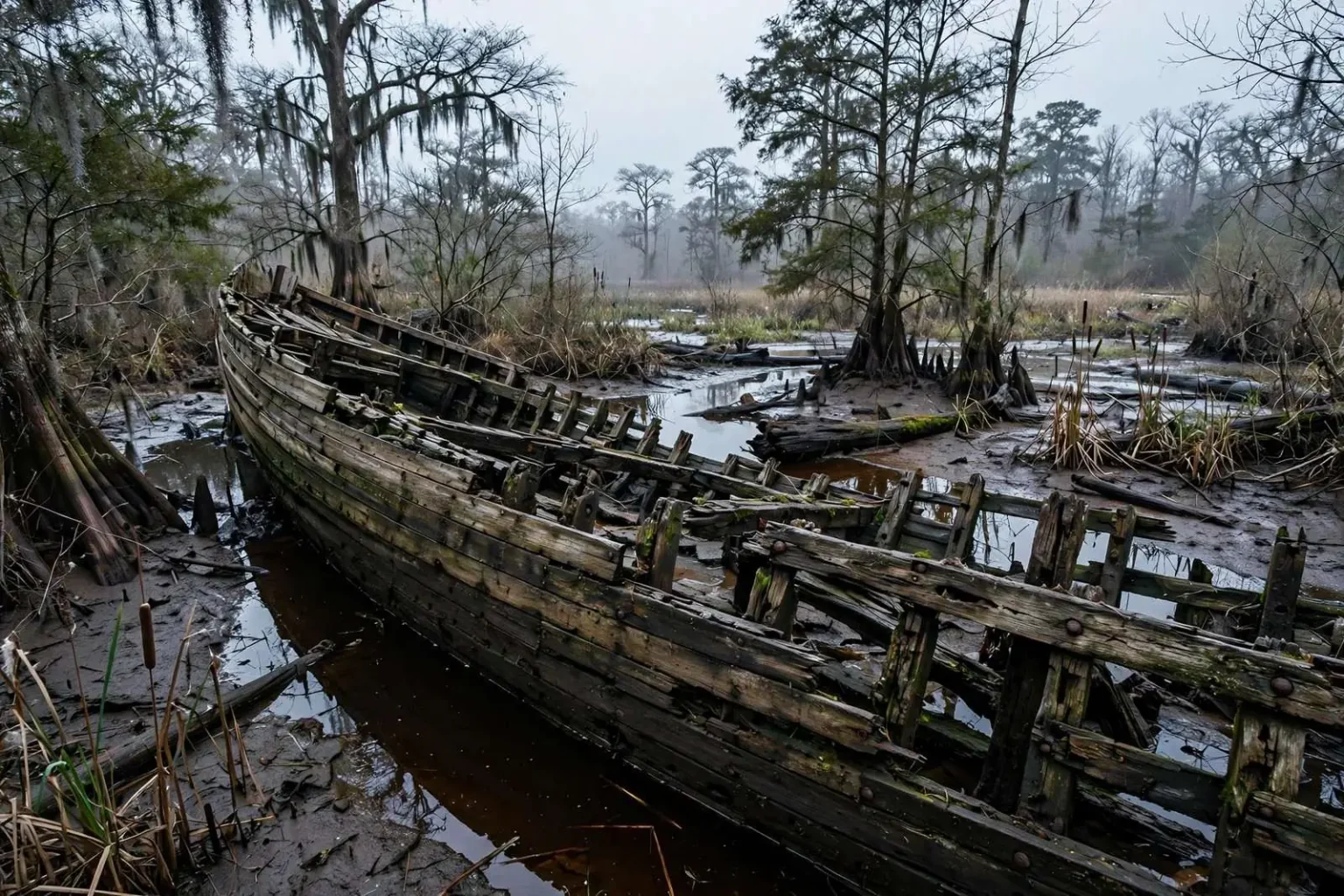
A veteran Alabama journalist believes he may have located one of the most sought-after wrecks in American history: the Clotilda, the last known ship to bring enslaved Africans to the United States. The discovery claim, made after an unusual turn of weather on the Mobile-Tensaw Delta, set off a search that Alabama historians and archaeologists have pursued in one form or another for generations — the effort to find the physical remains of the vessel that closed the transatlantic slave trade’s American chapter.
A low-water reveal
Reporter Ben Raines said a stretch of cold, windy weather pushed water levels in the lower Mobile-Tensaw Delta far below normal, exposing the submerged remains of a vessel he thinks could be the infamous ship. The delta — a vast labyrinth of rivers, bayous, backwaters and swamps spread across hundreds of thousands of acres north of Mobile Bay — is exactly the kind of landscape where a scuttled vessel could hide for more than a century and a half. Its channels shift, its water is dark with tannin, and its remoteness has shielded all manner of abandoned things from discovery.
The weather that exposed the wreck was the kind of event the delta produces only occasionally: sustained cold and wind driving water out of the lower delta’s sloughs and bayous, dropping levels well beyond their usual winter lows. For a few days, submerged timber that had never shown itself in living memory stood in the open air — and among it, Raines believed, sat the answer to one of Alabama’s longest-running historical questions.
Raines brought in experts who examined the wreckage and found pieces consistent with what is known of the Clotilda and its destruction. The examination focused on construction details — the materials, dimensions and building techniques recorded for ships of the Clotilda’s type and era — and on what history says about how the schooner met its end. The assessment produced enough apparent consistency to justify serious attention, though the experts involved were careful, as Raines himself was, to distinguish between evidence that fits the Clotilda and proof that the vessel is the Clotilda.
The history behind the hunt
The Clotilda arrived in 1860 carrying 110 captives from Africa. The voyage grew out of a bet by Mobile steamboat captain Timothy Meaher that he could smuggle slaves past the federal soldiers stationed at Forts Gaines and Morgan. By 1860 the importation of enslaved Africans had been illegal under federal law for more than half a century, and the Clotilda’s voyage was an open act of defiance of that prohibition — an international crime carried out on the water approaches of Mobile, where the forts’ garrisons were positioned to stop exactly what Meaher bet could slip past them. The ship slipped into Mobile Bay, transferred its human cargo up the river, and was then burned and sunk to destroy the evidence of the crime. The voyage left the Clotilda in the strange position of being both the last of its kind and an intended nonexistence: a ship whose owners intended history to forget it entirely.
Those brought ashore founded Africatown, just north of Mobile. The community — known also as Plateau — is among the most historically significant settlements in Alabama: a town founded by West Africans who had survived the middle passage, maintained pieces of their languages and traditions, and built a life together in the decades after emancipation. The story of Africatown’s founders, and of the ship that carried them, has been handed down through generations of their descendants, and the location of the Clotilda’s remains has been a matter of both scholarly inquiry and community memory for as long as anyone can remember.
Nothing confirmed — yet
Nothing has been definitively confirmed. Raines, known for outdoor and environmental reporting, said determining the find would require both state and federal effort. That caution reflects the standards that govern shipwreck identification: a claim of this magnitude — the discovery of the last slave ship to reach America — cannot rest on visual resemblance and enthusiasm. Confirming the identity of a wreck requires documented construction details, historical records and, typically, formal archaeological investigation conducted under permits from state and federal agencies that oversee Alabama’s submerged lands and historic resources.
The verification process, if it proceeds, would involve marine archaeologists examining the hull’s construction against the historical record of the Clotilda’s build, dimensions and materials, along with documentary research into the schooner’s origins. Any formal identification would also carry legal weight: shipwrecks of this significance are protected resources, and a confirmed Clotilda would instantly become one of the most important underwater historical sites in the United States, with implications for how the site is studied, preserved and interpreted.
Raines has often been an active participant in the stories he covers, and this one, he said, would need rigorous verification before the world could call it the Clotilda. His reporting career along the Gulf Coast has made him one of the region’s most recognizable journalists — a writer whose environmental and outdoor work has taken him into the delta’s swamps and waterways for years, and whose familiarity with that landscape is precisely what put him in position to notice what low water had revealed. The combination of journalist and searcher is unusual in mainstream reporting, and it shaped how the claim was presented: as a promising lead reported by the person who found it, offered to experts and the public with the caveat that certainty would take time and institutional effort.
Why the Clotilda matters
The search for the Clotilda is not an exercise in treasure hunting; it is the search for one of the few physical witnesses to a story that has survived otherwise only in documents and memory. The ship is the bookend of a terrible history — the last vessel to deliver enslaved Africans to American shores, arriving on the eve of a civil war that would end the institution those captives were brought to feed. Finding its remains would give Africatown’s descendants, and the nation, a tangible anchor for a history that has too often been treated as abstraction.
If confirmed, the discovery would close a long chapter of speculation about where the fabled ship came to rest in Alabama’s waterways. For more than a century and a half, the question of the Clotilda’s fate has generated searches, false leads and competing theories — stories of sunken hulls in the delta’s backwaters passed along by fishermen, hunters and historians. The possibility that one of those stories is true, and that the answer has been sitting in the lower delta all along, is exactly the kind of revelation the wreck’s history has always promised: a ship built to be forgotten, waiting to be found.
The delta as a keeper of secrets
The Mobile-Tensaw Delta has always been the wild margin of Mobile’s history. Spread across the confluence of the Alabama and Tombigbee rivers as they gather into the Mobile River system, it is a landscape of sloughs, oxbows, cypress-tupelo swamps and shifting channels that has swallowed boats, barges and settlements since people first navigated the region. Its waters are stained dark by tannin from cypress and oak, visibility underwater is minimal, and large portions of it are accessible only by shallow-draft boat — conditions that make both accidental discovery and systematic survey equally difficult.
It is also the landscape through which the Clotilda’s captives passed. After the schooner arrived in Mobile Bay, the human cargo was moved by steamboat up the river system and hidden in the delta’s swamps while the ship’s owners worked out how to dispose of the evidence. The delta that hid the people also, in the end, hid the ship — and the possibility that both the tragedy and its covering-up left physical traces in the same waters is what gives the search its particular resonance for those who know the history.
Low-water events like the one that exposed the wreck do not come often. Sustained drought and hard north winds can pull water out of the lower delta’s backwaters by several feet, revealing features normally invisible beneath the surface. Locals who work the delta speak of these episodes as rare openings — days when the landscape briefly shows what it keeps — and Raines’s recognition of the opportunity, and his quick move to bring experts to the site, was the product of years spent learning the delta’s rhythms.
What comes next
The weeks following the discovery claim were expected to determine whether the find moves from rumor to archaeology. State and federal agencies with authority over Alabama’s submerged historic resources would need to be part of any formal examination, and the experts Raines assembled were clear that the pieces consistent with the Clotilda were a beginning, not a conclusion. The distinction matters for Africatown’s community, which has carried the story of the ship for generations and has seen claims about the wreck come and go.
Whatever the verification ultimately establishes, the episode has already accomplished one thing: it has returned the Clotilda, and the story of the 110 people it carried, to public attention. The history of Africatown — its founding by Africans who survived the last illegal slave voyage to America, its decades as a self-sustaining community, and its descendants’ ongoing effort to preserve that memory — belongs to the same story as the wreck in the delta. Raines’s find, if it holds, would close the longest-running mystery in that history, and would give the community that has kept the story alive a physical piece of evidence to match: the ship itself, or what remains of it, exactly where the delta’s waters have kept it since the men who tried to erase it let it sink.


