Crash on the Causeway Backs Up Traffic Into Baldwin County
A crash near Ralph and Kacoo's on the Causeway caused major delays into Baldwin County Monday afternoon before being cleared by nightfall.
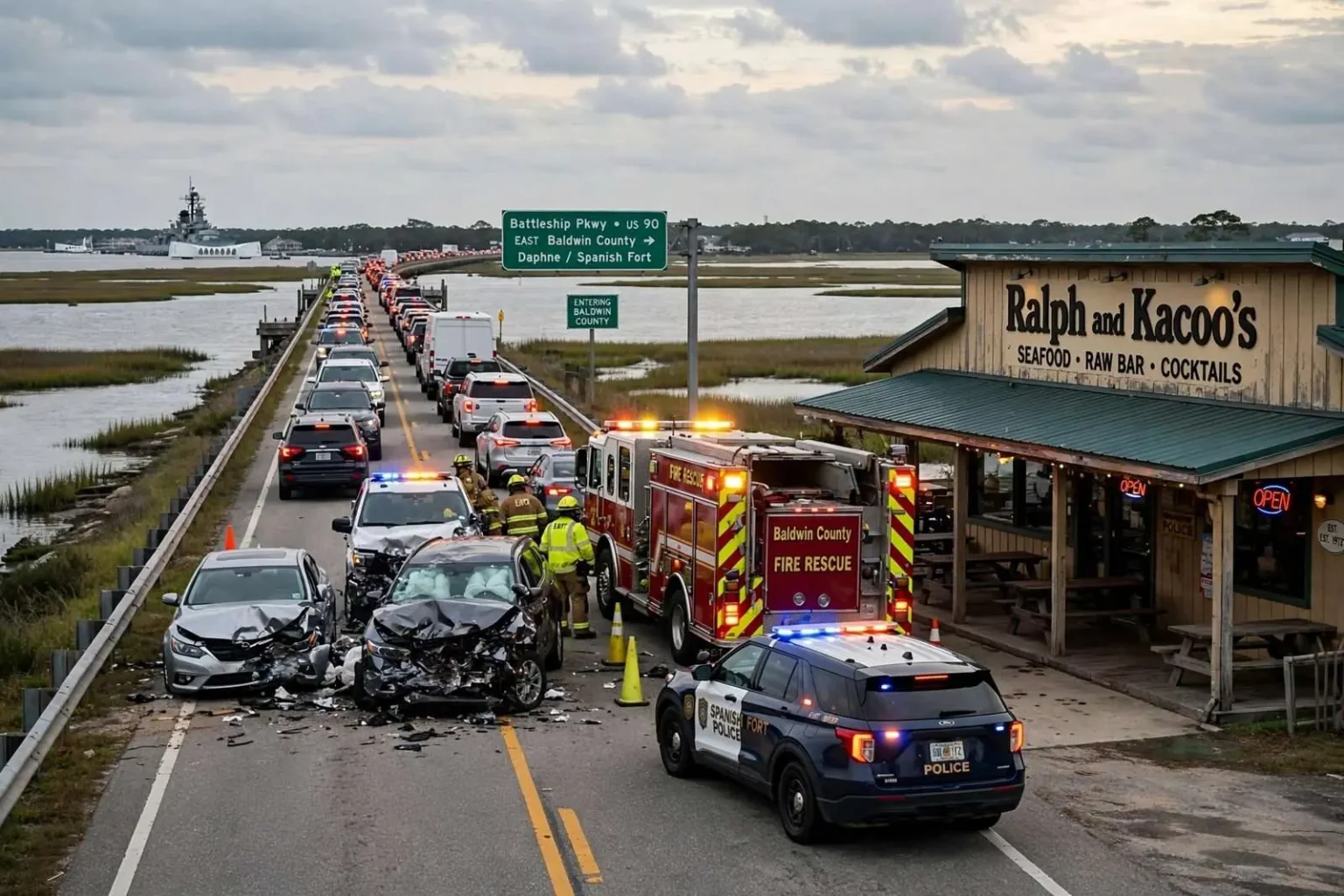
A major crash on the Causeway brought traffic to a crawl heading into Baldwin County on Monday afternoon, backing up drivers making the Mobile Bay crossing during the height of the afternoon commute. The wreck occurred near Ralph and Kacoo’s, the well-known seafood restaurant that sits along the Causeway’s Battleship Parkway corridor, and it left police cruisers and fire trucks strung along the shoulder as crews worked to clear the roadway and get traffic moving again.
The Causeway — the common local name for the Battleship Parkway section of U.S. 90 that links Mobile and Baldwin County across Mobile Bay — is one of the region’s busiest and most heavily traveled routes. It carries thousands of commuters each day between Mobile and the fast-growing Eastern Shore communities of Spanish Fort and Daphne, alongside shoppers, commercial traffic, and the steady stream of visitors drawn to the strip of waterfront restaurants, bait shops, and attractions that line the low causeway on both sides of the bay.
The geography of the crossing is what turns any single wreck there into a regional problem. Unlike an interstate, the Causeway has no shoulders to speak of along much of its length and limited places for vehicles to turn around or exit, so a crash blocks essentially all through capacity in the affected lanes. Because there are limited alternate routes across the bay — the Jubilee Parkway on Interstate 10 is the principal other crossing — drivers diverted from one route pile onto the other, and even a single crash on the Causeway can cause significant backups that ripple for miles in both counties. Monday’s backup, stretching back into Baldwin County, fit a pattern that Eastern Shore commuters know well: a fender-bender on the bay can cost an hour.
The location of Monday’s wreck, near Ralph and Kacoo’s, put it on one of the Causeway’s most recognizable stretches. The restaurant, long a fixture on the Mobile side of the parkway, anchors a cluster of seafood spots that draw heavy lunch and dinner traffic, which compounds the commute problem — the same hours that bring workers home across the bay also bring diners onto the two-lane corridor. Access points for the restaurants mean turning traffic merging into through lanes, and that mixing of local turns and fast commuter traffic is a familiar hazard along the route.
What Police Said Happened
Spanish Fort police, who handle the Baldwin County side of the parkway, said the crash involved three vehicles and happened during the height of rush hour. According to police, one of the three vehicles crossed into oncoming traffic, triggering the collision with the other two. The oncoming-crossing pattern — a vehicle leaving its lane and striking traffic headed the other way — is among the most dangerous crash types on a road like the Causeway, where opposing lanes are separated by little more than a painted line and closing speeds are high.
Serious injuries were reported in the crash, but police said those injuries do not appear to be life-threatening. Fire and rescue units responded alongside law enforcement, a standard deployment for a multi-vehicle injury crash on the bay crossing, where extrication and transport can be complicated by the causeway’s confined layout. No information was released about what caused the initial vehicle to cross into oncoming traffic, and police had not announced any charges in connection with the wreck.
The response to a Causeway crash typically draws from both counties out of necessity. The parkway itself sits low across the bay, running over a series of trestle and fill sections past the Mobile-Tensaw delta on its northern end, and the jurisdictions along it are divided: Mobile police and fire handle the western reaches, Spanish Fort public safety agencies the Baldwin side, and the USS Alabama Battleship Memorial Park — the parkway’s namesake attraction, where the WWII-era battleship sits moored just off the road — marks one of the most visited mid-bay points. For responders, the confining geography means an injured motorist can be closer to a Mobile hospital while the crash scene falls under Baldwin County authority, a split that local agencies drill around regularly.
Monday’s wreck also underscored how dependent the Eastern Shore economy has become on the bay crossings. Spanish Fort and Daphne have grown into major retail and residential centers — shopping destinations that draw customers from across the region and bedroom communities whose residents commute west into Mobile each weekday. Every one of those daily trips depends on one of two bridges. When the Causeway backs up, traffic engineers and commuters alike watch whether the Interstate 10 Bayway can absorb the overflow; when both routes are stressed at once, as happens during peak hours, the entire Mobile Bay corridor slows together.
The Causeway’s own history explains some of its limitations. The original crossing of Mobile Bay at that location dates to the 1920s, when the bankhead-era causeway and its draw spans opened the Eastern Shore to automobile travel and made the beachfront at what is now Spanish Fort and the resort strips along the bay reachable for a day trip. When the Interstate 10 Bayway opened decades later with its higher, faster crossing, the old Causeway settled into its current role: the scenic, low-speed, business-lined alternative. Its restaurants, marinas, and waterfront views are a regional draw precisely because the road is slow — but the same low, constrained design is what makes a crash there so disruptive. There is no room to route traffic around a wreck, and no exit ramps to siphon it off.
Weather adds another layer to the corridor’s vulnerability. The low-lying parkway is exposed to fog rolling off the bay, standing water in heavy rain, and occasional wind-driven high water, all of which contribute to the crash history along the route. Local drivers tend to treat the Causeway with a particular caution in fog and rain, and visibility complaints are among the most common explanations offered for multi-vehicle wrecks along the stretch. Police did not indicate what conditions were like at the time of Monday’s crash, which occurred in clear enough weather for the afternoon commute to proceed normally until the wreck brought it to a halt.
Traffic Restored by Nightfall
By Monday night, the crash had been cleared and traffic was moving normally again across the bay. The restoration capped a commute disruption that had stretched across the evening peak, the hours when the Causeway and the Interstate 10 Bayway together carry their heaviest loads of the day.
For commuters, the episode was a familiar reminder of the corridor’s fragility — one wreck, one blocked stretch of a two-lane road in the middle of a bay, and the region’s entire east-west movement hiccups for an afternoon. For the three drivers involved, the outcome could have been worse: serious injuries, by police account, but none expected to be life-threatening. Police urged drivers making the bay crossing to allow extra time when wrecks are reported, to avoid rubbernecking past response scenes, and to treat the Causeway’s limited access points with the care that its mix of commuter and restaurant traffic demands.
Safety advocates and local officials have long debated what, if anything, can be done to make the Causeway corridor more forgiving. The options that surface in any serious discussion carry familiar trade-offs. Wider shoulders or a center barrier would physically separate opposing traffic and give stranded vehicles room to pull over, but the parkway’s low profile, its trestle sections, and the flood-prone margins of the bay make reconstruction expensive and environmentally sensitive. Better lighting and more visible lane markings have been raised after previous wrecks, particularly for the fog-prone stretches. In practice, the corridor operates much as it has for decades, and the burden of safety falls largely on driver behavior — obeying the reduced speeds the road demands, signaling early for the restaurant and marina turn-offs, and leaving distance in the tailgating-heavy commute hours.
Law enforcement presence along the parkway is likewise split and targeted. Spanish Fort police patrol the eastern half, Mobile units the western, and both agencies run periodic traffic enforcement focused on the corridor’s chronic issues: speed, improper lane usage during the dinner rush, and impaired driving on weekend nights when the restaurants are busiest. The Monday crash fell squarely in the evening peak, when both halves of the parkway are at their most crowded and a lane-blocking wreck does the most damage.
The broader context for the region’s bay-crossing dependence is ongoing. Mobile and Baldwin County together form one of the fastest-growing metropolitan areas on the Gulf Coast, and the traffic volumes on both the Causeway and the Interstate 10 Bayway have climbed steadily with the population. Studies of a third crossing have surfaced repeatedly over the years without producing construction, which leaves the region with the two routes it has and the congestion patterns Monday’s crash illustrated. Until capacity changes, the practical guidance for bay commuters remains what it has long been: check traffic before committing to a route, remember that the Causeway offers scenery and restaurants at the price of vulnerability, and expect that when something goes wrong in the middle of Mobile Bay, the whole region will feel it until the roadway is cleared.
Monday’s three-vehicle wreck ended the way most of these incidents do — with a slow afternoon, a cluster of emergency vehicles along the water, injuries that were serious but not catastrophic, and a road returned to normal by nightfall. But the pattern it fits is not going anywhere. The Causeway will remain both one of the region’s most beloved drives and one of its most fragile, a two-lane thread of local life stretched across the bay, where the difference between a routine commute and a multi-mile backup is a single vehicle crossing a painted line.