Crestview Family Seeks Justice After Father in Wheelchair Is Killed in Hit-and-Run
An arrest warrant names William Michael Boles in the hit-and-run death of 71-year-old Wilber Ray Heath on Highway 90 in Crestview; the suspect may be in.
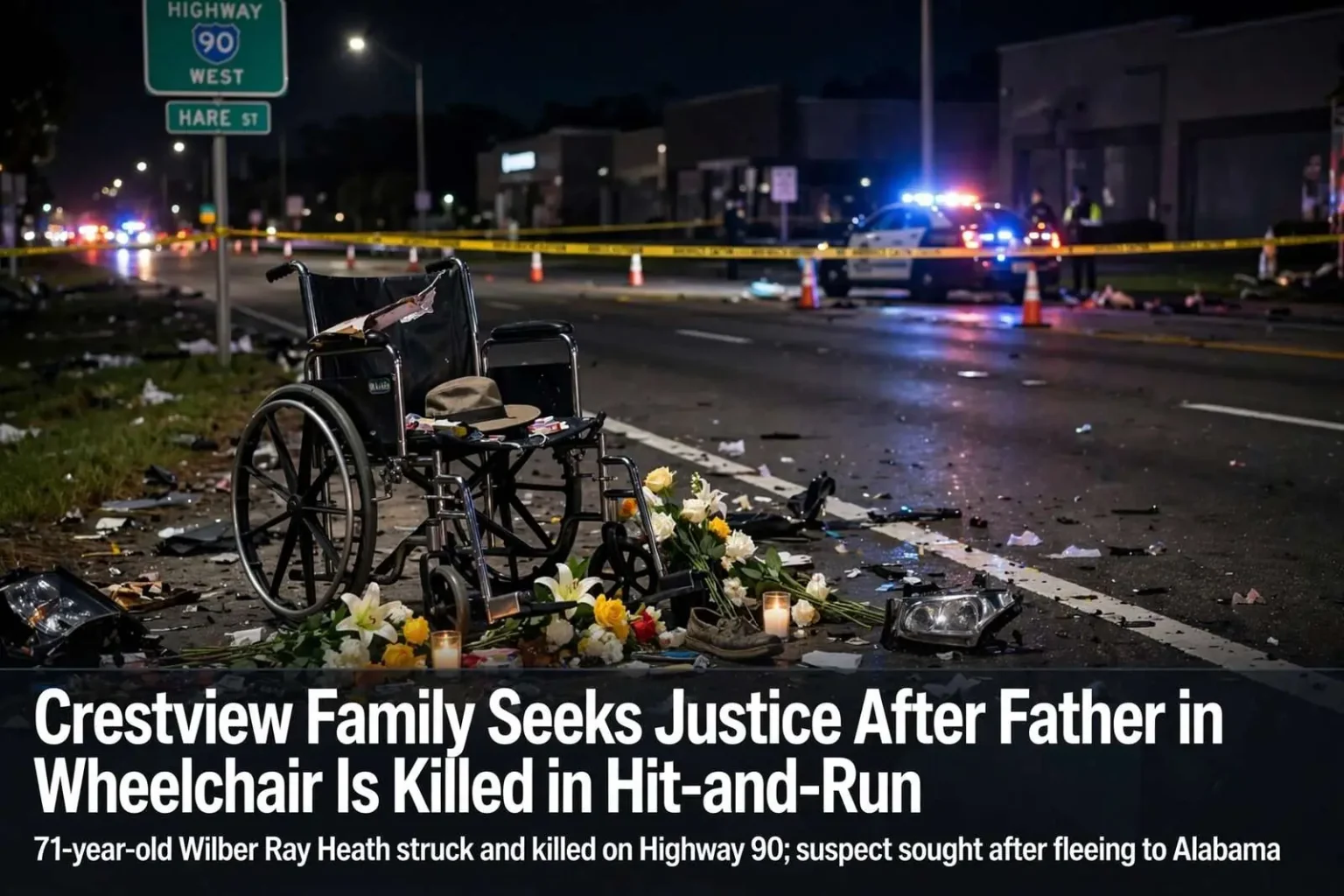
A Crestview family was searching for answers after a 71-year-old man crossing Highway 90 in his wheelchair was struck and killed by a car that sped away, and troopers said the suspected driver may have fled into south Alabama. The hit-and-run left a well-traveled stretch of the highway closed for the investigation and put the Florida Highway Patrol on a hunt that crossed the state line within days. For the family of the victim, the search for the driver turned a sudden loss into an open question that only an arrest could begin to answer.
Wilber Ray Heath was hit Tuesday night near Hare Street as he tried to cross the highway. The car kept going eastbound without stopping, according to the Florida Highway Patrol. The details of the scene told their own story: a man in a wheelchair attempting to cross one of Crestview’s busiest roadways after dark, a driver who did not pause, and wreckage left behind for the next passersby to discover. Crossing a multi-lane highway in a wheelchair leaves a pedestrian slow-moving and low to the ground, with little chance of being seen in time by a speeding driver or of getting out of the way once a collision becomes inevitable — and investigators would have worked backward from the physical evidence to establish how the crash unfolded.
Highway 90 carries a heavy mix of local and through traffic through the heart of Crestview, the seat of Okaloosa County in the Florida Panhandle. The route runs parallel to Interstate 10 and serves as the area’s main commercial corridor, lined with businesses, driveways and cross streets — including Hare Street — that feed directly onto it. Pedestrians and drivers share that corridor daily, and the sections without controlled crossings are the ones local officials have long identified as hazardous. Nighttime crossings are the most dangerous of all, when visibility drops and vehicle speeds stay high, and the combination proved fatal at the spot where Heath was struck.
A Warrant and a Flight Across the Line
An arrest warrant was later issued for William Michael Boles, 48, who faces charges of leaving the scene of a deadly crash along with several traffic offenses. Troopers said they had reason to believe Boles may have left Crestview and could be in the Covington County and Andalusia, Alabama area — putting law enforcement on both sides of the state line on notice. The charge at the center of the case, leaving the scene of a crash involving death, is a serious felony in Florida, and the additional traffic charges reflect the range of violations tied to the collision itself.
The geography of the suspected flight is straightforward. Andalusia sits in Covington County, Alabama, roughly an hour’s drive north of Crestview by way of the rural highways that connect the Panhandle to south-central Alabama, and the region’s back roads cross the state line in several places. When a suspect is believed to have crossed into Alabama, the Florida Highway Patrol does not pursue alone — troopers coordinate with Alabama counterparts, including the Covington County Sheriff’s Office and the Andalusia Police Department, passing along the warrant details and any vehicle description so officers there can be on the lookout. Extradition between the two states is a routine legal process once an arrest is made, but finding a person who is actively avoiding detection across a wide rural region is a slow, methodical task.
For investigators, hit-and-run cases turn on physical evidence and public tips. A car involved in a fatal collision almost always carries damage — a crumpled hood, a shattered windshield, paint transfer — and a vehicle matching that description in a repair shop or parked in a yard can crack the case. Tips from residents of Covington County, where someone might notice a damaged car that arrived abruptly, become as valuable as anything gathered at the Crestview scene.
A Family’s Search for Answers
Heath’s daughter, Becky Glover, described driving up on the crash scene without knowing her father was the victim, then returning the next day to collect what was left at the roadside — his hat, a piece of his shoe and the armrest from his wheelchair. She said the loss would stay with the family for a very long time. Coming upon the aftermath of a collision that turned out to involve her own father is a layer of trauma few families ever face, and her account of returning for those scattered pieces of his daily life captured what the family was left holding in place of answers.
The circumstances of the death sharpened the family’s grief into a public plea. A crash in which the driver stops is painful; a crash in which the driver leaves behind a 71-year-old man in a wheelchair and keeps driving eastbound adds an element that family members and investigators alike describe as unconscionable. Each day without an arrest extends the uncertainty, and Glover’s willingness to speak publicly about the roadside details served both as remembrance and as a call for anyone with information to come forward. In hit-and-run cases, that public voice often matters — jurors, tipsters and witnesses respond to the human story behind a case number.
For the Crestview community, the case also renewed familiar concerns about pedestrian safety along Highway 90. Residents of the neighborhoods near Hare Street know the crossings where traffic moves fast and visibility is poor, and a fatal crash at one of them tends to prompt renewed calls for improved markings, lighting or crossing infrastructure. None of that undoes a loss like Heath’s, but it is the conversation that follows such deaths in corridor towns across the Panhandle, where the highway functions simultaneously as main street and high-speed thoroughfare.
What Comes Next in the Case
The legal path ahead runs through the warrant for Boles and the coordination between Florida and Alabama authorities. Once he is located and arrested, he would face extradition to Okaloosa County to answer the charge of leaving the scene of a crash involving death along with the accompanying traffic offenses. Prosecutors in cases like this rely on the reconstruction of the crash, the damage evidence and witness accounts to establish not just who was driving but that the driver knew — or reasonably should have known — that a collision had occurred before leaving the scene.
Until that arrest happens, the case remains open and public. The Florida Highway Patrol continues to ask anyone with information about Boles’s whereabouts or a vehicle matching the crash to come forward, whether through the troopers directly or through an anonymous tip line. Family members like Glover keep the case visible, and tips from ordinary residents — a sighting, a damaged car, a conversation — remain the most common way these cases end. For now, a Crestview family waits for the answer the crash scene could not give them, and officers on both sides of the Alabama-Florida line keep looking.
Hit-and-run crashes carry a particular weight in the communities where they happen, and the Heath case has all the elements that keep one in public memory. The victim was elderly and navigating the world from a wheelchair; the driver not only failed to stop but continued in the direction that carried the car away from help; and the suspect’s apparent disappearance across a state line turned a local tragedy into a regional manhunt. Cases with those features tend to draw sustained attention from residents, who follow along as tips come in and wait for word of an arrest that will let the story reach some kind of ending.
The reality of investigating such a case is less dramatic than the search sounds. Troopers compile the evidence from the scene — debris patterns that show where the impact occurred, paint and plastic fragments that help identify the vehicle, skid or gouge marks that establish speed and direction — and they distribute what they know to other agencies. Media coverage does much of the remaining work: descriptions of the suspect and any vehicle circulate through the Panhandle and into south Alabama, reaching people the troopers could never canvass individually. A single person who recognizes a dented car parked behind a relative’s house can accomplish what weeks of formal investigation cannot.
Crestview, for its part, is a community that has grown quickly in recent years, feeding off the expansion of military and aviation employment in the Eglin corridor, and its growth has increased traffic on roadways like Highway 90 that were sized for a smaller town. That tension between a highway built to move vehicles and a city that now lives along it frames the safety questions raised whenever a pedestrian dies there. Advocates for safer crossings point to crashes like this one in urging improvements, while the daily reality of the corridor — cars moving fast, driveways and side streets feeding in constantly — remains unchanged for the people who cross it.
For the Heath family, none of the broader issues change the immediate one: a father and grandfather is gone, his daughter is left with a hat and a piece of a wheelchair to remember him by, and the person responsible had not yet been found as the warrant stood. The family’s message through the case has been consistent — they want the driver found, and they are asking anyone who knows anything to help make that happen.