Crestview Man Charged in Georgia Wire Fraud Case Tied to Fake Wu-Tang Clan Affiliation
A Crestview man was charged with wire fraud in Georgia after prosecutors said a group posed as affiliated with Wu-Tang Clan to defraud hotels.
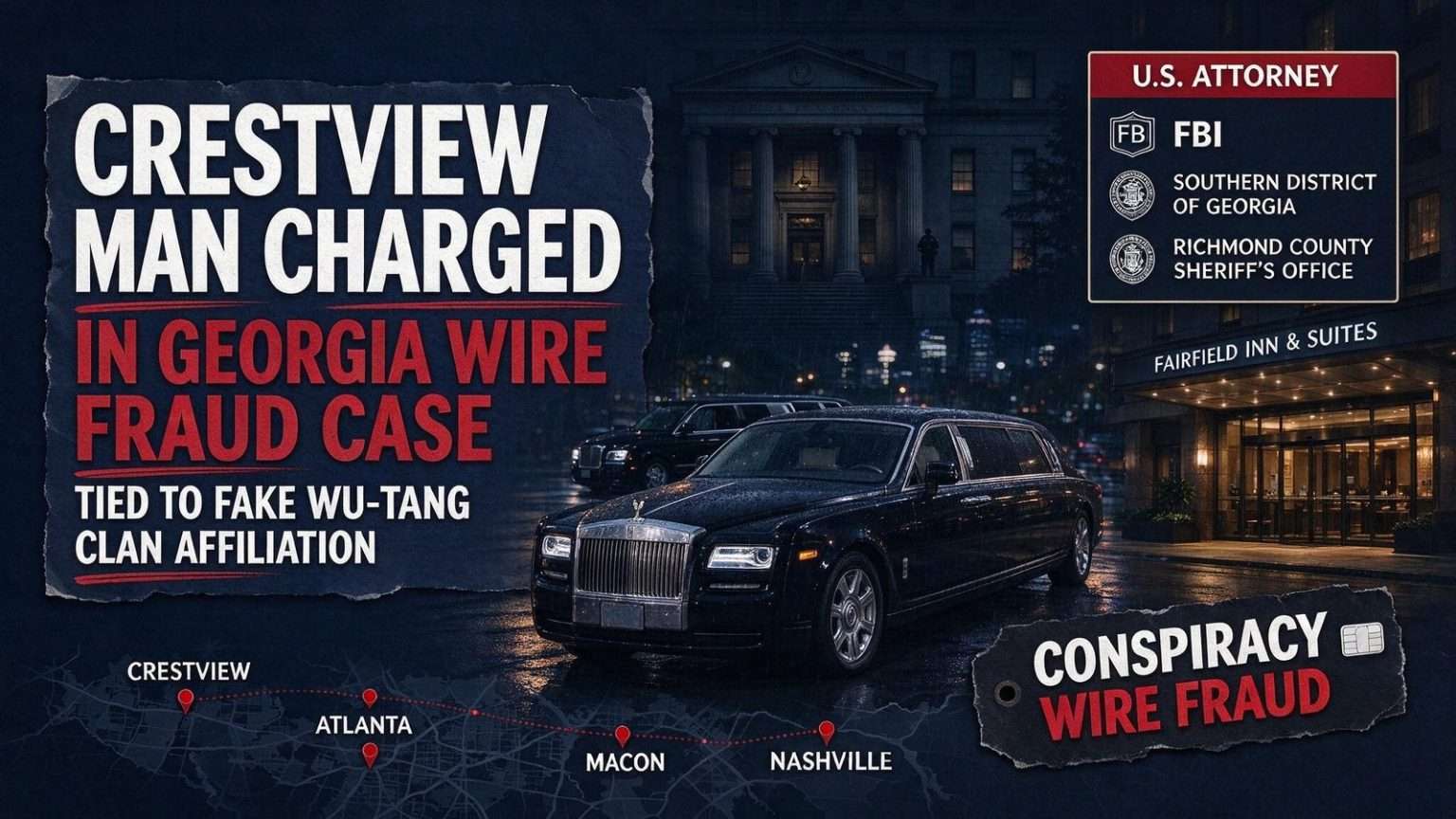
CRESTVIEW, Fla. — Two men, one from Crestview, face federal charges in Georgia after prosecutors said they used fraudulent and stolen credit cards to steal from hotels and a limousine company in a scheme built around a bogus entertainment industry identity. The case, announced by federal prosecutors in the Southern District of Georgia, stretches across multiple Southern cities and centers on claims that the group passed itself off as connected to some of the biggest names in music.
Aaron Barnes-Burpo, 28, of Crestview, and Walker Washington, 51, allegedly organized a group that portrayed itself as affiliated with the Roc Nation production company and the hip-hop group Wu-Tang Clan. Prosecutors said the men used those fictitious representations to open doors that a stranger with stolen credit cards could not otherwise walk through, arranging services and accommodations in advance and presenting themselves as advance men for a high-profile entertainment operation.
According to the U.S. Attorney’s office, the group used the fraudulent affiliations along with stolen credit cards to rent luxury limousines, including a Rolls Royce, and to defraud hotels of thousands of dollars in goods and services. The cities touched by the scheme included Atlanta, Macon, and Nashville — a circuit that tracks the travel patterns of the entertainment world the defendants were accused of imitating.
U.S. Attorney for the Southern District of Georgia Bobby L. Christine announced the charges: one count each of conspiracy to commit wire fraud and aggravated identity theft. The wire fraud count covers the use of interstate communications in a scheme to defraud, while the aggravated identity theft count carries a mandatory two-year prison term on its own under federal sentencing law, stacked on top of any sentence for the underlying offense.
How the Scheme Came Apart
The scheme unraveled when staff at a Fairfield Inn and Suites in Augusta became suspicious and alerted authorities, Christine said. Hotel employees who deal daily with guests, reservations, and payment methods are often the first line of detection in credit card fraud cases, and in this instance their report set off the investigation that eventually connected incidents in multiple cities.
From that initial report, the case grew into a joint federal-local investigation. The FBI and the Richmond County Sheriff’s Office are investigating the case, which is being prosecuted by Assistant U.S. Attorney Patricia Rhodes in federal court. The FBI’s presence reflects the multi-state nature of the alleged scheme, and the Richmond County Sheriff’s Office brought local knowledge of the Augusta incidents that first exposed the group.
Prosecutors say the men’s impersonation of a Roc Nation and Wu-Tang Clan affiliation was central to the fraud, giving hotels and transportation companies reason to extend services on the promise of later payment or on cards that were not what they appeared to be. Impersonating a real company’s name in connection with a fraud scheme can support both wire fraud and identity theft charges under federal law.
Wire fraud is one of the most commonly charged federal offenses because it applies to nearly any scheme to defraud that crosses state lines — a low bar in an era when reservations, emails, and payment authorizations routinely travel between states. Penalties for a single count can reach up to 20 years in prison, and sentencing judges weigh the total loss attributable to a defendant across the scheme.
The Players and the Pretense
Roc Nation, the entertainment company founded by Jay-Z, and the Wu-Tang Clan, the legendary Staten Island hip-hop group, are names that carry immediate credibility in the hospitality world. A caller claiming to arrange accommodations for artists or their entourages can plausibly request blocks of rooms, late-night services, and premium transportation without raising alarms — precisely the trust the scheme is accused of exploiting.
Luxury transportation is a natural target for this kind of fraud. Limousine companies regularly take reservations from new clients for high-value rentals, and a Rolls Royce rental represents thousands of dollars in vehicle value and operator time extended to a customer before any payment dispute surfaces. By the time a chargeback appears, the vehicle and the client have often moved on to the next city.
For the small hotels and service providers on the receiving end, the losses are rarely recoverable once the group has moved on. Stolen credit card data is typically discarded quickly after a few successful uses, and the businesses must absorb the cost of rooms occupied, meals served, and miles driven. Industry groups that track hospitality fraud urge hotels to verify payment methods for high-value bookings and to be alert for telltale signs such as callers who refuse to provide verifiable company contacts.
Why Federal Prosecutors Took the Case
The Southern District of Georgia, headquartered in Augusta and Savannah, regularly prosecutes fraud cases that span the region, and the multi-city pattern here fit squarely within federal jurisdiction. When a scheme touches Georgia, Tennessee, and Florida, as this one did through incidents in Atlanta, Macon, Nashville, and the defendants’ Florida connections, federal charges consolidate what would otherwise be a tangle of local prosecutions.
The aggravated identity theft statute, enacted by Congress in 2004, requires that a defendant knowingly use the identification of another person or of a company during certain felony offenses. Prosecutors have used it in fraud cases involving the impersonation of real businesses, and its mandatory two-year consecutive sentence gives it particular weight in plea negotiations.
Christine’s announcement of the charges put the case among the office’s slate of fraud and financial crime prosecutions, which also regularly include pandemic-related fraud, telemarketing schemes, and identity theft rings. Such announcements serve a public purpose beyond the courtroom: they warn hospitality and transportation businesses in the region that a pattern of fraud may be active and that their reports matter.
Assistant U.S. Attorney Patricia Rhodes will carry the prosecution, and the case will proceed through the federal court system — arraignments, discovery, and potentially a trial or plea agreement. Defendants in wire fraud conspiracies sometimes contest the government’s evidence about who participated and how much loss can be attributed to each person, since sentencing turns heavily on those figures.
What the Charges Mean
A conspiracy to commit wire fraud conviction can carry up to 20 years in prison, fines, and restitution orders requiring defendants to repay victims. Aggravated identity theft adds a flat two years that cannot run concurrently and cannot be waived in a plea. Combined, the charges give prosecutors substantial leverage and give defendants strong incentive to negotiate.
Restitution in cases like this one flows to the hotels and the limousine company that absorbed the losses, though recovery depends on the defendants’ assets and income for years after sentencing. Courts can order payment schedules that follow defendants after release from custody.
The case is a reminder of how far a convincing story and a handful of stolen card numbers can travel before anyone checks the credentials behind them. It also illustrates why front-line hotel staff — the desk clerks who notice something off about a guest or a reservation — remain one of the most valuable sources of fraud referrals that federal investigators receive.
As the case moves through federal court in the Southern District of Georgia, additional charges or additional defendants are possible if the investigation continues to connect incidents across the cities the group allegedly touched. The FBI and the Richmond County Sheriff’s Office have not indicated whether the investigation remains open to further developments.
For businesses on the Gulf Coast and across the Southeast, the case carries practical lessons. Hotels can require verification for blocks of rooms booked under corporate or entertainment affiliations, limousine operators can confirm card authorizations before dispatching high-value vehicles, and all of them can treat a suspicious reservation as worth a phone call to authorities rather than a loss to write off later.
The Broader Fraud Landscape
Schemes built on borrowed prestige are a recurring feature of federal fraud dockets. Impersonating a well-known company or celebrity affiliation costs nothing but confidence, and it works because front-line staff are trained to accommodate, not interrogate, high-status guests. Fraud investigators note that the most successful schemes of this type rarely involve sophisticated technology — they rely on social engineering, the deliberate exploitation of politeness and procedural trust.
The spread of the alleged activity across state lines also shows how mobile fraud operations can be. A group that spends only a night or two in each city leaves behind scattered victims, each with a small individual loss, and no single police department sees the full pattern until someone aggregates the reports. That aggregation is exactly the role the FBI played here, and it is why federal investigators encourage businesses to report even modest losses that seem part of a pattern.
For Crestview, the case is a brush with a federal docket far from the Okaloosa County courthouse where local matters are usually heard. But residents of Northwest Florida communities appear in federal fraud cases regularly, both as defendants and as victims, and the U.S. Attorney’s offices covering the Panhandle and southern Georgia have made financial crimes a consistent enforcement priority.
The defendants are presumed innocent unless convicted, and the charges now filed are accusations. What prosecutors must ultimately prove is that the men knowingly participated in a scheme to defraud — that they knew the cards were stolen and the affiliations fictitious — and that the losses attributed to them match the evidence. Those questions will be resolved in federal court, where the case now heads.