Crews Free Trapped Driver After Two-Vehicle Crash Blocks I-65 in Mobile
Mobile Fire Rescue freed one trapped motorist after a two-vehicle crash blocked lanes of I-65 near the Dauphin Street exit Friday.
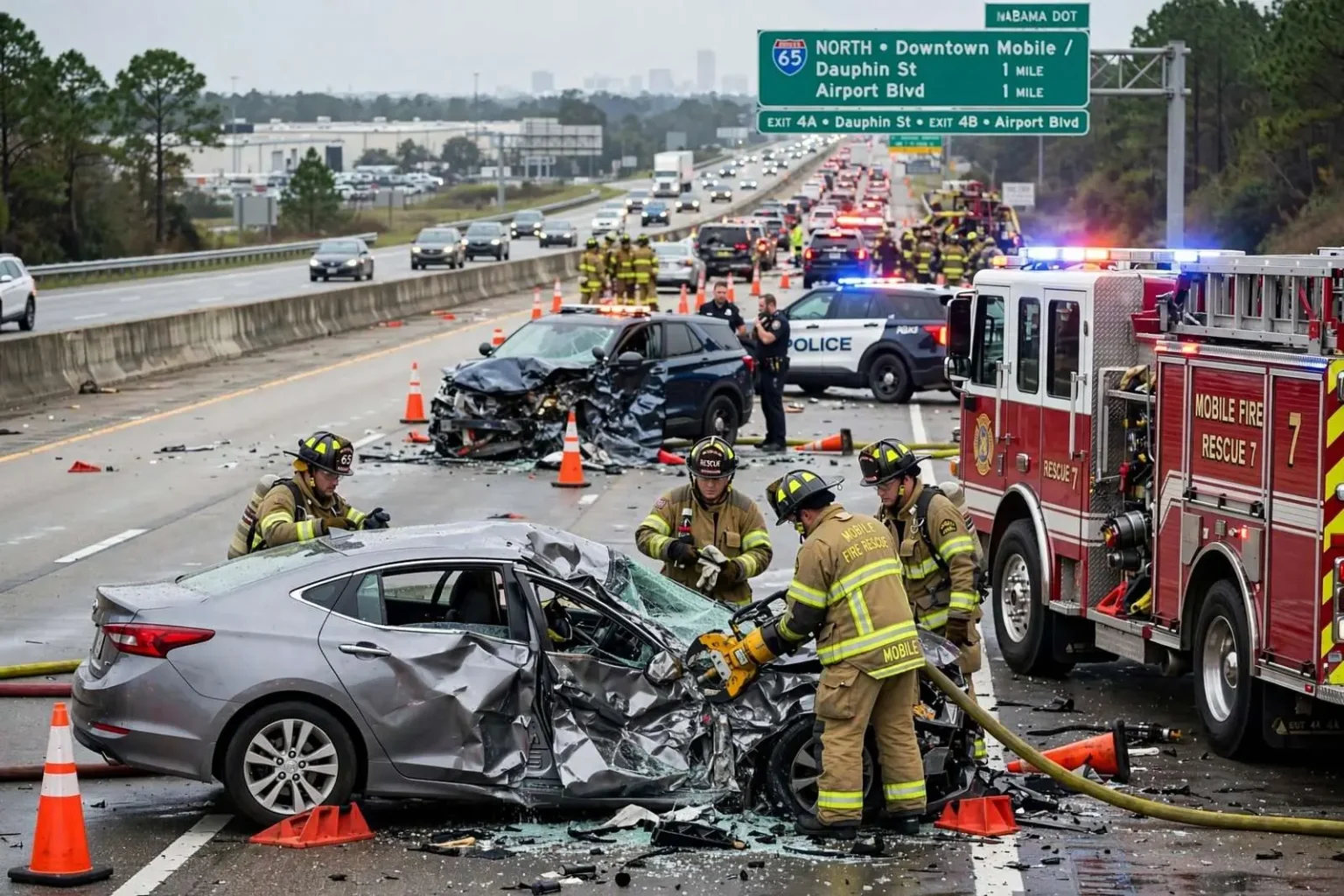
MOBILE, Ala. — Mobile Fire Rescue crews spent Friday afternoon working a crash that snarled traffic on Interstate 65 between the Dauphin Street and Airport Boulevard exits, one of the busiest stretches of interstate in the Mobile metropolitan area. The two-vehicle collision left two lanes of the interstate blocked while firefighters worked to free one person who was trapped inside a vehicle.
That person was pulled from the wreckage and taken to a hospital; the extent of their injuries was not immediately known. Fire officials said the cause of the crash remained under investigation. The response drew resources from multiple units across the city as crews managed two problems at once: the extrication itself, and the traffic chaos the blocked lanes created behind it.
The Scene on Interstate 65
Interstate 65 between the Dauphin Street and Airport Boulevard exits carries an enormous daily load of commuters, freight traffic, and travelers connecting the Port City to the rest of the Gulf Coast. When a collision blocks two of its lanes on a Friday afternoon — the leading edge of the weekend’s heaviest traffic — the backup builds in minutes and stretches for miles, trapping drivers in a crawl while emergency crews work a few hundred yards ahead.
That is what responders confronted. The two-vehicle crash had left one occupant trapped inside the wreckage, which meant the incident could not be cleared by towing alone. Mobile Fire Rescue crews staged apparatus to protect the scene, assessed the vehicle’s condition, and began the deliberate work of cutting away the structure around the trapped person — a process that requires hydraulic rescue tools, coordinated manpower, and time that each passing minute made more expensive in the lanes behind.
Extrication: The Deliberate Work of Rescue
Freeing a person trapped in a crashed vehicle is among the most technically demanding jobs fire departments perform. Crews stabilize the vehicle so it cannot shift while rescuers work, then use hydraulic spreaders, cutters, and rams — the tools popularly called the jaws of life — to peel back doors, remove the roof, or push the dashboard away from the occupant as the injuries and the wreckage demand. Every cut is made with the patient in mind: glass and metal are managed, debris is controlled, and medics work alongside the rescuers to monitor and treat the trapped person throughout.
The time such an operation takes depends on the entrapment’s severity — a pinned door may take minutes, a severely deformed cabin much longer. When the crew succeeded in freeing the trapped motorist, paramedics took over, packaging the patient for transport to a Mobile hospital, where the full extent of their injuries would be assessed. Fire officials’ statement that the injuries were not immediately known reflected the reality that a trauma evaluation continues well after the rescue ends.
Mobile Fire Rescue at Work
Mobile Fire Rescue is the city’s all-hazards fire and emergency medical service, operating fire stations spread across Alabama’s third-largest city and responding to tens of thousands of calls annually, the majority of them medical. Interstate incidents are a routine part of that workload: the city is ringed and crossed by interstates 10 and 65, and every day brings crashes of every scale to those corridors.
Units from stations near the crash’s location between Dauphin Street and Airport Boulevard would have been dispatched first, supplemented by additional companies for the manpower an extrication requires. A fire engine and a rescue squad carry the hydraulic tools; a district chief coordinates the scene; and police units handle the traffic side, directing the re-routing decisions that keep the interstate’s remaining lanes moving as best they can.
Traffic on a Friday Afternoon
The timing magnified everything. Friday afternoons on Mobile’s interstates are the week’s congestion peak, and a two-lane blockage between the Dauphin Street and Airport Boulevard exits — the corridor that carries drivers between downtown, the airport, and the western suburbs — turned the interstate into a parking lot in both directions as rubbernecking slowed the opposite side as well. Drivers exiting early clogged the surface streets along the corridor, and the ripple extended through the interchanges where I-65 meets I-10 and the airport’s approach roads.
Traffic agencies used the standard toolkit: alerts to drivers through navigation apps and highway message boards, advisories to the media, and a staged reopening of the roadway as crews finished their work. The full clearing of an injury crash with an extrication commonly takes more than an hour, and the queue it leaves takes almost as long to dissolve after the lanes reopen.
Two-Vehicle Crashes and Their Causes
Fire officials said the cause of the crash remained under investigation, a determination that falls to the police traffic-homicide or traffic-investigation units depending on the injury severity. Investigators will reconstruct the collision from its physical evidence — the vehicles’ final positions, the damage patterns, skid marks or their absence, and the data recorded by the vehicles’ onboard systems — to determine which driver’s actions set the crash in motion and whether any citations are warranted.
On urban interstates like I-65 in Mobile, the leading causes of two-vehicle crashes follow a familiar list: following too closely, unsafe lane changes, speed too great for conditions, distraction, and impairment. Friday afternoon traffic adds its own risk profile — congestion that produces sudden stops, drivers changing lanes to escape the backup, and the fatigue of a work week’s end. The district between Dauphin Street and Airport Boulevard, with its closely spaced entrances and exits, concentrates those factors.
The Corridor: I-65 Through Mobile
Interstate 65 runs the length of Alabama from Mobile to Huntsville, and its Mobile terminus is the interchange with Interstate 10 — one of the most consequential junctions on the Gulf Coast, where the east-west freight corridor of I-10 meets the north-south spine of I-65. The stretch between the Dauphin Street and Airport Boulevard exits sits just north of that junction, channeling traffic between downtown Mobile, the airport district, and the communities along the freeway’s path toward Saraland and points north.
The corridor’s daily traffic mixes local commuters with the long-haul trucks that move through the Port City’s logistics economy, and its capacity has been the subject of decades of planning as Mobile’s growth pushed development along its interchanges. Every incident on this stretch, however brief, is measured against that baseline of heavy use — which is why a Friday afternoon blockage made news beyond the immediate scene.
How the Public Learned and Responded
News of the crash spread first through the traffic apps and social media posts of drivers caught in the backup, then through confirmations from fire officials describing the extrication. Mobile Fire Rescue’s public updates on significant incidents have become a regular channel for such news, providing the confirmed facts — the location, the blockage, the extrication, the hospital transport — while the police investigation proceeds on its own timeline toward any determination of cause.
The public’s role in these incidents is mostly patience and prudence: moving over and slowing down for emergency scenes, as Alabama’s move-over law requires, and avoiding the rubbernecking that turns one blocked lane into three. The state’s move-over statute protects responders working on the roadside, a population — police, fire, tow operators — that loses members nationally every year to passing traffic.
The Patient’s Journey After Rescue
Once freed, the trapped motorist’s care moved to the hospital, where trauma teams evaluate crash patients for the injuries the scene assessment could only suggest. Mobile’s position as the Gulf Coast’s medical hub means crash victims on its interstates are transported to facilities equipped for major trauma, and the progression from scene to emergency department to definitive care follows the regional trauma system’s protocols. The fire department’s statement that the injuries were not immediately known is standard in such cases: paramedics report on the patient’s condition as they found and treated it, while the hospital’s evaluation establishes the complete picture.
Occupants of vehicles in freeway crashes face a spectrum of potential injuries, from the minor bruises of a well-managed impact to the serious trauma of a high-speed collision or a compromised cabin. The fact that one occupant was trapped — unable to exit the vehicle without rescue — signals a significant impact or a structural deformation serious enough to pin the occupant, one of the markers emergency responders use to identify potentially severe injuries.
What Comes After the Lanes Reopen
Once the patient was transported and the scene was processed, tow operators cleared the wreckage and crews swept the debris from the travel lanes, returning the interstate to its afternoon flow. The investigation continued afterward, as it does in every injury crash: the police report drafted from the evidence and statements, the insurance claims filed, and — depending on the findings — the possibility of charges against a driver whose actions caused the collision.
For the drivers who spent the afternoon in the backup, the crash was a delay. For the person who was trapped, it was the kind of afternoon that reorganizes a life — a rescue, a hospital, and a recovery whose length the initial reports could not predict. And for Mobile Fire Rescue, it was a Friday’s work: a scene protected, a vehicle opened, a person freed, and the corridor handed back to the traffic that never stops on the interstate that threads the city.
Interstate Safety Reminders for Mobile Drivers
Incidents like this one carry the standing reminders that safety officials attach to every serious interstate crash. Leave following distance that allows a reaction to sudden stops — the rear-end collision is the interstate’s most common crash. Check mirrors and signal before lane changes, especially in congested stretches between closely spaced exits. Slow down for the conditions rather than the posted speed alone. Never drive impaired or text behind the wheel, and move over for stopped emergency vehicles — the law and the rescuers who work these scenes ask nothing more, and nothing less.
The Friday afternoon crash between the Dauphin Street and Airport Boulevard exits ended the way such incidents do: the trapped driver at the hospital, the investigation continuing, the interstate reopened, and Mobile’s Friday traffic restored to its ordinary crawl — until the next crash, and the next crew dispatched to work it.