
‘Critical Mass Index Zero’: Mobile Fire-Rescue Runs Out of Available Ambulances
Mobile Fire-Rescue issued a critical mass index zero code as delta-variant COVID cases filled hospitals and left the city without available ambulances.
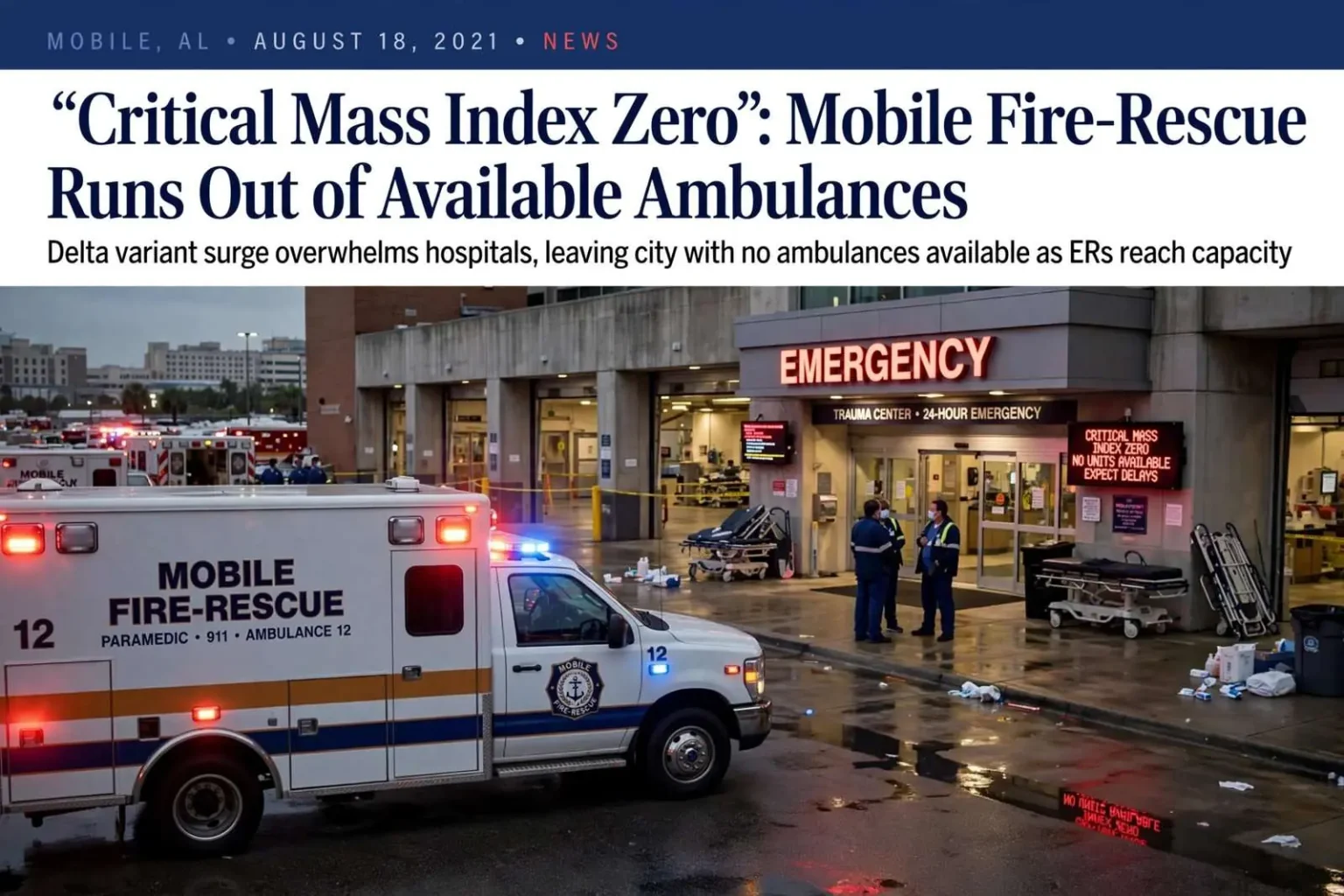
MOBILE, Ala. — Mobile Fire-Rescue declared a “critical mass index zero” on Wednesday, Aug. 18, 2021 — a code signaling that not a single ambulance in the city was available to answer a call, as the delta variant surge overwhelmed area hospitals.
The department issued the code that afternoon after weeks of mounting strain. Local hospitals had been operating at or near capacity for an extended stretch as COVID-19 caseloads climbed across the region, and the backlog worked its way backward through the emergency response system until it reached the ambulance crews themselves.
The bottleneck traced back to the intensive care units. As ICUs filled with COVID-19 patients, emergency room patients who would normally be transferred upstairs had nowhere to go. The backed-up ERs, in turn, could no longer accept new ambulance arrivals — leaving crews idling with patients and the city’s fleet effectively out of service.
A “critical mass index zero” is the kind of declaration fire departments hope never to issue. It does not mean 911 calls stop arriving; it means the department has no ambulance to send until one frees up, forcing dispatchers to hold calls, prioritize the most serious emergencies and watch response times stretch against a rising tide of requests for help.
A chain reaction through the hospital system
The mechanics of the crisis were simple to describe and hard to untangle. An ambulance delivers a patient to an emergency room only when the hospital can accept that patient. When an ER is full, the crew waits with the patient — sometimes for an hour or more — and that ambulance, with its two medics, is out of service for every other call in the city during the wait.
Each delayed handoff therefore multiplies. A handful of full emergency rooms can consume a city’s entire ambulance fleet, not because the crews are slow but because there is nowhere to put the patients they carry. That is what Mobile watched happen through the summer of 2021, as the delta variant drove case counts to levels the region had not seen in the pandemic to that point.
The declaration underscored how the summer 2021 delta surge was degrading routine emergency response across Mobile, with fire-medics caught between full hospitals and a rising volume of 911 calls. Residents calling for help with chest pain, injuries or anything else faced waits that depended not on the nearest fire station but on the discharge speed of intensive care units across the metro area.
The delta surge hits the Gulf Coast
The delta variant swept the Gulf South in the summer of 2021 with a ferocity that exceeded anything the region had seen in earlier waves. Hospitalizations climbed through July and August, striking younger and healthier patients than in previous surges, and Alabama’s hospitals — already operating with some of the nation’s tighter staffing margins — filled floor by floor.
Statewide, intensive care units ran at or beyond normal capacity for weeks, forcing hospitals to expand critical care space into conference rooms and other wards while transferring patients between facilities to find open beds. Emergency medical services across the Gulf Coast reported the same pattern Mobile did: ambulances queued at emergency room entrances, response times climbing, and dispatchers triaging calls that in normal times would each get an immediate response.
What the code means in practice
When Mobile Fire-Rescue hit “critical mass index zero,” the department’s options narrowed to triage. Life-threatening calls — cardiac arrests, severe trauma, difficulty breathing — still got the first available ambulance, while lower-acuity calls waited, sometimes for extended periods, or received advice over the phone until a unit freed up.
Fire engines staffed with paramedics became the system’s pressure valve. A fire apparatus cannot transport a patient to a hospital, but it can arrive quickly, begin treatment and stabilize a patient until an ambulance finally clears an emergency room somewhere in the city. During the surge, that division of labor became routine rather than exceptional.
The strain fell on the crews as much as the patients. Medics worked shifts that consisted largely of sitting in emergency room parking lots, waiting to hand off patients, then running from call to call in whatever time remained. The department, like fire-medical services across the region, relied on overtime and mutual aid arrangements to keep units staffed through weeks when the normal schedule could not cover the demand.
Mobile Fire-Rescue’s role in the city
Mobile Fire-Rescue operates as both the city’s fire department and its primary ambulance service, a combined role common among Southern cities of its size. The department runs engine and ladder companies from stations across Mobile and fields the transport units that answer medical calls — which make up the large majority of its workload in a typical year.
That dual mission is what made the August declaration so significant. The department’s fire suppression capability was never the bottleneck; its ambulances were. A city can fight a fire with the engines it has, but medical response depends on a chain that extends beyond the city’s control — into emergency rooms and intensive care units operated by hospitals dealing with the same surge from the other side.
Public safety officials spent the summer urging residents to reserve 911 for genuine emergencies, to seek alternatives for routine medical needs, and above all to take the steps available to slow the virus’s spread — vaccinations foremost among them by the summer of 2021, when the delta wave was hitting hardest in communities with low vaccination rates.
The recovery question
A “critical mass index zero” declaration typically lasts hours, not weeks, and departments log them as indicators of systemic stress rather than as permanent conditions. But each occurrence during the delta surge represented a period when someone in Mobile called for an ambulance and none was available — a gap between the city’s emergency promise and its capacity that officials could do little to close on their own.
The episode became part of the documented record of how the delta variant strained not just hospitals but the entire emergency response chain in mid-sized American cities. Health officials later cited the summer 2021 surge as the pandemic’s most punishing stretch for many Southern hospital systems, precisely because it combined high caseloads with severe staffing shortages and, in much of the region, lagging vaccination rates.
For Mobile residents, the practical takeaway during those weeks was to adjust expectations around emergency response. Calls that would normally bring an ambulance within minutes could take far longer, and the department’s public messages urged patience, prevention and appropriate use of the 911 system so that the sickest patients could reach the crews that remained available.
The declaration also illustrated a lesson hospital administrators had been making all summer: emergency response capacity is a single connected system. An intensive care bed two hospitals away affects how quickly an ambulance reaches a street in Mobile, and the “critical mass index zero” code made that connection visible in the starkest terms the department has.
What came after
The delta surge crested and receded in the weeks that followed, as waves of hospitalizations eventually turned downward and emergency rooms regained the capacity to accept ambulance arrivals promptly. Ambulances cleared their queues, response times recovered toward normal, and the department stepped back from the edge that the mid-August declaration had marked.
But the summer left its mark on the region’s emergency services. Departments re-examined their surge plans, hospitals adjusted transfer protocols, and the experience entered the planning file for the next crisis — whatever shape it takes — as proof of how far a full hospital system can bend a city’s first responder network.
For the medics who lived through it, the summer of 2021 was defined by the waits: crews parked outside emergency rooms with patients who needed beds, radios carrying calls they could not yet answer, and the knowledge that somewhere in the city, someone was waiting for the ambulance they were sitting in.
Mobile Fire-Rescue’s Aug. 18, 2021, declaration stands as a marker of that season — the day the city’s entire available ambulance fleet was effectively in use, and the emergency response system itself became a casualty of the surge it was working to manage.
Regional context: EMS under strain everywhere
Mobile was not alone in hitting the wall. Fire departments and ambulance services across Alabama and the Gulf Coast issued similar warnings during the delta wave, and some jurisdictions activated mutual aid agreements that sent crews across county and state lines to cover unanswered calls. Rural services, with two or three ambulances to serve entire counties, faced versions of the same arithmetic with even less margin.
The strain also collided with an industry-wide staffing shortage. Paramedic and EMT training pipelines had thinned for years before the pandemic, turnover accelerated during it, and hospital vacancies meant newly licensed medics could often earn more in an emergency room than on a truck. Departments that entered 2021 short-handed had no reserves left when the surge consumed their schedules.
National and state EMS associations spent the summer documenting the pattern — units out of service waiting at hospitals, response times climbing in city after city — and pressed for relief that ranged from funding for staffing to simply treating ambulance crews as part of the hospital capacity problem rather than separate from it.
Mobile’s mid-August code fit squarely into that regional picture: a city with a functioning fire-medical department, adequate equipment on paper, and no way to conjure hospital beds for the patients its crews were carrying. The fix had to come upstream, in the wards and intensive care units where the delta variant was filling every bed it could find.


