Crowds Line Downtown Mobile Streets for Veterans Day Parade
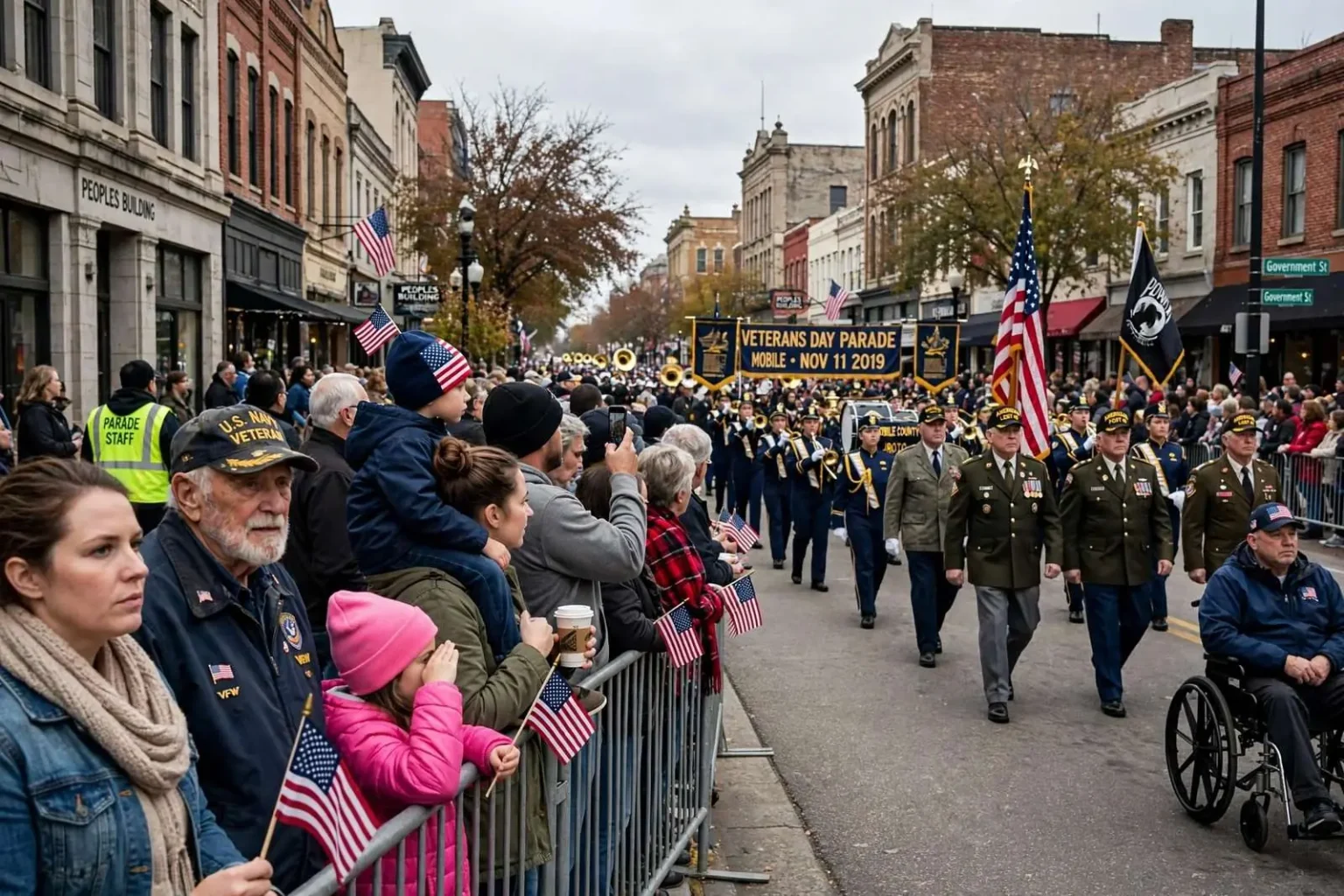
Downtown Mobile crowds honored veterans at the annual Veterans Day parade, with active-duty troops, veterans groups and officials taking part.
Veterans Day and what it marks
Veterans Day traces its origin to Nov. 11, 1918 — the eleventh hour of the eleventh day of the eleventh month, when the armistice ended fighting in the First World War. What began as Armistice Day became a national day of honor for all who have served after the Second World War and Korea expanded the community of veterans, and Congress made the modern federal holiday official in 1954. Unlike Memorial Day, which honors those who died in service, Veterans Day recognizes every American who has worn the uniform, living or dead — which is why its traditions center on parades and gatherings where veterans can be thanked in person.
That distinction shapes the character of the day in communities like Mobile, where the parade is less a solemn memorial than a public expression of gratitude — crowds waving, children saluting, veterans’ organizations marching in formation. The holiday’s timing in November, near the season’s first cool fronts, has made it a fixture of the fall calendar across the Gulf Coast, with ceremonies and processions from Mobile to the Eastern Shore.
Mobile’s parade tradition
Mobile has marked Veterans Day with a downtown parade for decades, and the 2019 edition continued the tradition of pairing the march with tributes to service members past and present across the Gulf Coast. The route through downtown draws spectators from across the metro area, many of them families with current service members stationed along the Gulf — a region whose military connections run from the historic ports of Mobile Bay to the aviation and training installations scattered across the Panhandle and south Alabama.
The 2019 procession drew active-duty service members, veterans’ organizations and local officials, including then-Congressman Bradley Byrne, who joined the crowd in honoring those who have worn the uniform. Byrne, who represented southwest Alabama’s First District, has made military and veterans’ issues a consistent focus of his public work — a reflection of his district’s makeup, where a substantial share of residents are veterans, active-duty families or workers in defense-related industries.
“They have served our country, so we should have at least one day a year to turn around and say thank you,” Byrne said at the event. “Today is that day, but every day should be Veterans Day.” The sentiment captures the holiday’s intent: a single public moment of gratitude meant to remind the community of a debt that exists all year.
Among those watching was the wife of a veteran, who summed up the morning’s spirit simply: “It is humbling to me that I get to be married to a superhero.” Her words — spoken from the crowd rather than a podium — carried the perspective of the families whose daily lives absorb the realities of military service: the deployments, the moves, the long absences that the public sees only glimpses of. For the families lining the route, the parade is as much theirs as the marchers’, a public acknowledgment of a private commitment.
How the parade comes together
A downtown parade of this scale represents weeks of coordination among the city, veterans’ organizations, school bands, ROTC units and the businesses along the route. Streets close early in the morning; the marching order is set with active-duty units, veterans’ groups and community organizations interleaved; and spectators claim their spots along the sidewalks hours before the first step is taken. Downtown’s layout — Government Street, Royal Street and the blocks around Bienville Square — has hosted civic processions for well over a century, making the route itself part of the tradition.
Veterans’ organizations form the backbone of the lineup: American Legion posts, Veterans of Foreign Wars chapters and service organizations from across Mobile County march alongside the active-duty formations. School bands and JROTC units fill out the procession, and for many of the students involved, the parade is their most direct contact with the veterans’ community their textbooks describe in past tense — men and women, many of them neighbors and relatives, who served in Vietnam, the Gulf War, Iraq and Afghanistan.
Why the Gulf Coast shows up
South Alabama’s connection to the military is deep and structural. The region has sent generations of its sons and daughters into the services, and the Gulf Coast economy remains woven through with defense installations, shipbuilding and aviation work. On Dauphin Island and along the bay, the presence of the past is literal — from Fort Gaines and Fort Morgan, which guarded Mobile Bay during the Civil War, to the USS Alabama, the battleship moored permanently in the bay as a memorial to the state’s World War II veterans.
That living connection is what distinguishes a parade in a military-connected region from one elsewhere. The spectators are not observing a tradition from the outside; a large share of them have a uniform hanging in a closet at home — their own, or one belonging to a spouse, parent or child. The 2019 turnout reflected that reality, packing downtown blocks in a morning-long expression of a community’s relationship with its service members.
Veterans returning home to south Alabama
The veterans watching from the sidewalks in 2019 represented service across the generations — from aging veterans of Korea and Vietnam to young families still adjusting to life after deployments in Iraq and Afghanistan. Each generation returned to a different homecoming: the Vietnam generation famously returned to a divided country, while the post-9/11 generation came home to communities that, whatever else changed, learned to separate the war from the warrior. Parades like Mobile’s are part of that continuing correction — a public, repeated statement that service is seen.
For veterans in the crowd, the day also carries practical weight. Outreach by veterans’ organizations and county veterans’ service officers peaks around the holiday, connecting former service members with benefits claims, healthcare navigation and employment programs they have not accessed. South Alabama’s veterans’ services network uses the gatherings to reach men and women who served but never registered with a veterans’ organization — often the very people most likely to need help navigating the Department of Veterans Affairs system.
The morning’s spirit
The observations from the 2019 crowd ran to gratitude and family. The congressman’s line — that every day should be Veterans Day — and the military wife’s description of her husband as a superhero bracketed what the morning was about: not spectacle, but acknowledgment. Spectators packed the streets early and stayed through the final units, a turnout that has repeated itself across the decades of the parade’s history.
Downtown merchants and restaurants absorbed the crowd before and after the procession, another instance of the civic rhythm that Mobile’s downtown has rebuilt around events — the parade calendar joining Mardi Gras season and the year’s other celebrations as anchors of the city center’s vitality. City officials have long credited such gatherings with sustaining investment in the historic core, where the density of pedestrians on event mornings shows the district working as designed.
As the last unit passed and the barricades came down, the 2019 edition joined the long record of Mobile Veterans Day parades — decades of Nov. 11 mornings in which the city turns out, lines the streets and says thank you to the people among them who have served. The tradition, like the holiday itself, is built on the premise the congressman voiced: that a community that pauses once a year, publicly, keeps the gratitude alive on all the days between.
The parade also functions as a passing-down mechanism. Children who march in school bands one year stand on the curb the next as spectators, then as scouts, then — in some families — as service members themselves. The continuity of that cycle is what a decades-old parade tradition represents in a military-connected community: not nostalgia, but an ongoing recruitment of each generation into the work of remembering. Organizers of civic observances across the Gulf Coast describe the crowds of the last decade as including more young families than in years past, a sign that the holiday’s audience is renewing itself.
For the veterans’ organizations that march each November, the parade is also membership season — the public visibility that reminds residents these posts exist, welcome new members and continue their year-round work of burials honors, color guards, scholarship programs and community service. The American Legion and VFW posts of Mobile County perform color-guard details at veterans’ funerals throughout the year, a quieter service that most residents encounter only once, at a family graveside, without realizing the volunteers standing there are the same ones they watched march downtown on Nov. 11.
The 2019 parade, like its predecessors, ended with the downtown blocks emptying and the banners coming down — but the exchanges it captured remain the point of the exercise. A congressman telling a crowd that one day of thanks should extend to every day. A military wife calling her husband a superhero and calling it humbling. A city packing its historic streets for the better part of a morning to look at the people among them who served, and to be seen doing so. That is what Mobile has done with Nov. 11 for decades, and the crowds lining downtown in 2019 showed no sign of stopping.