
Cyclist Hospitalized After Being Struck by Car on Theodore Dawes Road
Mobile police say a cyclist suffered non-life-threatening injuries after being hit by a car while crossing Theodore Dawes Road at Helton Road.
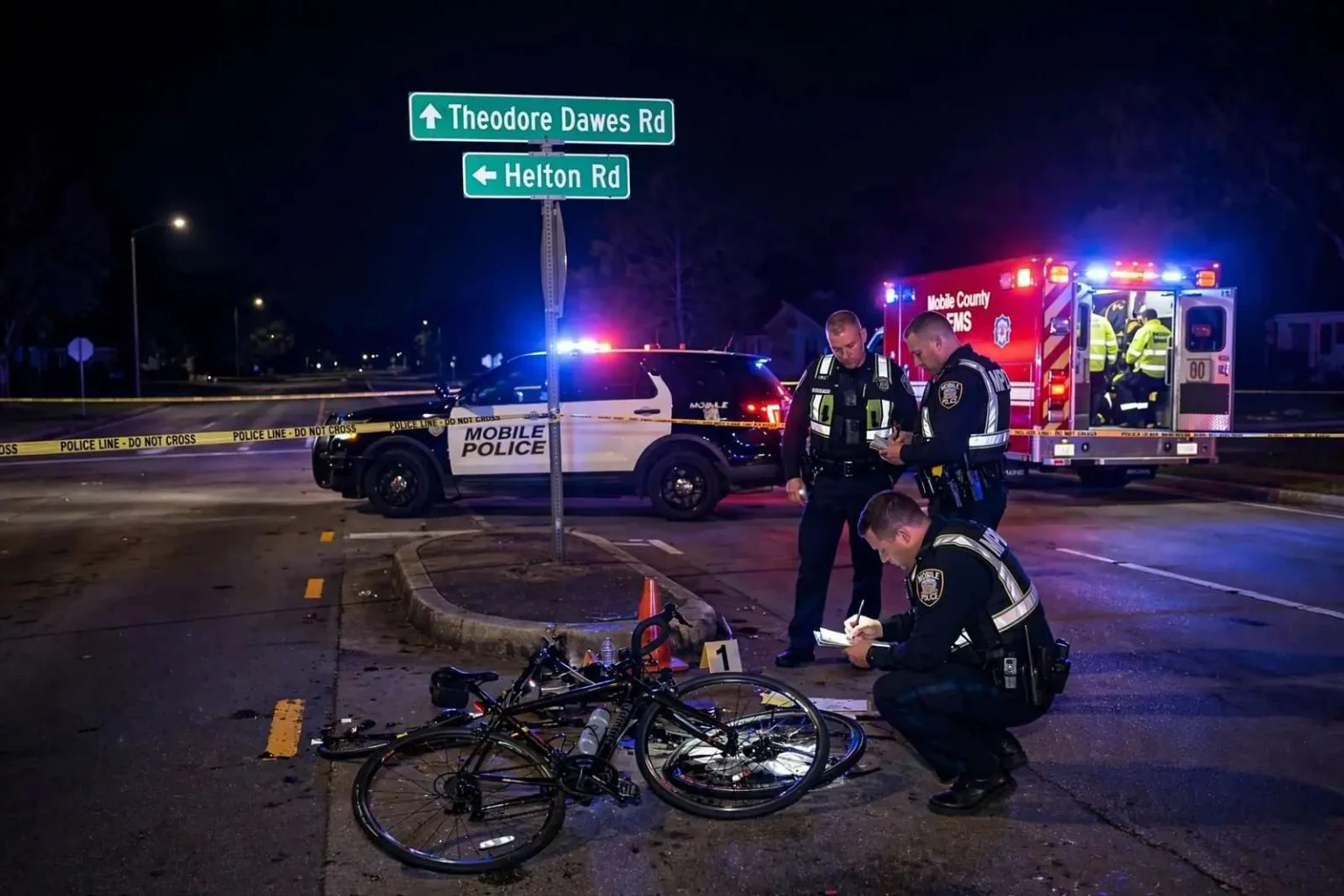
MOBILE COUNTY, Ala. — A cyclist was hospitalized with non-life-threatening injuries after a car struck him as he tried to cross Theodore Dawes Road in west Mobile, the Mobile Police Department said. According to an MPD release, officers responded to the crash around 9:30 p.m. Thursday, Aug. 11, 2022, near where Theodore Dawes Road meets Helton Road. Police said the man attempted to cross the northbound lanes of Theodore Dawes Road from the center lane when a car traveling on Helton Road hit him, and the crash remained under investigation.
The 9:30 p.m. timing placed the crash in darkness, on a road where the lighting between intersections is sparse and where traffic moves at corridor speeds even in the evening hours. Cyclists struck by vehicles at night face compounded risks — reduced visibility for both the rider and the driver, and the difficulty drivers have distinguishing a person on a bicycle from the background of the roadway. That the cyclist’s injuries were described as non-life-threatening was the notable outcome of an incident that easily could have ended worse.
The intersection area where Theodore Dawes Road meets Helton Road is a junction of two west Mobile roadways that carry a mix of commuter and local traffic, and the crash scene drew MPD’s traffic investigators to document the roadway, the vehicles and the sequence that put the cyclist in the path of the car. The department’s release described the man’s attempt to cross the northbound lanes from the center lane, a detail that anchors the investigation’s reconstruction of the crash.
The crash site on Theodore Dawes Road
Theodore Dawes Road is one of the principal north-south corridors of west Mobile, running from the Cottage Hill Road area south toward Highway 90 and carrying heavy daily traffic between the residential subdivisions that line it and the commercial centers that anchor its intersections. The road is wide, multi-laned in its main stretches and built for automobile volume, and the northbound lanes where the cyclist attempted to cross are the lanes carrying traffic toward Highway 90 at that point. Helton Road connects into the corridor from the west, serving the neighborhoods that branch off it, and the junction of the two roads is a point where turning and crossing movements mix with through traffic.
Crash investigations at such junctions work from the physical record: the final positions of the car and the bicycle, the point of impact, the driver’s account and any witness statements. MPD’s release indicated the cyclist was crossing from the center lane of Theodore Dawes Road when the car traveling on Helton Road struck him, and the investigation remained open on the questions those facts raise — the speed of the car, the timing of the crossing and what each party saw in the moments before impact.
West Mobile’s roadway network was designed across decades of suburban growth, and its arterial roads like Theodore Dawes were built primarily for car traffic. Pedestrian and bicycle infrastructure on such corridors is limited, with cyclists sharing lanes designed for vehicles and crossing points concentrated at signalized intersections. That context frames every crash of this kind: the places where cyclists and cars meet are often the places the roadway design serves cars best and everyone else least.
Cyclist safety on west Mobile corridors
The crash underscores the risks cyclists face on Mobile’s arterial roads, particularly after dark. Bicycle advocates and safety agencies consistently identify multi-lane arterial crossings as the highest-risk moments in a cyclist’s trip, and the guidance is uniform: cross at signalized intersections where drivers expect stopping movements, use lighting and reflective gear at night, and never assume an approaching driver has seen a bicycle in time to react.
For drivers, the corresponding obligations are written into Alabama law. Motorists must maintain a safe distance from cyclists, exercise due care around them and treat a bicycle as a vehicle with a right to the roadway. Nighttime driving adds the duty of adjusted speed and attention, since the distances at which a driver can perceive a cyclist shrink sharply after dark. The investigation into the Aug. 11 crash will examine both sides of that ledger — the cyclist’s crossing and the driver’s operation — before MPD reaches any determination.
The non-life-threatening classification of the cyclist’s injuries also reflects the emergency response that follows such crashes. MPD officers secure the scene and begin the investigation while EMS crews evaluate and transport the injured, and the hospital treatment that follows addresses the injuries a vehicle strike produces — fractures, road rash, head and torso trauma — with outcomes that depend heavily on speed and the point of impact. A cyclist struck at corridor speeds who survives with non-life-threatening injuries has avoided the statistical norm for such crashes at higher speeds.
How MPD investigates nighttime crashes
A crash like the one on Theodore Dawes Road puts MPD’s traffic unit through a defined process. Investigators document the scene with measurements and photographs, identify and interview witnesses, evaluate the roadway’s lighting and sight lines, and examine both vehicles — the car’s damage pattern, the bicycle’s condition and any evidence of braking or avoidance. At night, lighting becomes part of the evidence: whether the cyclist had lights or reflectors, how far ahead of the car he would have been visible and what the driver’s line of sight was from the travel lane on Helton Road.
The department’s public release in such cases is deliberately limited, describing the time, location and basic sequence while the investigation runs. The determination that follows — whether any charges or citations result — comes only after that work is complete, and crashes involving injuries can take weeks before the final report closes the open questions.
The Thursday, Aug. 11, 2022, crash near the Helton Road junction added to the record of vehicle-cyclist incidents on Mobile’s arterials, and the police department’s call for information in such cases typically continues through the investigation. Witnesses who saw the crash or the moments before it provide the details that physical evidence cannot, particularly about speeds and signals in the seconds before impact.
Theodore Dawes Road and the growth of west Mobile
Theodore Dawes Road anchors one of the fastest-growing parts of Mobile County, serving the residential development that has spread west of the city over the past several decades. The corridor’s traffic volume has grown with it, as has the mix of users — commuters on the through lanes, students near the school zones, and cyclists and pedestrians whose presence on the roadway has increased even as the road’s design has remained oriented to vehicles. The junction with Helton Road sits in the middle of that landscape, where neighborhood traffic enters the arterial and crossing movements become inevitable.
City and county planners have studied corridor improvements for roads like Theodore Dawes — better lighting at intersections, marked crossings, and signal timing that accounts for slower road users — but the pace of such changes lags the growth that generates the traffic. In the meantime, the practical safety burden falls on the road users themselves, on the habits of drivers and the choices of cyclists about where and when to cross.
The Aug. 11 crash ended with the cyclist hospitalized with non-life-threatening injuries and the car’s driver facing an open investigation rather than a determined outcome. The questions MPD’s release left unanswered — the speed of the car, the exact sequence at the junction, any charges that might follow — remain with the investigation, which the department said was continuing.
What the crash means for the corridor’s users
For the cyclists who ride the west Mobile corridors, the incident is a reminder of the margin that separates a routine ride from a hospital stay. Crossing a multi-lane arterial from its center lane at night brings a rider into the space where drivers are least expecting a slow-moving target, and the outcome reported here — non-life-threatening injuries after a vehicle strike — is as good as such incidents get. For drivers on Theodore Dawes Road and Helton Road, the crash is the corresponding reminder of the duty to expect cyclists at any hour, to scan the roadway’s edges and center as well as the lane ahead, and to treat the corridors’ junctions with the attention their crash history demands.
Anyone who witnessed the crash or has information about it can contact the Mobile Police Department, where the case file remains open until the investigation concludes. The department’s traffic investigators continue to review the evidence gathered at the Helton Road junction, and updates will come through the same channels that carried the initial release.
The Mobile Police Department’s investigation into the Aug. 11, 2022, crash will resolve the open questions in its own time. What the record already shows is a cyclist struck while crossing the northbound lanes of Theodore Dawes Road near Helton Road at 9:30 on a Thursday night, taken to a hospital, and expected to recover — the facts MPD documented, and the baseline from which the corridor’s safety conversation continues.


