Daphne Album Release Set for Afterschock and the Deep End’s Debut Live-Band Project
Mobile-area rapper Afterschock announced The Couch Chronicles Vol. 1, his first album with live band the Deep End, with a release event at Club 44 in.
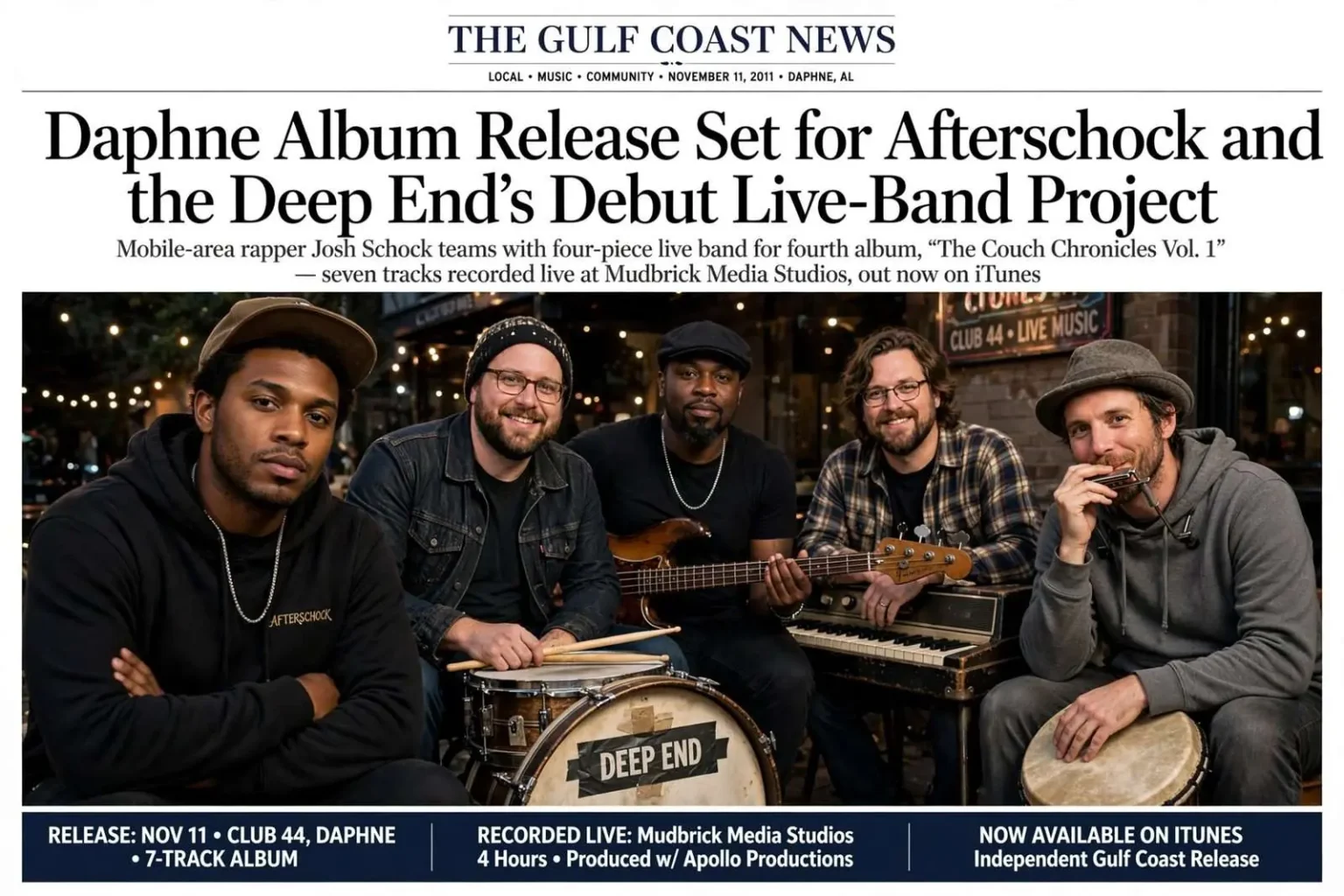
Mobile-area rapper Josh Schock, performing under the name Afterschock, announced plans for the release of The Couch Chronicles Vol. 1, his fourth solo album and first recorded with a full live band called the Deep End. After three records built as a solo act, the new project put a working rhythm section behind his vocals and reshaped what his music could sound like on stage and on record.
The announcement set up a release event at a Daphne venue and placed the album on iTunes, giving the project both a hometown debut and a storefront that reached listeners far beyond the Gulf Coast. For an artist working independently, that two-track launch — local stage, global download — was the plan in miniature.
From solo act to live band
The Deep End featured a four-piece lineup bringing together musicians from New Orleans and the Mobile area: Eddy Christmas on drums, Jerry “JBlakk” Henderson on bass, Chuck “Fadeaway” McNaulty on keyboards and backup vocals, and J.P. “The Skippa” on hand drum and harmonica. The mix of hip hop vocals with live instrumentation marked a new creative direction for Afterschock, whose earlier albums had not been made with a band playing in the room.
The instrumentation choices gave the record its character. A conventional rap album leans on programmed drums and sampled loops; this one ran on a human rhythm section, with hand percussion and harmonica supplying color that a beat machine cannot fake. Drawing players from two cities mattered as well — New Orleans musicians bring a feel for groove that comes from playing in a city where live bands back nearly every genre, and pairing that feel with a Mobile-area rapper made the project a genuine Gulf Coast collaboration.
The album’s seven tracks were written over the course of 30 days, with Schock describing the songwriting process as deeply personal. The material explored themes of perseverance and financial struggle within the independent music scene, drawing from the challenges of sustaining a career in hip hop during difficult economic times. A month of writing produced a focused set rather than a sprawling one, and the song titles and themes pointed squarely at the working artist’s life the record grew out of.
Four hours at Mudbrick
The recording sessions took place at Mudbrick Media Studios, where the collaboration between Afterschock and the Deep End came together over roughly four hours of studio time. The project was funded by Andrew Davis and Apollo Productions. Compressing an album’s recording into a single short session required preparation on the band’s part, and it reflected a budget-conscious method common in regional music: rehearse until the songs are ready, then record them before the clock runs out.
Working that way has advantages beyond cost. Live-in-the-room recordings capture the small imperfections and reactions between players that make a band sound like a band, and for a hip hop project built specifically around live instrumentation, that texture was the whole point. The four hours at Mudbrick were spent documenting arrangements the group had already shaped together, not discovering them.
The funding arrangement behind the record followed a pattern familiar across independent music. With no label covering costs, projects move when someone with resources — here, Andrew Davis and Apollo Productions — puts money behind them. That backing carried the album from a month of writing through the studio and out to a release date, a timeline many independent projects never complete.
Club 44 and release night
The album release event was scheduled for November 11, 2011, at Club 44 in Daphne, with the record also set to become available on iTunes. The Daphne venue provided a fitting launch point for an artist rooted in the Gulf Coast music community, and the date gave fans the chance to hear the new material performed by the Deep End — the lineup that recorded it — on the night the record arrived.
Eastern Shore rooms like Club 44 have long been part of the circuit Mobile-area musicians rely on. The club sat close enough to Mobile to draw the home crowd across the bay, and far enough into the Baldwin County market to introduce the act to listeners who might not catch a Mobile gig. For a release show, that balance is exactly what an artist wants: the core audience that follows the music plus new faces a record announcement brings in.
The November 11 date also mattered for momentum. A release show timed to an album’s digital debut concentrates attention — local press, fellow musicians and fans all have a specific night to show up, and the conversation around the record starts from the same room. For The Couch Chronicles Vol. 1, the plan was for that room to be in Daphne and for the music to be available everywhere else by the time the amps cooled down.
Schock’s fourth album, then, arrived carrying two stories at once: the personal one written into its lyrics, and the practical one written into its making — a rapper, four players from two cities, a month of writing, four hours of tape, local backers, and a hometown stage set for a Friday night in November.
The sound of the seven tracks
The album’s instrumentation shaped its seven songs in different combinations. Christmas’s drums and Henderson’s bass formed the foundation most tracks stood on, the pocket that turned Schock’s rapping from a vocal line into something an audience could move to. McNaulty’s keyboards filled the middle of the mix and his backing vocals answered Schock on choruses, while “The Skippa’s” hand drum and harmonica — the lineup’s most unusual pairing — added a rootsy edge that distinguished the record from strictly programmed hip hop.
Because the material was written in 30 days with these players in mind, the songs arrived shaped to the band rather than forced onto it. Writing for a known lineup lets an artist leave space for each musician’s strengths, and the thematic material — perseverance, money trouble, the grind of independent artistry — matched the stripped-down, working-band format that carried it. There was nothing ornamental about the project’s production, and the songs did not pretend otherwise.
Schock’s description of the writing as deeply personal signaled the album’s register. The Couch Chronicles Vol. 1 took its title from the image most independent artists recognize: the couch that doubles as an office, a rehearsal spot and sometimes a bedroom while a music career gets off the ground. Songs built on that material tend to land with the listeners living the same story, and that was the audience the album was speaking to first.
Independent hip hop on the Gulf Coast
The project sat within a regional tradition worth naming. Southern hip hop grew from independent economics — artists pressing records, booking their own shows and building followings city by city — and the Gulf Coast has contributed its share to that history. Mobile’s scene, smaller than Atlanta’s or New Orleans’ but connected to both, has sustained artists through exactly the kind of do-it-yourself structure The Couch Chronicles Vol. 1 followed: local funding, regional studios, hometown release shows and digital distribution as the multiplier.
Mudbrick Media Studios filled the studio role in that structure. Regional studios like it exist because local artists need somewhere to record that does not charge big-city rates, and the relationships between artists and studio owners often stretch across multiple projects. A four-hour session at a home-region studio, with players who know the room, is how much of the Gulf Coast’s independent catalog actually gets made.
The release event at Club 44 closed that loop. Venue, studio, band, backer and audience all sat within a few miles of each other, and the only element reaching beyond the region was the iTunes listing that let anyone with an internet connection buy what Daphne was hearing live. It was a small production by industry standards and a complete one by independent ones — an album, from first lyric to release night, built entirely on Gulf Coast ground.
What release night meant for the band
For the Deep End, the November 11 show served as both a debut and an audition. A first performance of a full album’s material tells a band what the studio version cannot — which songs move the room, which arrangements breathe on stage and where the set needs adjustment. Bands that record together before touring together often use the release show as that test, and the Daphne date gave the four-piece its first full read on the material before any wider bookings.
The date also joined two audiences that rarely sit in the same room: hip hop listeners who follow Schock’s solo work and live-music fans who come out for bands. Projecting a rap album through a four-piece lineup made that overlap possible, and the mixed crowd a release show draws is part of how a project like this one finds its long-term audience.
The album’s availability on iTunes from release day meant the room in Daphne was not the ceiling. Fans could take the record home that night, and the digital listing let the album keep working after the show ended — played, shared and discovered by listeners with no connection to the Gulf Coast scene that produced it. Independent releases live or die on that long tail, and Schock’s plan put the record on the platform where the tail lives.
The Couch Chronicles Vol. 1 closed its cycle the way it opened: with work. A month of writing, an afternoon of recording, local money spent wisely and a stage booked on the Eastern Shore. Whether the project grew from there, its model was already in place — a rapper with a band, an audience with a reason to show up, and a record that cost little and carried everything.